
How Can ACH Processing Benefit Your Business?

Imagine a world where cash flow is seamless, paper checks are relics of the past and getting paid—or paying others—happens almost as effortlessly as sending a text. Welcome to the age of Automated Clearing House (ACH) payments, where modern businesses are reimagining the way money moves and unlocking new levels of efficiency, flexibility and security. 

ACH payment processing continues gaining popularity as businesses and customers recognize this system’s many benefits. ACH processing is an electronic payment method that allows companies and individuals to send and receive money.

These digital transactions offer significantly lower costs and added convenience for recurring transactions. As a result of ACH’s benefits, many businesses are leaving paper checks and other payment methods behind in favor of this electronic option.


ACH Payments: What Are They and How Do They Work?

ACH payments are a digital method for sending and receiving funds. These transactions pass through the Automated Clearing House, an electronic funds transfer (EFT) system established by the Bureau of the Fiscal Service, letting businesses and individuals send credit and debit card payments.

Businesses often use these payments to cover employee payroll or receive money for customer payments for goods and services. In many cases, electronic payments must obtain an authorization request from a credit card network or issuing bank. ACH payments instead go through the Federal Reserve or a clearinghouse to secure payments.

Once the request passes through one of these organizations, the receiving depository financial institution (RDFI) posts the payment to the requestor’s account. Businesses save money and time making money transfers when using ACH instead of credit card authorization. They can accept or send payments of as much as $1 million each day, and the system recognizes revenue faster, so you can receive or send funds in as little as a few hours.


Are ACH Payments Safe?

As a government-established electronic payment method, ACH transactions must follow strict federal regulations for safety in money transfers. Nacha, a non-profit organization, also regulates and runs this money transfer network. CSG Forte is a Nacha Preferred Partner. These controls make fraud rare, though not completely unlikely.

Here are a few additional ways your business can reduce the risk of fraud:

  • Choose a trusted payment provider: Ensure your provider complies with Nacha rules. You can look for Nacha-preferred partners for the most security.
  • Use microdeposits: The best payment providers offer microdeposits to verify recipient identity. These are two small deposits made to an account before formal transactions begin.
  • Seek information protection: Your provider should utilize tokenization and encryption to disguise sensitive data. These controls ensure only the intended recipient can interpret the data you send.


Benefits of ACH Payments for Businesses

Many businesses adopt ACH payments for ease, security and speed. This electronic money transfer method continues to grow in popularity, with companies carrying out 5.94 billion transactions using this method in 2022. Businesses compare these transactions to previous payment methods like paper checks and see distinct ACH payment benefits, leading them to adopt the system.

  • Lower Costs: Compared to electronic and paper payment methods, ACH transactions are one of the most cost-effective money transfer options. Credit card companies require network fees for processing transactions. These fees range from 1.5% to 3.5%. Checks also cost $2.01 for internal expenses like financial institution fees and $4 for external costs like personnel. Paper checks are often mailed, which is an additional expense when you factor in materials and postage. In comparison, ACH has a median internal spending of $0.15 and an external cost of $0.25.
  • Speed: ACH payments have faster processing times. Like all electronic processing methods, ACH is faster than payments like checks, which must be mailed and manually entered. Checks might also get lost, extending the time before the recipient receives money in their account.
    ACH transactions also process faster than many electronic transfer methods, sometimes within a few hours on the same business day. You can also schedule transactions for one or two business days away. With same-day transfers, you can ensure that payments settle the day your business sends them out.
  • Minimal Human Error: Human error can cause payment delays and impact organizations’ cash flow. With computer-automated payment through ACH processing, you reduce mistakes like incorrect payment amounts or errors in recipients’ account numbers. You can set recurring payments up once, ensure the information is correct and let the transaction repeat each billing cycle without needing adjustment.
  • Customer Convenience: ACH payments also have many benefits for customers, including the convenience of a one-time setup. For recurring expenses like rent or a subscription service, your business can request authorization once, then continue to take payments as needed. Customers like this method because it is convenient and they will always pay on time, avoiding late fees or lapses in service. Business-to-business transactions also work well with ACH because many companies are switching to digital money management tools.
  • Expense Tracking: With ACH, your business can record all income electronically, and the information is more easily accessible to bookkeepers. With ACH payments you can easily view transactions online and connect them to money received or disbursed.


Collect ACH Payments With CSG Forte

With CSG Forte’s complete payments solution with ACH processing, we make it easy for your business to send and receive digital payments. Learn how you can start accepting ACH payments and Get Started with CSG Forte today.

Why Secure, Modern Payment Portals Are the New Standard for Businesses

Digital payments provide convenience and processing efficiencies, but they also introduce several risks for both payers and businesses, including cyberattacks. Cybercriminals target all types of organizations large and small, including healthcare providers, financial institutions, government agencies, retail businesses and most other types of transaction-based businesses. They’re looking for security weaknesses in outdated payment systems that make it easy to access sensitive information. Ransomware attacks, phishing schemes and data breaches jeopardize personal information—and trust.

Consumers are increasingly and justifiably worried about data security. A 2024 survey found that 78% of U.S. consumers expressed concerns about data security when using online services, up from 73% the previous year. Almost half (44%) of respondents had experienced data loss, identity theft or online fraud, with 29% of the victims experiencing significant harm. Only 26% of respondents believe digital payment methods are secure from theft.

Identity theft or a data breach shatters trust. Across industries, security is the most valued factor when making any kind of payment, as identified by 94% of respondents to an American Express survey. Most (84%) consumers expect strong security—to protect their data and credit—from any organization requesting payment. When their financial information isn’t protected, customers may hesitate to use online payment portals again. Or they may take their business elsewhere.

A single security lapse can have devastating consequences for a business’ reputation and finances. More than half (58%) of U.S. consumers believe that brands that get hit with a data breach are not trustworthy, and 70% said they would stop shopping with a brand that suffered a security incident.

Businesses and government agencies must prioritize payment security and risk management to safeguard customer data and revenue and maintain trust. That means investing in digital payment solutions that meet the highest standards for cybersecurity, compliance, and fraud prevention.


Common Payment Risks in Digital Transactions

As digital transactions gain popularity, businesses and consumers alike must understand the various risks.

Payment fraud is the main risk in digital transactions, and comes in many forms, such as:

  • Identity theft: Bad actors steal personal information to make unauthorized purchases.
  • Account takeovers: Bad actors gain access to accounts and initiate transactions without the account holder’s knowledge.
  • Phishing scams: Bad actors trick victims into revealing sensitive information such as passwords or card details.
  • Social engineering: Bad actors manipulate individuals through social engineering tactics to gain access to sensitive information or trick them into authorizing fraudulent transactions.
  • Data breaches: Hackers infiltrate systems and steal sensitive customer data, including payment information, to make fraudulent transactions.
  • Card-not-present (CNP) fraud: Common in online purchases, this refers to fraudulent transactions that occur without the presence of the physical card.

Chargebacks are another key risk in digital transactions. Customers can request a chargeback—a reversal of funds following a debit or credit card purchase, initiated when the customer files a dispute over the charge with their bank or credit card provider. A large proportion of chargebacks reverse legitimate fraud (i.e., transactions that show up on a customer’s account due to fraudulent activity). However, some chargebacks occur due to “friendly fraud”—when the customer doesn’t recognize the charge, has delivery problems or wants to avoid the return process. Whether they’re due to legitimate or friendly fraud, chargebacks are costly for businesses. Payment processing providers charge fees—up to $50 or $100 for each chargeback.

Maintaining regulatory compliance is one of the most complex ways businesses navigate online payment risk. Regulations such as Payment Card Industry Data Security Standard (PCI DSS) for data security and strong customer authentication must be adhered to, and they change regularly. Organizations have to get it right, or risk steep fines and penalties.


Key Components of a Successful Payment Risk Management Strategy

To effectively manage payment risk, choose a payment system that includes:

Verification services

To reduce payment failures, fraudulent transactions and chargebacks, proactively verify:

  • Routing and bank account numbers
  • Account ownership
  • Customer account data is current (e.g., card not expired)
  • Accounts are active and have sufficient funds


Modern Security Measures

When it comes to payments, security is about more than just locking down individual transactions—it requires a comprehensive strategy that addresses every point where sensitive data is stored, transmitted, or accessed. A strong payments platform weaves together multiple safeguards to reduce risk, strengthen compliance, and maintain customer trust. The following measures form the foundation of a modern, secure system.

  • Encryption & Tokenization: Protecting sensitive payment data requires a layered approach. Tokenization and encryption safeguard information both at rest and in transit. PCI-validated end-to-end encryption disguises card data during transmission, making it appear valueless if intercepted. Meanwhile, tokenization randomly generates a unique token with no intrinsic value for every set of sensitive information. This allows credit card or ACH data—such as the primary account number (PAN) for credit cards or the bank account or bank routing number for ACH transactions—to be safely stored, processed, and transmitted across systems without exposing the actual details.
  • Access Control: Payment systems must employ strong authentication protocols so that only authorized personnel can interact with sensitive data and systems. Multi-factor authentication (MFA) adds a critical layer of defense by requiring multiple identifiers to access a system or approve a transaction, making unauthorized access far more difficult.
  • Built-In PCI Compliance: Another essential safeguard is built-in PCI compliance. A payment system must meet the highest compliance and regulatory standards, including PCI Data Security Standard (PCI-DSS) requirements for handling credit card payments, as well as local and federal regulations. A trusted payments partner helps businesses navigate this complex landscape by providing secure solutions and supporting compliance in real time—minimizing risk and reducing the likelihood of breaches that can erode customer trust.
  • Hosted Payment Pages: Hosted payment pages also offer strong protection. Instead of entering bank account or card details directly on an organization’s website, customers are redirected to a secure checkout page managed by a third-party gateway or service provider. On that page, sensitive data—such as account and routing numbers, PANs, CVVs, and expiration dates—is collected and transmitted by the provider’s secure servers. Because the organization’s systems never touch or store this data, PCI scope is significantly reduced.
  • Reducing Access to Sensitive Data: Some platforms go even further by offering solutions that limit direct access to sensitive data. For example, having customers pay through secure, unique microsites rather than sharing payment information over the phone reduces both the number of people who handle sensitive details and the risk of fraudsters posing as customer service representatives.


Advanced Fraud Detection

Even with strong security controls and compliance in place, fraud is an ever-present threat. Fraudsters constantly adapt their methods, meaning businesses can’t rely solely on static defenses. Instead, payment systems must incorporate tools that can learn, evolve, and recognize the signs of suspicious activity before losses occur. Modern fraud detection is about continuous adaptation and proactive monitoring.

Today’s platforms use advanced tools like machine learning (ML), artificial intelligence (AI), and behavioral analytics to spot subtle, complex patterns of fraudulent activity that would slip past basic rule-based systems.

These tools analyze transaction data and user behavior, monitoring elements such as transaction timing, frequency, device fingerprints, and even typing speed. Anomalies are flagged for further investigation, giving businesses the ability to react before fraudulent activity escalates. The key is adaptability—fraud detection systems must continuously learn and evolve in order to keep pace with increasingly sophisticated threats.

When You Don’t Want to DIY: Secure, Compliant Payment Processing Builds Trust

Even with a strong payment system, risk management is a heavy lift. Cyber threats, fraud schemes, and regulatory requirements are rapidly evolving. The good news? You don’t have to shoulder fraud detection and prevention on your own.

Knowing that their payment data is handled securely gives customers peace of mind and builds trust. By using secure, compliant payment solutions and prioritizing risk management, your organization demonstrates a commitment to safeguarding customers’ personal data and financial transactions. This proactive approach to cybersecurity and compliance not only helps prevent fraud but also reassures residents that your business is trustworthy, responsible and transparent. When customers know your business is taking the right steps to secure their personal information, they are more likely to pay online—and on time—and continue doing business with you.

Ready to strengthen your payment security? Discover how CSG Forte’s secure, compliant payment solutions can help you protect customer data, reduce risk, and earn lasting trust. Contact us today to learn more.

What Are ACH Debits? ACH Debit Transactions Explained

Like many activities, financial transactions have gone digital. These electronic transactions occur primarily through an affiliated financial institution network called the Automated Clearing House (ACH) Network. This system helps move money between parties’ financial institutions simply, quickly and cost-effectively.

Nacha is that governing body that oversees the network and its transaction processing, which totals billions of dollars processed every year. Nacha establishes the rules and procedures for submitting and processing ACH debit and credit requests — the two main transaction categories. In 2020 CSG Forte was named a Preferred Partner for Government Agency ACH Payment Gateways by Nacha. This is a designation given based on leadership and innovation in advancing the ACH network.


What Is an ACH Debit?

An ACH electronic debit is a transaction withdrawing money from an account electronically. ACH debits can pull funds from checking and savings accounts, though restrictions on debits may apply to some business accounts.


Identification Requirements

Whether the transaction classifies as an ACH debit depends on which party originates the request.

For each debit, there’s a corresponding ACH credit — funds received by the other party to the transaction. When you authorize a company or individual to withdraw funds from your account electronically, they initiate the request with the network. These qualify as ACH debits since they’re pulling money from — debiting — your account. The funds’ ultimate deposit into their account represents the transaction’s ACH credit portion.


ACH Debit Payment Timing

While ACH debit payments and credits are swift, they’re not instantaneous. NACHA aggregates transactions and processes them in batches. The ACH Network settles payments four times each day to facilitate efficient money transfers.


Advantages of ACH Debits

ACH debits for business have numerous advantages, including:

  • Cost control: ACH debit processing is generally more affordable than handling physical checks or even credit or debit card transactions.
  • Better risk mitigation: Since fewer people are involved in processing, there’s less fraud and error risk.
  • Faster payment collection: ACH debits provide cash flow sooner than traditional check processing.
  • Improved recordkeeping: Completing payments with ACH debits creates electronic traces for easier tracking, reporting and reconciliation.
  • Environmental friendliness: ACH debits reduce the need for paper checks and mail trucks that consume resources.
  • Reversibility: ACH debits can be reversed when errors occur, unlike wire transfers, which are generally challenging to recapture.


ACH Debit Challenges

ACH debits can also pose some unique challenges, such as:

  • Financial institution restrictions: Some account holders restrict ACH debits to transactional, daily, weekly or monthly limits.
  • Limited funds availability insight: The ACH network doesn’t support immediate feedback on errors or guarantee funds availability.
  • Real-time execution: The ACH network doesn’t provide instant credits, though it can significantly reduce processing time versus physical checks.


How Do ACH Debits Work?

ACH debits follow a prescribed three-step process:

1. The payee initiates the request: The recipient submits a message to their account holder, called the originating depository financial institution (ODFI), requesting it to debit the payer’s account using:

  • The bank routing and account numbers of the account to debit.
  • The transaction amount.
  • The Standard Entry Class (SEC) code.
  • A proposed transaction settlement date.

The ODFI then enters the request on the ACH network.

2. The payer’s account holder receives the request: At regular intervals each business day, the ACH network passes these withdrawal requests to the payer’s account holder, the Receiving Depository Financial Institution (RDFI). The network bundles demand by institution, so the RFDI will get multiple debit requests with each “drop.” The RDFI investigates the requests and transmits any error messages or rejections to the ACH network.

3. The transaction settles: As long as there are no errors or rejections before the proposed settlement time, the ODFI and RDFI will transfer balances between each other through their respective Federal Reserve accounts. Once the ODFI receives the funds, it credits the payee’s account to finalize the transaction.


Main Types of ACH Electronic Debits

There are two primary categories of ACH debit transactions — recurring payments and one-time authorizations — before the activities receive additional standardized coding.

Recurring Payments: Establishing an automatic payment with a company gives it recurring authorization to initiate an ACH debit from your account information. For example, many consumers sign up for automatic payments on their wireless bills or streaming services. As the bill comes due each month, the provider uses the agreement to request the funds to satisfy the amount owed. This convenience ensures people don’t forget to pay and prevents late fees or service disruptions.

On-Demand ACH Transactions: One-time authorizations allow a receiving party to request the monies for a single transaction. They are also called on-demand ACH debits because they don’t represent an ongoing arrangement. An example is a consumer agreeing to an ACH electronic debit from their account for a tax payment or individual purchase. Under this ACH debit type, consumers generally retain more control over when a business can electronically withdraw funds.

Standard Entry Class Identification: The ACH network recognizes numerous debit types beyond recurring and on-demand. Initiators can use a three-character SEC code to identify the precise type.

  • Accounts receivable entry (ARC): This code represents converting checks from payment drop boxes or mail into one-time authorization to debit the payer’s account electronically.
  • Back-office conversion (BOC): BOC transactions use a check presented in person to initiate an ACH debit after acceptance.
  • Machine transfer entry (MTE): This code applies to automated teller machine (ATM) withdrawals to debit a bank account for the funds withdrawn from the machine.
  • Point-of-purchase transaction (POP): Unlike BOC check conversions, POP transactions use physical checks immediately upon receipt and return the paper check to the presenter once the system accepts the debit.
  • Point-of-sale entries (POS): POS transactions may be the most common, as they use your debit card to withdraw the corresponding funds from your account.
  • Prearranged payment and deposit (PPD): Recipients use this code to originate recurring and automatic payments.
  • Shared network entry (SHR): Much like the MTE, the SHR code settles ATM withdrawals for machines within the same network.
  • Telephone-originated request (TEL): This SEC identifier applies to payment authorizations received in phone interactions.
  • Web-initiated transaction (WEB): As its name suggests, WEB is reserved for ACH debits agreed upon through internet activity.


ACH Debit vs. ACH Credit

ACH credits differ slightly from ACH bank debits, though they generally represent two sides of the same transaction.

A transaction qualifies as an ACH credit when an account holder electronically sends money to another’s account, typically at a different financial institution. Since they’re depositing funds rather than withdrawing them, this action is also called a “push.”

The ODFI will enter the request with ACH, which passes the crediting information onto the RDFI. Settlements occur the same way as with ACH debit — as long as the information reconciles correctly, the RDFI accepts the funds and credits the recipient’s account.

Direct deposits, electronic refunds and peer-to-peer payments are all ACH credit transaction examples.


EChecks vs. ACH Debit

eChecks — short for electronic checks — can represent an ACH debit, but the term isn’t definitive. While eCheck can describe any portion of the digital money exchange, ACH debit applies specifically to cases where the recipient initiates the payment request.

Another key difference is whether the money transfers via ACH. eChecks can be used to support a wire transfer that occurs outside the ACH network. Almost all physical checks go through some electronic processing, but not all result in ACH debit and credit transactions.


Choose CSG Forte as Your ACH Debit Solution

As an experienced NACHA Preferred Partner for payment solutions, CSG Forte leverages scalable, easy-to-use technology to simplify and streamline online payment collection.

Contact us to request a personalized quote, or apply for your account today.

How Do BillPay Notifications Work?

Your customers expect their bill payment experiences to be as seamless as their favorite online shopping checkout. But for many billers, the process is far from that. Customers get frustrated, leading to missed payments, delayed cash flow and overwhelmed support teams. That’s where BillPay notifications come in. These convenient nudges play a critical role in transforming the payment experience for both your customers and your hard-working employees.

Better billing starts with better communication. Let’s explore how BillPay notifications work, why they matter and how they can help you deliver a more modern, efficient and customer-friendly payment experience.


Why Bill Payment Notifications Matter

Billers today face three core challenges: poor customer experience, lagging operational insights and limited development resources. CSG Forte BillPay notifications directly address the first two by:

  • Anticipating customer needs: When customers don’t receive timely reminders or updates, they’re more likely to miss payments. This not only disrupts your cash flow but also leads to increased service calls, customer dissatisfaction, and, ultimately, churn.
  • Providing timely reminders: According to Datos Insights, Americans spent $5.6 trillion last year paying 16.8 billion bills—60% of which were one-time payments. That means a substantial portion of bill timeliness relies on consumers’ memory and organization.

BillPay notifications help bridge that gap by proactively guiding customers through the payment process, reducing friction and improving on-time payment rates.


Types of BillPay Notifications

CSG Forte’s BillPay solution supports a variety of notification types to meet customers where they are:

  • Email Reminders: Sent before due dates, these reminders help customers stay on top of their obligations.
  • Text to Pay Notifications: SMS messages with embedded payment links make it easy to pay on the go. In fact, two-thirds of consumers who receive these texts say it’s the fastest and easiest way to pay.
  • Calendar-Integrated Notifications: For customers using mobile apps or portals, alerts provide real-time updates.

These channels are designed to be flexible and customizable, allowing billers to tailor the experience to their customer base.


How Notifications Are Triggered

Behind the scenes, BillPay notifications are powered by smart automation and real-time data.

  • Trigger Logic: Notifications are scheduled based on due dates. For example, a reminder might be sent three days before a bill is due, followed by a follow-up if payment hasn’t been received.
  • Real-Time Integration: CSG Forte’s centralized management hub gives billers real-time visibility into payment activity, allowing for faster response times.
  • Customization: Billers can define the frequency, channel and content of notifications. Whether it’s a branded email or a friendly text, the message reflects your organization’s tone and values.


The Customer Journey

Here’s how a typical notification flow might look:

  1. Bill is generated: The system identifies a new bill and schedules a reminder.
  2. Reminder is sent: An email or SMS is sent a few days before the due date.
  3. Follow-up is conducted: If the bill remains unpaid, a second reminder is triggered.
  4. Confirmation is received: Once payment is made, the customer receives a confirmation message.

This journey ensures customers are informed at every step, reducing confusion and increasing the likelihood of on-time payments.


Benefits for Billers

BillPay notifications aren’t just convenient for customers—they’re a game-changer for billers too:

  • Improved cash flow: Timely reminders lead to more on-time payments.
  • Reduced support volume: Fewer missed payments mean fewer calls to your support team.
  • Enhanced customer satisfaction: Proactive communication builds trust and loyalty.
  • Increased operational efficiency: Automation frees up your team to focus on higher-value tasks.


Real-World Results

The impact of BillPay notifications is already being felt across the CSG Forte customer base. One customer, the treasurer of Warrick County, shared that they “nearly stopped taking online payments” because they couldn’t find an accurate, consistent vendor. “Forte’s services have been invaluable,” she said.


How to Get Started

Ready to modernize your bill payment experience? Here’s how to begin:

  1. Review your current workflow: Identify gaps in your existing notification process.
  2. Select your channels: Choose the notification types that best suit your customers.
  3. Customize your messaging: Align the tone and branding with your organization.
  4. Let CSG Forte do the heavy lifting: Our plug-and-play solutions integrate seamlessly with your existing systems.

BillPay notifications are more than just reminders—they’re a strategic tool for improving customer experience, boosting operational efficiency, and driving consistent cash flow. With CSG Forte, you can deliver a modern, flexible and branded payment experience that keeps your customers informed and your business thriving. Let’s make bill payment easier—for everyone.

Get in touch with one of our payment experts today to learn more about how CSG Forte BillPay notifications can improve your business.

The Embedded Payments Advantage—Why Healthcare Platforms Can’t Afford to Wait

For patients, navigating medical bills can be more stressful than the care itself. Outdated, manual payment processes are inconvenient, opaque and riddled with friction—frustrating patients while damaging the financial health of healthcare organizations. From unclear pricing and confusing billing statements to clunky third-party payment portals, today’s payment experience leaves both sides dissatisfied.

When patients experience payment friction, they sometimes delay or skip payments, meaning providers face cash flow challenges and trust in the system erodes. But there’s a better way. Embedded payments transform the financial side of care by streamlining the payment process, offering transparency and enabling seamless transactions. The result: a smoother payment experience that benefits patients and providers alike.


Outdated, Manual Payment Processes Frustrate Providers and Patients

Manual payments are a hassle for patients and providers. Outdated systems lead to:

Inefficiency and cash flow problems. Manual healthcare payment systems create inefficient workflows. More than two-thirds (67%) of executives and decision-makers in healthcare payer organizations say their firms’ manual payment platforms are reducing efficiency.

CSG Forte President Saurabh Joshi recently told PYMNTS that “non-digitized payments—cash, paper checks, money orders—introduce several operational challenges, such as manual processing errors, delayed reconciliations, record-keeping issues, increased administrative burden and security and fraud risks. These challenges lead to increased costs, losses and cash flow issues for healthcare providers, which can hurt business operations and outcomes for these essential businesses.”

Poor patient experience. Medical bills are a source of anxiety and frustration for patients. In a survey of 1500 patients, more than half said paying a medical bill is stressful. Outdated, friction-filled payment processes can make an unpleasant situation even worse–frustrating patients, delaying payment (resulting in late fees), and leading to churn.

Friction is common in the healthcare payment experience. Almost half (44%) of consumers reported at least one issue when paying for their latest healthcare service, according to PYMNTS research. Younger patients are the most likely to experience payment challenges, with 68% of Gen Zers and 63% of Millennials reporting at least one issue. Fewer Gen Xers (37%) and Baby Boomers (18%) had difficulties.


What payment problems do patients encounter?

  • Lack of transparency: Opaque pricing is a top patient complaint. Copays, deductibles and out-of-network labs and anesthesiologists (surprise!) mean that many patients don’t know what they owe before—or even after—a visit. “We’ll send you a bill” is the last thing patients want to hear as they head home after a procedure. In fact, transparency and communication issues—such as unexpected costs and unclear billing statements—were the most frequently cited problems for all ages, experienced by more than 40% of patients born after 1978. More than half (53%) of patients find understanding their health insurance coverage and benefits stressful, and 53% find comprehending what they owe stressful. More than a third (40%) are not satisfied with provider billing.
  • Inconvenience: Across industries, 91% of billers receive complaints from customers about how inconvenient it is to pay their bills, according to PYMNTS research. Login and authentication problems, lack of autopay options, and being redirected to a third-party payment portal (that doesn’t work) waste time and frustrate customers. Compared to other industries, healthcare ranks low in ease of payment, with only 8% of consumers indicating that healthcare payments are easy. Patients often experience frustration and confusion regarding payment processes, including where, how, and how much to pay. Other industries provide simpler, more efficient, and more convenient payment methods.
  • Not enough choice in payment methods: More than a third (34%) of billers reported receiving this complaint. Another PYMNTS report found that more than 25% of patients born after 1978 experienced payment method limitations, including a lack of digital payment options. Across industries, 41% of executives at smaller firms (less than $10 million in annual revenue) and 25% at large companies (annual revenue over $500 million) said lack of payment choice was their top recurring complaint from bill payers.


Healthcare providers feel the pain of all that friction:

Late—or no—payments hurt the bottom line. Customers who don’t understand their bill—or find it a hassle to pay—may delay payment or not pay at all. More than a third (37%) of patients will not pay their bill if they cannot understand the administrative experience.

Furthermore, across industries, millennials are more likely than other generations to skip bills that make it hard to pay. Almost a quarter (23%) of millennials who prioritize paying certain bills over others pay bills that are easy to pay first, compared to 19% of bridge millennials and 18% of Gen Z. Late payments disrupt healthcare organizations’ cash flow and increase collection costs. Uncollected payments and write-offs decrease revenue.

Dissatisfied patients find a new provider. The avoidance of payments friction is a key determinant of patient loyalty to their healthcare providers, despite high levels of patient satisfaction with the care that they provide. About 63% of consumers say they’d switch healthcare providers if unhappy with their experiences—including how they pay for care and discover its costs. Top reasons for switching providers include the lack of a cost estimate before an appointment (38%), a complex billing process (36%) and the absence of a payment plan or third-party financing (27%). What’s more, 32.5% of patients would switch providers for payment plans and the availability of digital payments.


Embedded Finance and Embedded Payments: The Cure for Ailing Payment Processes

Just as modern medicine treats the root cause of illness, embedded finance and payments address the underlying problems in today’s clunky healthcare payment systems.

Embedded finance: Embedded finance solutions implement financial services directly into nonfinancial apps, websites or other platforms. Healthcare organizations can offer patients convenient payment options (such as payment plans) within the patient portal, enabling seamless transactions for medical services and streamlining billing processes.

Embedded payments: Although people often refer to embedded finance and embedded payments interchangeably, the terms differ in scope. Embedded finance encompasses a broader range of financial services, like financing or insurance options. In contrast, embedded payments specifically focus on integrating payment functionalities directly into apps or websites. Embedded payments enable patients to make transactions seamlessly within a website or application without being redirected to external payment gateways. A patient logs into the portal to view test results and can see an outstanding balance, then pay it directly within the portal without being redirected to a separate billing site.


Three Benefits of Embedded Finance and Payments

Convenient payment experiences lead to more on-time payments and patient retention. Embedded payments reduce friction, making it quicker and easier to pay. Patients have a choice of payment methods, including credit or debit card, Automated Clearing House (ACH), or digital wallet. Greater convenience leads to prompt payment and increased patient satisfaction and retention.

When healthcare providers offer financing options within their portals, they make it easier for customers to complete transactions without leaving the site. This increases the likelihood that patients will make a partial payment right away. Furthermore, embedded payments provide a feeling of security that portal redirects cannot. Redirecting patients—especially less tech-savvy ones—to an unfamiliar checkout page with different branding can feel disjointed and raise security concerns.

Transparency improves trust. When financing is embedded in portals, patients know their costs and payment options before they sign the treatment consent form. This price transparency strengthens trust between patients and providers. Providing upfront digital cost estimations—breaking down treatment costs, insurance coverage and financing options—empowers patients to make informed choices about their care, reduces unexpected bills, and builds healthy relationships with providers.

Embedded finance boosts revenue. By integrating financing options directly into their portals, healthcare organizations can generate revenue through fees, interest or commissions. Embedded finance also increases customer engagement and loyalty by providing convenient financial solutions such as personalized payment plans. Greater loyalty translates into greater customer lifetime value.


Take Advantage of Embedded Finance and Payments with CSG Forte

Embedded finance eliminates the friction of outdated medical payment systems by bringing payments and financing directly into patient portals, where people already manage their care. By improving convenience, transparency, and trust, it boosts on-time payments, strengthens patient loyalty, and protects providers’ revenue.

Not sure where to start? CSG can help. We work with our partners to offer healthcare organizations embedded finance solutions, making it easy to manage transactions while offering patients the most modern, streamlined financing options. CSG Forte, our world-class payment platform, is backed by exceptional customer support. CSG Forte integrates seamlessly within your existing platforms, enabling you to offer your patients the financial options they need to complete transactions. We supply everything you need to implement our solutions quickly and accurately.

CSG Forte’s secure healthcare payment solutions are just what the doctor ordered!

What Is Gateway Orchestration?

Do you need a gateway orchestration platform for your company?

Whether your business is looking to add touchpoints or new channels, or you’re looking for a simpler way to process payments from multiple payment service providers (PSPs) and financial institutions (FIs), a gateway orchestration platform may be a suitable solution for you. This guide explains everything you need to know about these software platforms.


Gateway Orchestration vs. Payment Gateway—What’s the Difference?

The main difference between gateway orchestration and single-connection payment gateways lies in their architecture. Payment gateways provide a secure connection between the customer’s bank and the merchant’s website or POS system. While orchestration platforms are similar in concept, they offer greater functionality.

A gateway orchestration platform is a much larger application that provides a centralized location for all the payment solutions your business uses, including but not limited to payment processors and FIs. Although gateway orchestration architecture is more complex than that of a single-connection gateway, the system provides a smooth, streamlined experience for both end users and administrators.


How Does Gateway Orchestration Work?

Here’s a brief overview of how the gateway orchestration process typically works:


1. Transaction Initiation

When the customer initiates a payment, the gateway orchestration platform may offer user interface (UI) solutions to capture the payment. The platform may also point to alternative payment methods, optimizing cost and keeping a practical UI.


2. Processing and Reconciliation

Once the payment has been initiated, the platform securely processes it through the selected PSP in compliance with all relevant regulatory requirements and security standards. The platform then automatically reconciles the transaction to ensure your records remain accurate.


3. Data Analysis

As part of the payment process, the orchestration platform collects and analyzes transactional data. This centralization is key, providing the company with one source of truth. This step provides an efficient path to gather information about:

  • Payment trends: Stay up to date with evolving trends in payment technology to ensure your customers have the most recent, cutting-edge options available to them.
  • Customer behavior: Understanding when customers choose to pay bills, which payment methods they prefer and what devices they use to make payments can help you determine what options you should provide for an optimal experience.


What Are the Benefits of Gateway Orchestration Platforms?

Adopting a gateway orchestration platform can help your business transform payment processes and gain a competitive advantage through the following benefits.


Simplified Payment Management

Gateway orchestration consolidates all the PSPs and FIs your business uses into one centralized platform, eliminating the need to coordinate with multiple software vendors. Trimming your vendor list down to one platform that connects to all payment methods your business accepts can save time and frustration.


Robust Fraud Prevention and Security

Gateway orchestration platforms often come with advanced security and fraud detection features, such as machine learning algorithms and comprehensive analytics, to help protect your data. These features are also important for adhering to data security regulations like PCI DSS, patient privacy laws and the International Organization for
Standardization (ISO) 27001.


Better UX

Because gateway orchestration platforms can access multiple PSPs and FIs, they can offer one single UI or application programming interface (API). This capability improves the customer experience by facilitating a coherent experience across platforms.


Reduced Costs

Your gateway orchestration platform offers alternative payment methods, such as Automate Clearing House (ACH) payments, which are a cost-efficient alternative to process:

  • Recurring transactions
  • Scheduled and automatic payments
  • Single-payment transactions when paired with account validation and recovery services


Business Continuity

A gateway orchestration platform provides redundancy by utilizing multiple different payment methods, which enables continuous payment processing even if one PSP experiences an outage or failure. Because you can keep processing with other payment methods, your solution minimizes your risk of downtime-related revenue loss.


Regulatory Compliance

It’s significantly easier to ensure your payment technologies adhere to data security regulations when you’re only working with one vendor and one centralized solution. A gateway orchestration platform simplifies compliance management by reducing the number of parties involved, which can help your company avoid noncompliance penalties and enhance security.


Straightforward Scalability

Expanding into new payments channels can be challenging when you’re working with multiple payment vendors. A gateway orchestration platform can help you adapt to new channels or processes by instantly connecting you to the customers’ favorite payment methods.


Reduced Time to Market

When you need to develop a new touchpoint, flow or process in your systems and application and that requires new testing and certification with your PSPs, you can add more payment options quickly with an all-in-one solution that connects to many different PSPs and methods.


Who Uses Gateway Orchestration?

Gateway orchestration is typically best for businesses that:

  • Experience high transaction volumes: The more transactions your business handles through each payment platform, the higher your costs will be. Businesses that process high volumes of payments each day benefit from the simplicity and convenience of a unified gateway orchestration platform.
  • Have diverse payment requirements: Large companies or those with high transaction failure rates benefit from a gateway orchestration platform’s ability to simplify transactions and consolidate payments from many sources.
  • Are expanding: Companies looking to diversify their offerings and add new channels and sales processes can benefit from a gateway orchestration platform’s cloud connectivity and centralized design. Compliance management becomes simplified and communication with vendors becomes less of a hassle.


Achieve Seamless Gateway Orchestration with CSG Forte

Quick, easy payments are a key component of the ideal customer experience, whether they’re paying in person with a digital wallet or online using a credit card. CSG Forte is a complete payment solution that handles every part of the payment process—from transaction initiation to analytics and reporting—so you can gain a competitive edge.

CSG Forte consolidates all your payment processes into one streamlined, integrated platform for easy management and high performance. Our solution offers high gateway availability and minimal downtime, enabling you to maximize revenue and provide your customers with the most convenient payment experience possible.

Learn how our solution can revolutionize your payment operations. Contact us today to schedule a free platform demo.


Smarter Payment Tools, Stronger Coverage: How Insurers Can Stop Involuntary Churn

People rely on their health, homeowners and auto insurance to protect them when it matters most. But even a single missed payment can put that coverage at risk. For better or worse, many missed payments occur unintentionally. Sometimes the payment failure stems from an expired credit card. Other times it’s outdated payment information. While they seem minor, these payment glitches create major problems: costly back-office cleanup, frustrated policyholders and—in extreme cases—policy termination. Involuntary churn occurs when customers lose coverage not by choice, but because of preventable payment failures.

Insurers need modern, automated payment tools that reduce administrative workload, prevent payment failures and boost customer retention and revenue. Involuntary churn is a silent revenue killer for subscription-based businesses like insurance.


The High Cost of Involuntary Churn in Insurance

Involuntary churn occurs when an insurance customer’s policy is canceled or not renewed due to payment problems—not because the customer actively decided to cancel. For example, if the premium payment (including any late fees) is not received by the end of the grace period, the policy will lapse. Insurance coverage officially terminates, and the policyholder is no longer insured. Unlike other subscription services, where interrupted service is an inconvenience, the stakes are much higher with insurance. Losing a Netflix subscription due to payment failure is annoying, but losing insurance coverage can be catastrophic.


Causes of Involuntary Churn

Most involuntary churn stems from payment failures due to:

  • Insufficient funds (for ACH transactions): The customer does not have enough money in the account to cover the premium
  • Fraud detection/false declines: The issuing bank’s fraud prevention system flags a legitimate transaction as suspicious.
  • Technical glitches: Issues arise with the payment gateway, processor or card network.
  • Credit card declines: This can be due to expired cards, outdated billing information, or an incorrect card number, CVV, or billing address
  • Card cancellations: This can be done by the cardholder or issuer, such as when the card is reported lost or stolen.
  • Credit limit barriers: When customers exceed their credit limit, additional payments will be declined.


Harmful Consequences of Involuntary Churn

There are several potential negative effects involuntary churn can have on a company’s revenue stream, including:

Revenue loss: When a customer’s premium payments are terminated, the insurer’s revenue stream is interrupted, which disrupts cash flow. On average, subscription providers lose 9% of their annual revenue from failed payments. Involuntary churn also reduces customer lifetime value by shortening the relationship with a customer who would otherwise have continued to provide revenue over a longer period. Insurance customers are long-term assets, so losing one early means walking away from years of premium revenue and missed opportunities to cross-sell other policies (such as bundling home and auto policies).

Voluntary churn: Customers hate dealing with payment failures. Each failed transaction increases the likelihood that customers will cancel their policy. Even if no accident occurs during the coverage gap (the worst-case scenario), policyholders may be frustrated enough by the payment ordeal to switch to another insurer instead of reinstating their policy. A PYMNTS survey found that 27% of subscribers are likely to cancel a subscription when notified of a failed payment.

Increased operational costs: The collections process—whether using automated or manual efforts to recover failed payments—is costly. Insurers incur costs related to:

  • Automated retries: The payment gateway or processor charges a fee for each payment attempt, including retry attempts for declined payments.
  • Communication: Billing staff send failed payment notifications and reminders via email, SMS or physical mail to prompt policyholders to update their payment information.
  • Increased call center volume: Customer service agents spend significant time handling inquiries related to failed payments, helping customers update billing details and reinstate policies. This diverts resources from other customer service needs.


The Solution: Smarter Recurring Payments with Fewer Failures

Payment reminders and recurring payments—automatically deducting premium payments from a bank account or credit/debit card on a scheduled basis—reduce late payments. However, autopay’s “set it and forget it” approach is not exempt from payment failures.

Customers using autopay may not remember to update their payment information when it changes, for example. Or, as happened to CSG Forte President Saurabh Joshi, the person’s address may be entered into the system incorrectly, leading to a surprise collection call. “I spent hours on the phone trying to get the issue resolved and protect my credit,” Joshi recalled in a recent MedCity News article.

To prevent payment failures and coverage disruptions, insurers need a payments system that automates several key tasks, such as:

  • Proactive account verification: To improve Automated Clearing House (ACH) transaction success rates, verify that routing and account numbers exist, customer account data is current and accounts are active and have sufficient funds.
  • Proactive communication: Notify customers via their preferred channel, whether that’s email, text or interactive voice response (IVR) that their credit card expires soon and encourage them to use digital channels to update their account information.
  • Account updates: Use an account updater solution that automatically communicates with card networks to obtain updated card numbers and expiration dates when a card expires, is reissued or otherwise changes, without requiring the customer to do anything.
  • Payment retries: Implement payment retry logic, a system that automatically resubmits failed payment attempts, to recover revenue and improve customer experience. Retry logic involves setting rules for when and how to retry, considering factors like decline codes, customer behavior and payment methods. Using machine learning to analyze historical payment data (to determine the best times to retry a failed payment) can significantly increase retry success rates while reducing unnecessary attempts (and their associated fees).


Fewer Failures Mean More Renewals, Revenue and Resourcefulness

A modern payment system that integrates with your agency management system (AMS), supports recurring payments and automates credit card updates benefits policyholders and insurers by:

  • Reducing revenue loss: Autopay increases on-time payments, improving cash flow. Automatically updating expired or outdated credit card data reduces payment failures, preserving revenue.
  • Enhancing operational efficiency: Billing staff don’t waste time tracking down customers to collect late payments or get updated credit card details. Eliminating manual processes and outreach allows staff to focus on helping customers with more complicated needs. Payment portals that integrate with your AMS eliminate duplicate data entry, reducing errors.
  • Improving customer experience and retention: Policyholders expect effortless digital payments. They don’t want the hassle of late fees, failed transactions or updating expired cards. A smooth, failproof payment experience boots satisfaction and loyalty, decreasing voluntary—as well as involuntary—churn.


Keep Every Policy and Capture Every Payment with CSG Forte

You don’t need to overhaul your payment system to improve on-time payments. Just add smart tools that streamline operations, reduce payment failures and deliver a convenient payment experience your policyholders won’t have to think twice about.

CSG Forte offers a suite of integrated payment solutions—including verification services, security and compliance solutions and recovery services—that work with your existing agency management system. No rip-and-replace required. With CSG Forte’s Account Updater, you can keep card data current, minimize involuntary churn and maximize revenue and cash flow without the back-office hassle.

Pairing recurring payments with a card updater in an integrated payment portal gives your agency a steady, predictable revenue stream—with minimal manual effort.

Ready to say “good riddance” to involuntary churn?

Talk to an expert today and discover how CSG Forte can help streamline your payment processing, reduce churn and unlock your business’s full revenue potential. Get in touch with one of our payments experts.

eCheck vs. ACH What Is the Difference?

Many terms exist to describe different types of automatic payments, and it can be hard to understand what they all mean. At a high level, the broadest category is electronic funds transfer (EFT). Automated Clearing House (ACH) payments and electronic checks, or eChecks, are two examples that fit under the EFT designation. The terms eChecks and ACH payments are often used interchangeably; however, they have distinct differences. ACH transactions include various forms such as payroll and interest, while eChecks refer only to electronic transactions completed between checking accounts.


What Is an Electronic Check, or eCheck?

An eCheck is a type of EFT that involves transferring money between two checking accounts. This payment method goes by several other names, including electronic check, direct debit and internet check. Many businesses incorporate eChecks into their systems to accept large amounts of money. Companies that operate solely online also benefit from eChecks because they offer customers an additional payment option for transferring funds.

eChecks function much like paper checks, but have an advantage because they do not become outdated. They also process faster because they skip the manual deposit process of sending a check and waiting to bring it to a bank. Typically, eChecks process in 24 to 48 hours. Customers also get more security through eChecks than they would with traditional payment methods, making them an appealing option for those sending and receiving funds.

It’s important to note that a business must work with a processing company to use electronic check ACH transfers. eChecks require particular software for safe and effective use.


How Do eChecks Work?

Unlike when a business uses a regular paper check, making an eCheck payment doesn’t require writing or printing information onto a piece of paper. Instead, the payer enters all information electronically, transferring funds from one account to the other without a traditional paper trail. Typically, the payee will send an online form. Customers then enter their checking account information and the amount paid. Payees can also accept eChecks over the phone with recorded phone calls. This process can save time and reduce paper use, reducing effects on the environment.

Another important note is that merchants must pay a small fee to process eChecks. The price is minimal and often worth the cost due to the added convenience and savings gained by not having to print and mail paper checks.

Other potential benefits for businesses when accepting eChecks include:

  • Convenience: Depositing checks at the bank can be time-consuming for customers and businesses. eChecks make it easier to facilitate transactions without requiring extensive work for administrative staff. Additionally, eChecks often clear much faster than traditional checks, allowing businesses to access funds quickly.
  • Cost-effectiveness: eChecks generally have lower transaction fees compared to credit card payments, making them ideal for large transactions. Due to several features implemented by the ACH network, customers who use eChecks may also be less likely to initiate chargebacks compared to transactions with credit card companies. Fewer chargebacks can help businesses avoid potential lost revenue.
  • Improved cash management: Fewer administrative obstacles and faster processing times contribute to better insights into funds, particularly for businesses with tight operating margins. Quicker access to funds can help facilitate better decision-making about expenses.
  • Increased customer satisfaction: Businesses that offer multiple forms of payment can access a broader range of customer preferences. Accepting eChecks can make businesses more appealing to customers looking for flexibility and ease of payment.


How Are eChecks Processed?

Businesses desiring to implement eCheck processing may want a more in-depth look at how the process works. Here’s a step-by-step explanation:

  1. Reach out for authorization: All ACH payments, including eChecks, require approval from both parties by sending a signed order form, speaking on the phone or filling out an electronic form.
  2. Enter payment information online: To begin processing information, you must enter customer information, including the bank’s routing number, account number, name, address and federal tax identification number.
  3. Confirm and submit: After filling out all necessary fields, your business should ensure all information is correct and confirm submission through the software or payment gateway.
  4. Initiate transfer: Submitting the payment details to the ACH network triggers the transfer of funds and coordinates with the bank for verification and movement of money.
  5. Bank verification: Once the payer’s bank receives the account information and confirms the availability of funds, it will approve the transaction for processing.
  6. Process payment: Once you submit a payment and the transaction is approved, the payer’s account will automatically withdraw the amount within three to five days.
  7. Receive confirmation: When the transaction is complete, both parties generally receive confirmation receipts that show the check amount and other details.
  8. Recordkeeping: The electronic process means the parties receive electronic records, which are often easier to manage and retrieve for accounting or auditing purposes.
  9. Settlement: The process is officially complete once the ACH settles the transaction with both banks.


What Is ACH Processing?

eChecks are a type of ACH payment, but not the only kind that exists. Broadly, ACH refers to the Automated Clearing House, a federal EFT system run by the National Automated Clearing House Association, or Nacha. The network moves money directly between banks for ease and security in transferring money. Consumers, businesses and governments use this funds transfer method.

ACH processing has two main categories—credits and debits—so you can send money to customers or request that customers pay you. Here are a few primary uses for ACH transactions:

  • Refunds (including taxes)
  • Interest payments
  • Government benefits
  • Payroll
  • Employee expense reimbursement
  • Mortgages
  • Financing
  • Direct deposits

ACH payments offer a range of advantages over other payment methods, including:

  • Low transaction costs: ACH payments charge a per-transaction fee, no matter the payment amount, which is significantly more affordable compared to some traditional payment methods like credit cards, wire transfers, checks or cash.
  • Secure payments: ACH processing provides secure payments by facilitating direct transactions between the payer and payee without any interference from a third party. This process can help reduce the chances of fraud or payment errors like misused credit card information, cash theft or bounced checks.
  • Repeatable and reversible transactions: Some electronic payment methods require customer bank account information at each transaction. ACH offers recurring payments and automated transactions for customers and businesses, helping to reduce missed payments, save time and keep private information secure. ACH payments are also reversible, which can reduce the risk of fraud.


How Does ACH Processing Work?

The ACH network connects thousands of banks and other financial institutions across the United States. When a business or individual pays or requests payment, the request gets batched with other transactions. Here’s an example of the process for ACH direct payment:

  1. Receive authorization: Before your business can bill a customer, you must receive permission through an authorization form that allows you to pull money from the customer’s bank account.
  2. Information collection: Your business must provide details about the transaction to your bank, including routing numbers, bank account information and transaction type. The depository institution in the ACH network is known as the originating depository financial institution (ODFI).
  3. Collecting and batching: The ODFI collects all transaction files and forwards them to be processed. During processing, the Federal Reserve or a clearinghouse receives the batch of transactions.
  4. Receiving and distribution: The institution sorts them to determine which bank the payment must come from, and which bank receives it, which is known as the receiving depository financial institution, or RDFI\. The recipient’s bank account gets the transaction and reconciles both accounts, which completes the transfer process.


EChecks vs. ACH: Breaking Down the Differences

eChecks are a specialized form of ACH transaction, so these two electronic payment types have many similarities. Both are processed electronically, use the same network for processing and require authorization before making or receiving a transfer. They also have the same transaction limit.

Though eChecks and ACH have many similarities, comparing electronic checks vs. ACH brings out a few differences, including:

  • Payment time: Both electronic transfer types take about four business days to process. However, those receiving eChecks may at times wait up to five days to receive the money.
  • Technology used: eChecks were not available when the ACH was first created. This payment type was added to the system after new technology was developed and requires using an eCheck service.
  • Payment uses: eChecks are more specialized than ACH transactions, usually for one-time expenses. This means the banking information is not stored once the transaction is complete. ACH covers recurring costs that occur on a schedule and stores the payment information for future deductions.

Cost per transaction: ACH and eCheck transactions typically charge fees based on a percentage of the total transaction, but the fees charged for eChecks are often much lower. ACH payments may present chargeback, reversal or return fees in some cases. Both payment types have lower costs to process than credit card transactions.


Choosing Between ACH and eChecks

ACH payments and eChecks offer affordability, speed and security, making them appealing money movement options for merchants and customers. You can refer to the difference between eCheck and ACH payment types to decide which is best for your business’ needs.

For example, a recurring expense like payroll is better handled through ACH than an eCheck. Payments from customers to your business might work better with an eCheck. Companies that see benefits in both types of transactions can often get them together since they use the same system.


Why Choose CSG Forte for eCheck and ACH Processing?

eChecks are a secure, fast and convenient way to receive payment from customers, but you need a processor that accepts this payment type. CSG Forte offers a payments platform that accepts eChecks, ACH transactions and credit and debit cards on a single platform. Our system integrates with existing ones and can be customized to meet changing business needs.

Contact one of our payment experts to learn more about how our complete payments solution can benefit you. You can also explore ways to get started with our solutions.

Digital Bill Payments vs. Traditional Portals: What’s Better?

For years, traditional online portals were the gold standard in bill payment. They offered a centralized place for customers to log in, view balances and make payments. But today, that model is showing its age.

That’s because payers expect more—more convenience, more flexibility and more control. They want to pay their bills the same way they shop online: with one click, from any device, without remembering a password. The question is no longer whether your portal works, but whether it’s working against you.


The Limitations of Traditional Portals

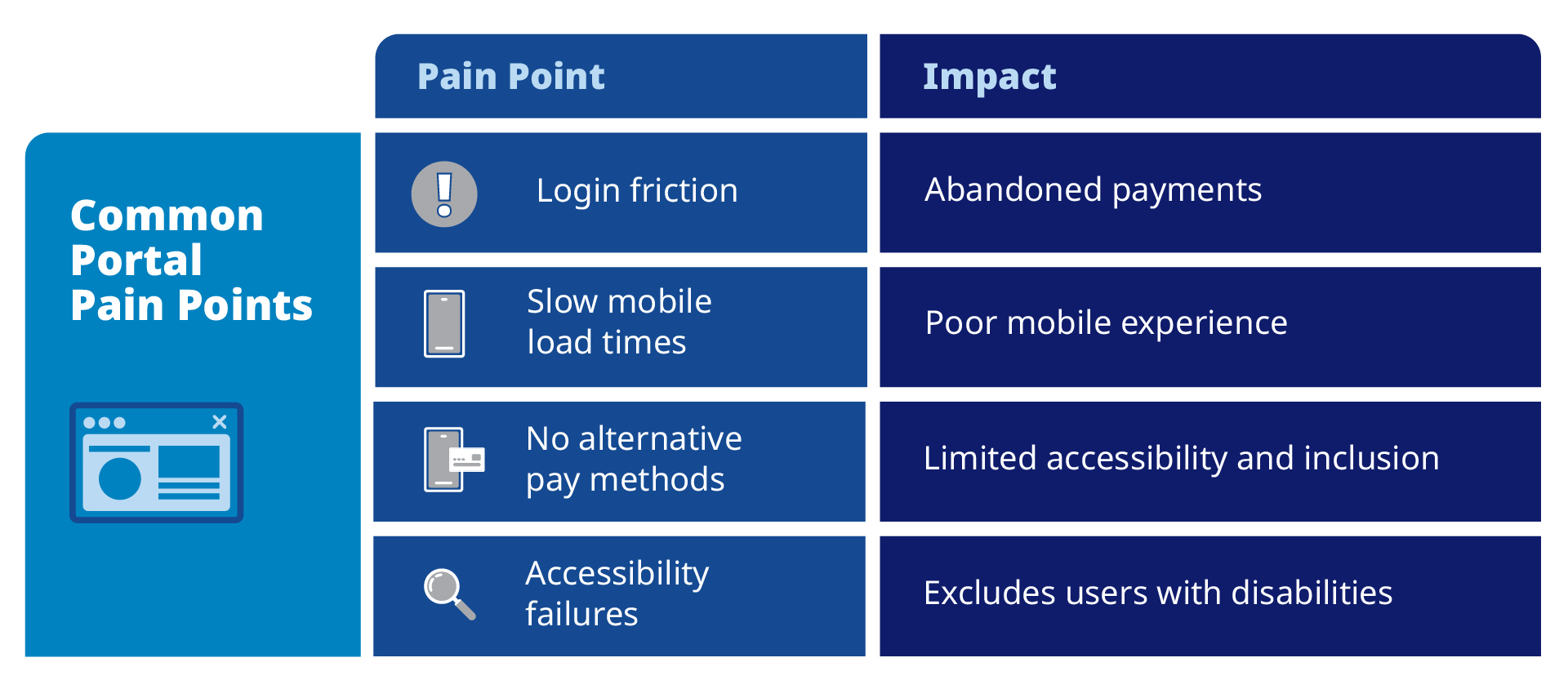
Legacy portals were built for a different era—one where desktop access was the norm and customer expectations were lower. But now, those same portals are a source of friction:

These stats reflect what many billers already know: traditional portals are failing to meet modern expectations. There are three core issues plague legacy systems:


1. Poor Customer Experience

Customers are frustrated by limited payment options, lack of recurring or scheduled payments and slow issue resolution. Many portals don’t support digital wallets, text-to-pay or even guest checkout. This leads to delayed or missed payments. It can even cause service disruptions and increased call center volume.
In fact, 93% of U.S. citizens believe government agencies should offer digital payment options—a clear signal that expectations have shifted.


2. Lagging Operational Insights

Many billers struggle to get a clear picture of payment performance. Data is often siloed across systems, making it difficult to respond to revenue inquiries or track transaction outcomes in real time. This lack of visibility hampers decision-making and slows down operations.


3. Limited Resources and Development Expertise

Even when organizations recognize the need for modernization, they often lack the internal resources to act. Integrating new payment solutions can feel daunting—especially for teams focused on core business operations.

Pain Point | Impact


What “Modern” Bill Payments Really Are

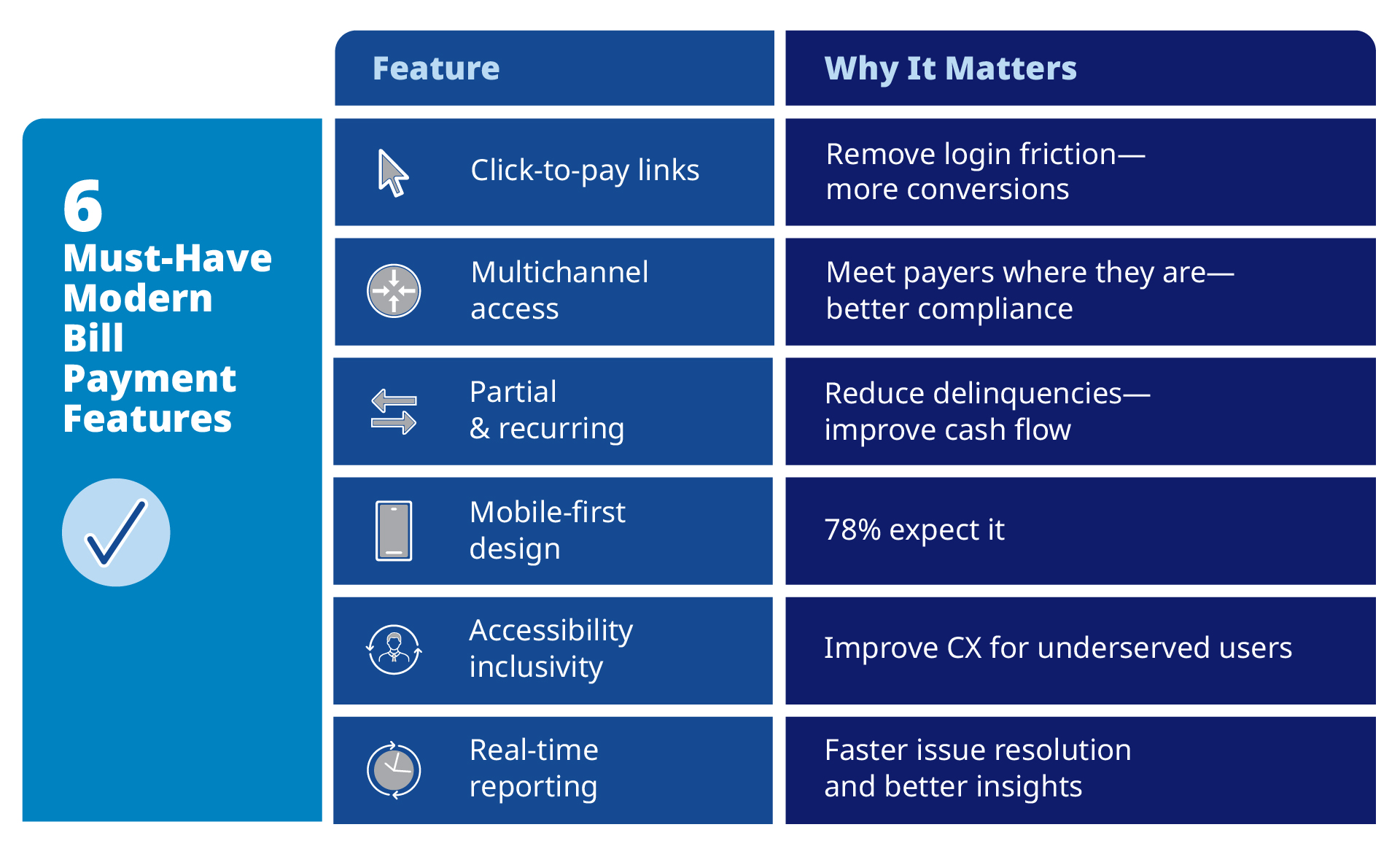
Modern bill payment isn’t just about digitizing the process—it’s about reimagining it for today’s customer. That means removing friction, expanding access and delivering a seamless experience across channels. Here are some of the key features truly modern bill payment platforms should offer:

  • Click-to-pay simplicity: No login required—just tap and pay from a text or email.
  • Multichannel support: Text-to-pay, digital wallets, kiosks, in-person, and more.
  • Saved payment options: Securely store info for faster future payments.
  • Built-in accessibility: Inclusive design for all users, including those with disabilities.
  • Scheduled and recurring payments: Help customers stay on track and avoid late fees.
  • Real-time reporting: Gain instant visibility into transactions and performance.

By 2024, 75% of adults globally had adopted digital payments—a clear signal that consumer expectations have shifted toward speed, convenience, and flexibility. A modernized bill payment platform will meet this demand with a robust, omnichannel payments platform that empowers billers to deliver seamless, branded payment experiences across every touchpoint.

Whether customers prefer guest or registered checkout, autopay or pre-pay setups, or even partial and overpay options, your platform’s infrastructure should support it all with minimal friction. It’s also advisable to have embedded text-to-pay functionality; it’s a favored method of receiving billing notices by users because it empowers billers to send secure, clickable links that drive faster payment completion.

Behind the scenes, a platform’s REST APIs and plug-and-play tools allow for rapid integration with existing systems, while a centralized dashboard simplifies operations, reporting and merchant lifecycle management. This isn’t just about offering payment options—it’s about transforming billing into a strategic advantage, increasing customer satisfaction, and unlocking a new revenue stream.

Recognizing these mounting and evolving challenges, organizations are turning to innovative partners who can help them bridge the gap between legacy systems and the needs of today’s digitally empowered payers. This is where CSG Forte stands out—offering a modern, agile bill payments platform designed to eliminate friction, deliver seamless experiences and equip businesses with the tools they need for operational excellence.

By embracing solutions like CSG Forte BillPay that are purpose-built for the digital age, companies unlock new levels of customer satisfaction and efficiency, transforming bill payment from a routine transaction into a strategic advantage.


A Real-World Example: Intech Worldwide

Intech Worldwide is a Texas-based provider of court and law enforcement records management and computer-aided dispatch services. After watching court clerks struggle to accept and process payments, Intech implemented CSG Forte’s text-to-pay functionality, customer experience saw a significant transformation. Users could pay bills instantly from any device without cumbersome logins, leading to faster payment completion and fewer abandoned transactions. The streamlined process reduced call center inquiries, improved overall satisfaction and made digital payments more accessible for all customers—including those previously underserved by traditional portals.

Feature | Why It Matters


Results That Go Beyond Improving the User Experience

CSG Forte BillPay goes beyond merely digitizing payments—it introduces adaptive solutions tailored for businesses of any size and with any needs, no matter how complex. With its flexible architecture, BillPay integrates effortlessly into existing IT ecosystems, offering rapid deployment and minimal disruption.

The platform provides comprehensive fraud prevention tools and PCI-compliant security, ensuring both billers and customers can transact with confidence. CSG Forte’s intuitive dashboards deliver actionable insights in real time, empowering teams to monitor trends, track payment completions and swiftly address issues as they arise.

By leveraging BillPay, businesses can future-proof their bill payment operations, staying ahead of evolving consumer expectations and regulatory requirements while cultivating loyalty through dependable, frictionless service. Here are three improvements select merchants who use CSG Forte BillPay have already experienced, and your business could, too:

  • 25–40% increase in on-time payments
  • Up to 50% fewer billing-related calls
  • 86% of customers would pay more for a better experience


Operational Efficiency Gains

Siloed, fragmented bill payments systems are a drag on efficiency, as well as on accuracy. With a centralized management hub and real-time reporting, billers can:

  • Grant refunds and process voids instantly.
  • Cancel or change the timing on scheduled charges.
  • Quickly respond to customer inquiries.
  • Reconcile data across systems with a single report.

Traditional portals once met the moment—but this is 2025. Today’s customers expect one-click, multichannel convenience. Modern bill payments don’t replace your portal—they enhance it, layering in flexibility, speed and accessibility that drive better outcomes for everyone.

Start small: launch one new channel, measure the result and scale from there. Whether you’re in government, healthcare, utilities, or property management, the path to better bill payments starts with a single step. And that step should be CSG Forte BillPay.

Ready to find out more about CSG Forte BillPay and what it can do for your organization and your customers? Get in touch with one of our experts today.

How ISVs Can Unlock Revenue With Embedded Payments

As more software platforms handle payment transactions, independent software vendors (ISVs) are discovering a powerful—and often untapped—revenue stream: embedded payments. Rather than sending users to a third-party payment portal, embedded payments allow customers to complete transactions directly within the software interface. It’s fast, intuitive and increasingly expected by today’s digital-first users. 

Think of the everyday convenience of in-app purchases or paying a medical bill directly in a patient portal. That’s embedded payments in action—and it’s transforming how platforms operate across industries like healthcare, property management and retail. 

Yet many ISVs still rely on outdated redirects or payment referral models—unwittingly giving away both revenue and control. By embedding payments, ISVs not only create a smoother experience for users but also open the door to a reliable stream of recurring income from transaction fees and value-added services. 

In this blog, we’ll explore what embedded payments are, why they matter for ISVs and how platforms can monetize them effectively—at their own speed and on their own timeline, only taking on the heavy lift of becoming a registered payment facilitator when and if it becomes the right move for their business. We’ll also discuss what to look for in an embedded payments partner, and how to get started—smarter and faster. 


What Are Embedded Payments?  

Embedded payments refer to payment functions that are built into a non-payment application or software platform. End users pay directly within the app or software interface, without being redirected to an outside payment portal. 

Examples of embedded payments: 

  • Healthcare Patients: A patient logs into the portal to view medical records and can see an outstanding balance, then pay it directly within the portal without being redirected to a separate billing site. 
  • Property Management Software: Tenants can pay rent directly within the tenant portal, streamlining the payment process for both residents and property managers. This not only eliminates the hassle of checks and manual payment tracking, but also integrates payment history, late fees and lease renewals into one centralized dashboard—making management more efficient and improving tenant satisfaction. 
  • Government Services: Residents can pay taxes, fees or permit applications directly within government portals, improving accessibility and streamlining the user experience while enhancing operational efficiency for agencies. 

The terms “embedded payments” and “integrated payments” are sometimes used interchangeably, but they aren’t the same. Integrated payments is a broader term that describes any payment functionality that is connected to a business’s core software systems. The payment system exchanges data with these systems to improve accuracy, simplify reconciliation and streamline workflows. But the payment interface might involve a separate window, a redirection or a clearly distinct module. The payer is aware of entering a payment zone and may feel uncertain about the security measures in place.  


Why Embedded Payments Matter for ISVs  

They help ISVs stand out in a crowded software market. By offering embedded payments, ISVs deliver a more seamless, full-service experience—attracting more merchant customers and outshining competitors that rely on separate payment systems. 

They help retain merchants by improving the end-user experience. Embedded payments reduce friction for end users, leading to higher conversion rates, more on-time payments, and greater customer satisfaction and retention. Furthermore, embedded payments provide a feeling of security that portal redirects cannot. Redirecting users—especially less tech-savvy ones—to an unfamiliar checkout page with different branding can feel disjointed and raise security concerns. For Gen Z users accustomed to seamless digital experiences, redirects may seem outdated and damage trust in the platform. Security is the top payment concern influencing how consumers choose to pay online, endorsed by 60% of survey respondents.  

Embedded payments deliver the smooth, secure experience today’s consumers expect. Happy merchants who experience the benefits of embedded payments are likely to continue using the ISV’s software platform.  

They generate a new revenue stream from payments. Embedding payment processing allows ISVs to tap into transaction fees and related charges every time a payment is processed within their software solution. This recurring revenue stream can significantly contribute to the ISV’s overall earnings. 


How ISVs Can Monetize Payments  

ISVs can monetize payments in several ways: 

Referral partnership: The ISV refers potential customers (merchants) to a payment processing provider in exchange for a commission or fee. In this model, the ISV doesn’t handle the payment processing directly. Instead, it leverages its network to bring new business to the payment provider. ISVs can focus on their core business while benefitting from moderate revenue potential through referral commissions.  

Payment facilitation: Payment facilitation streamlines the entire transaction process—making payments faster, easier and more convenient for everyone involved. It covers everything from setting up and managing payment methods to processing payments, reconciling transactions and preventing fraud. The goal? To deliver secure, seamless and accessible payments for both individuals and businesses.  

A payment facilitator is a company (such as an ISV) that provides payment processing services to other businesses (e.g., merchants). The company acts as an intermediary between the merchant and the acquiring bank and handles payment processing on behalf of the merchant.  

By acting as a payment facilitator and embedding payments, ISVs can earn a larger share of transaction revenue. 

But how do payment facilitators make money through payment processing?  

Transaction and subscription fees: Through embedded payments, payment facilitators unlock a new revenue stream—earning a share of every transaction processed on their platform. They generate approximately 66% of their revenue from payment processing, according to PYMNTS research.  

Value-added services: ISVs can boost earnings by offering services that enhance the payment experience and open new revenue streams, such as Automated Clearing House (ACH) payments, surcharging programs (that pass credit card acceptance fees to cardholders), chargeback dispute management, fraud prevention, data analytics, reporting and more. Many executives estimated that their share of revenue would increase in the next year primarily due to an increase in value-added services 

Strong merchant retention: Platforms that provide comprehensive solutions—including embedded payments—offer greater value to merchants, boosting platform stickiness and long-term merchant retention. 


Becoming a Payment Facilitator Can Be Complex and Expensive—But There’s a Workaround 

All that extra revenue sounds terrific!  So why aren’t more ISVs becoming payment facilitators? Because it demands major investments in time, money and dedicated resources, including: 

  • Partnering with a sponsoring acquirer (and being vetted by the acquirer) 
  • Obtaining Payment Card Industry Data Security Standards (PCI DSS) Level 1 certification 
  • Legal and regulatory compliance [Know Your Customer (KYC), Anti Money Laundering, and other requirements] 
  • Committing significant staffing and financial resources 

Many independent software vendors would rather focus on developing and maintaining their software platforms—not processing payments. Almost a third (31%) of ISVs that don’t support payment acceptance identify security and risk management as the top reasons.   

But there’s good news for ISVs. You can monetize embedded payments without the hefty investment and headaches of becoming a payment facilitator. How? 

By taking advantage of payment facilitation as a service (PFaaS). PFaaS refers to a business model where a company such as CSG provides payment facilitiation services to other businesses on a fee-for-service basis. The ISV outsources its payment processing to a third-party provider, who manages payment processing on its behalf.  

PFaaS is a turnkey solution that allows software platforms to embed payments and enjoy the revenue benefits of becoming a payment facilitator—without taking on the full regulatory, compliance and operational burdens.  

With the right payments partner ISVs can monetize payments without: 

  • Taking on the risk or compliance burdens of a full payment facilitator 
  • Managing KYC, PCI (Payment Card Industry) standards and Nacha compliance 
  • Handling chargebacks or regulatory audits 
  • Maintaining a payment gateway and handling updates 

Related content: 6 Ways to Increase Revenue and Decrease Risk with the Right Payments Partner 


What to Look for in an Embedded Payments Partner  

Not all embedded payments partners are created equal. To simplify the process of adopting payment functionality, look for a partner that offers: 

Industry flexibility: Choose a payments solution that can accommodate the specific requirements of different industries, ranging from healthcare and property management to education and field services.  

Modularity: You should be able to choose which modules to include in your payment system. Your partner should allow you to embed solutions like recurring payments (autopay), text-to-pay, account verification, and automatic updates.  

Built-in PCI compliance: The PCI council has strict rules for businesses that accept and process card payments. To protect cardholder data, businesses must: 

  • Conduct routine network maintenance 
  • Implement data encryption 
  • Add security against malicious software 
  • Restrict internal access to sensitive data 

Select a payments partner that provides the highest level of PCI compliant infrastructure (Level 1), including secure firewalls and network configurations, encryption of cardholder data. For compliance with PCI, Nacha, industry-specific (e.g., Health Insurance Portability and Accountability Act or HIPAA), and state-level data security requirements, look for modern security measures, including   

  • PCI validated end-to-end encryption 
  • Tokenization 
  • Hosted payment pages 

Choosing a partner that offers a PCI compliance program (including assistance with registration and validation and monthly vulnerability scans) simplifies the compliance process and avoids PCI non-compliance fees and risk exposure.  

Fraud prevention tools: Fight fraud with automated account authentication that validates payment information before processing the payment.  

Responsive customer support: Merchants must have swift, effective help when they encounter issues with their payment platform. Choose a payments partner that provides quality, consistent and knowledgeable support whenever merchants need it.  

Rapid onboarding: Look for a partner who gets you up and running in days, not weeks.  


A Smarter Path to Embedding Payments with CSG Forte

Embedded payments are more than a convenience for end-users—they’re a revenue stream for ISVs. 

Ready to turn your software into a revenue-generating payments engine without adding more staff? 

CSG Forte’s PFaaS partnership makes it simple and approachable. Flexible control payment processing allows you to choose your level of involvement and risk in the payment process.  

You can white label a CSG Forte solution for seamless integration, fast onboarding, lowered risk and reliable payment processing. Let Forte handle the hard tasks—such as compliance, onboarding and maintenance—so you can focus on product development and growth. 

Ready to get started with embedded payments? Visit CSG Forte to learn how we can help you boost revenue by embedding payments or talk to an expert today.