
Unlocking Growth: How Embedded Payments Empower ISVs and Drive Merchant Success

A customer clicks “Pay Now,” and the transaction completes without ever leaving the app. That’s not just a smoother checkout—it’s a strategic shift in how businesses can deliver value, build trust and generate revenue. Embedding the payment platform right into your site or application retains and highlights your voice, your branding and, ultimately, your customer base.

For independent software vendors (ISVs), embedded payments are no longer a technical feature—they’re a business imperative. Instead of bolting on third-party processors or sending users to external portals, ISVs can now own the entire payment experience. That means faster onboarding, cleaner user flows and more control over branding, compliance and monetization.

Digital payments provide convenience and processing efficiencies, but they also introduce several risks for both payers and businesses, including cyberattacks. Cybercriminals target all types of organizations large and small, including healthcare providers, financial institutions, government agencies, retail businesses and most other types of transaction-based businesses. They’re looking for security weaknesses in outdated payment systems that make it easy to access sensitive information. Ransomware attacks, phishing schemes and data breaches jeopardize personal information—and trust.

The numbers back it up: embedded payments are expected to drive $6.5 trillion in volume by 2025, and SMBs that adopt them can see 25–50% revenue growth boosts. This means the stakes are high—and the opportunity is massive.


The Problem with Traditional Payment Setups

For too long, accepting digital payments has meant juggling multiple vendors, navigating complex compliance requirements and sacrificing user experience. Disconnected systems lead to:

  • Poor checkout experience that erodes customer trust: When the payment interface feels disconnected from the rest of the application—using generic third-party styling or redirecting users off-platform—it creates friction, undermines brand credibility and increases the likelihood of cart abandonment.
  • Fragmented data and dashboards: ISVs often manage merchant data across multiple disconnected systems, making it difficult to access real-time insights into merchant performance. Without a unified view, ISVs lack the visibility needed to proactively support their merchants and drive business growth.
  • Slow merchant onboarding: Completing lengthy Know Your Customer (KYC) processes, reconciling and tracking paperwork manually and juggling inconsistent integration timelines delay revenue generation and frustrate users.
  • High support burdens: ISVs often struggle to support merchants when payment issues arise, as they must coordinate across multiple providers. This leads to increased support requests and puts additional strain on ISV teams, making it challenging to deliver timely and effective assistance.
  • Data breaches: Hackers infiltrate systems and steal sensitive customer data, including payment information, to make fraudulent transactions.
  • Security and compliance risks: Without centralized oversight, ISVs face greater exposure to Payment Card Industry Data Security Standard (PCI DSS) violations, data breaches and regulatory penalties. Vulnerabilities increase when handling sensitive customer payment data across disparate systems.

These challenges don’t just impact individual merchants—they compound at the ISV level. When ISVs rely on merchant-led or third-party payment integrations, every issue their merchants face becomes magnified: fragmented data, inconsistent branding and operational inefficiencies ripple upward and outward, making it even harder for ISVs to maintain control and support their customers while also scaling their platforms. This means lost revenue opportunities and higher churn. What’s more, limited payment options and delayed onboarding contribute to lower conversion rates and higher churn.

Maintaining regulatory compliance is one of the most complex ways businesses navigate online payment risk. Regulations such as Payment Card Industry Data Security Standard (PCI DSS) for data security and strong customer authentication must be adhered to, and they change regularly. Organizations have to get it right, or risk steep fines and penalties.


So, What Are Embedded Payments?

Embedded payments refer to the integration of payment functionality directly into a software platform—allowing users to complete transactions without leaving the application. This creates a frictionless experience for both merchants and consumers. For ISVs, embedding payments means becoming strategic partners, offering a unified solution that powers both business operations and revenue generation.

By embedding payments directly into platforms, ISVs can overcome the limitations of traditional payment setups and deliver a more unified experience. This transformative approach offers operational, branding and revenue advantages.

Operational Efficiency

Embedded payments eliminate the need for multiple providers and fragmented systems. With a unified infrastructure, ISVs gain:

  • One source of truth for transactions
  • Simplified APIs and integrations
  • Faster merchant onboarding
  • Real-time reporting and analytics

Brand Control

A seamless UX from login to checkout strengthens brand identity and trust. ISVs can offer:

  • Branded checkout experiences
  • Custom payment flows
  • Reduced churn and higher customer satisfaction

Revenue Growth

Embedded payments unlock new revenue streams. ISVs can:

  • Monetize every transaction
  • Offer value-added services like recurring billing and digital wallets
  • Set custom pricing models

Compliance and Risk Reduction

By partnering with platforms like CSG Forte, ISVs can offload burdens related to:

  • PCI DSS and KYC compliance
  • Data privacy regulations
  • Payment fraud management


Embedded Payments vs. Payment Facilitation Models

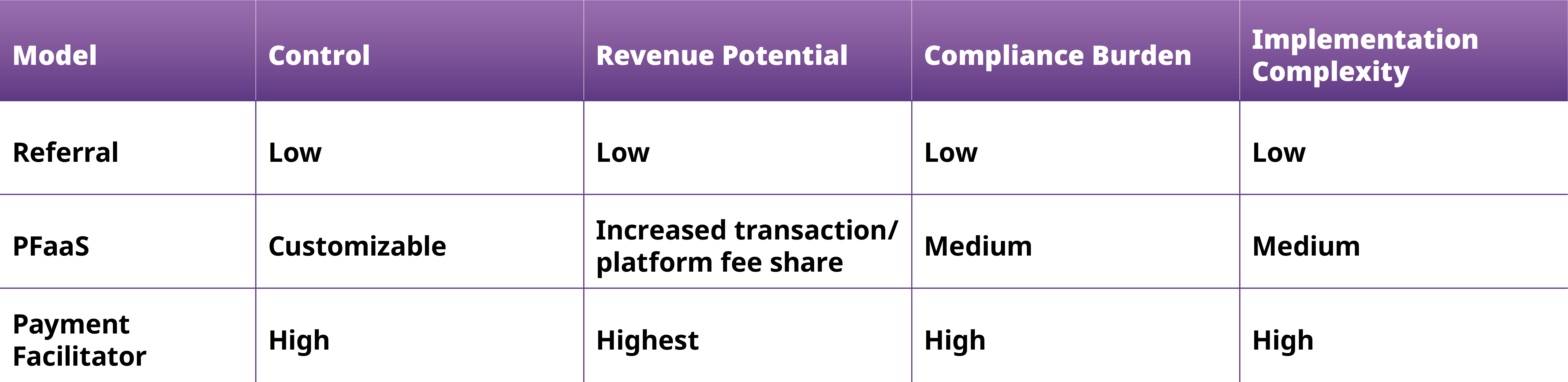
Not all embedded payment strategies are created equal. CSG Forte offers three flexible models to meet different business needs:


For ISVs ready to take full ownership of the payment experience, becoming a registered payment facilitator offers the highest earning potential and customization.

Embedded payments are making waves across a multitude of industries:

  • Healthcare: HIPAA-compliant solutions streamline billing and improve collections.
  • Property management: Secure rent collection and flexible tenant payment options.
  • Government: Simplified tax, permit and utility payments with constituent-friendly UX.
  • Education: Tuition and campus payments with seamless API integration.

Take Buildium, for example—a property management platform that saw 35% YoY growth and 99.99% uptime after embedding payments with CSG Forte.

Implementation and Integration Strategy

CSG Forte makes implementation seamless with:

  • REST APIs for and onboarding, transaction processing, management and reporting
  • Dex, our payment operations platform for real-time visibility and control
  • Dedicated support teams, including Solutions Engineers and Partner Success Managers

Our tried-and-tested onboarding journey includes:

  • Discovery and solutioning
  • Integration and testing
  • Go-live and training
  • Ongoing support and optimization

Whether you choose PFaaS or full facilitation, CSG Forte tailors the experience to your business needs.

Beyond revenue, embedded payments are a powerful retention tool. One survey found that 65% of merchants are willing to switch vendors if embedded finance isn’t offered. For ISVs, this means offering embedded payments is a top predictor of vendor stickiness. Neglecting it can lead to higher churn and lost market share.

Future-Proof Your Organization by Embedding Payments

Embedded payments are more than a technical upgrade—they’re a strategic imperative. They offer ISVs:

  • Greater control over the customer experience
  • Scalable infrastructure for growth
  • New revenue streams and stronger margins
  • A competitive edge in a crowded market

Whether you’re just starting with a referral model or ready to become a registered payment facilitator, CSG Forte provides the tools, support and flexibility to help you succeed.

Ready to explore your modernized payments journey? Contact our payments experts to schedule a free demo and let’s talk about how CSG Forte can help you monetize, scale and future-proof your platform.

Why Secure, Modern Payment Portals Are the New Standard for Businesses

Digital payments provide convenience and processing efficiencies, but they also introduce several risks for both payers and businesses, including cyberattacks. Cybercriminals target all types of organizations large and small, including healthcare providers, financial institutions, government agencies, retail businesses and most other types of transaction-based businesses. They’re looking for security weaknesses in outdated payment systems that make it easy to access sensitive information. Ransomware attacks, phishing schemes and data breaches jeopardize personal information—and trust.

Consumers are increasingly and justifiably worried about data security. A 2024 survey found that 78% of U.S. consumers expressed concerns about data security when using online services, up from 73% the previous year. Almost half (44%) of respondents had experienced data loss, identity theft or online fraud, with 29% of the victims experiencing significant harm. Only 26% of respondents believe digital payment methods are secure from theft.

Identity theft or a data breach shatters trust. Across industries, security is the most valued factor when making any kind of payment, as identified by 94% of respondents to an American Express survey. Most (84%) consumers expect strong security—to protect their data and credit—from any organization requesting payment. When their financial information isn’t protected, customers may hesitate to use online payment portals again. Or they may take their business elsewhere.

A single security lapse can have devastating consequences for a business’ reputation and finances. More than half (58%) of U.S. consumers believe that brands that get hit with a data breach are not trustworthy, and 70% said they would stop shopping with a brand that suffered a security incident.

Businesses and government agencies must prioritize payment security and risk management to safeguard customer data and revenue and maintain trust. That means investing in digital payment solutions that meet the highest standards for cybersecurity, compliance, and fraud prevention.


Common Payment Risks in Digital Transactions

As digital transactions gain popularity, businesses and consumers alike must understand the various risks.

Payment fraud is the main risk in digital transactions, and comes in many forms, such as:

  • Identity theft: Bad actors steal personal information to make unauthorized purchases.
  • Account takeovers: Bad actors gain access to accounts and initiate transactions without the account holder’s knowledge.
  • Phishing scams: Bad actors trick victims into revealing sensitive information such as passwords or card details.
  • Social engineering: Bad actors manipulate individuals through social engineering tactics to gain access to sensitive information or trick them into authorizing fraudulent transactions.
  • Data breaches: Hackers infiltrate systems and steal sensitive customer data, including payment information, to make fraudulent transactions.
  • Card-not-present (CNP) fraud: Common in online purchases, this refers to fraudulent transactions that occur without the presence of the physical card.

Chargebacks are another key risk in digital transactions. Customers can request a chargeback—a reversal of funds following a debit or credit card purchase, initiated when the customer files a dispute over the charge with their bank or credit card provider. A large proportion of chargebacks reverse legitimate fraud (i.e., transactions that show up on a customer’s account due to fraudulent activity). However, some chargebacks occur due to “friendly fraud”—when the customer doesn’t recognize the charge, has delivery problems or wants to avoid the return process. Whether they’re due to legitimate or friendly fraud, chargebacks are costly for businesses. Payment processing providers charge fees—up to $50 or $100 for each chargeback.

Maintaining regulatory compliance is one of the most complex ways businesses navigate online payment risk. Regulations such as Payment Card Industry Data Security Standard (PCI DSS) for data security and strong customer authentication must be adhered to, and they change regularly. Organizations have to get it right, or risk steep fines and penalties.


Key Components of a Successful Payment Risk Management Strategy

To effectively manage payment risk, choose a payment system that includes:

Verification services

To reduce payment failures, fraudulent transactions and chargebacks, proactively verify:

  • Routing and bank account numbers
  • Account ownership
  • Customer account data is current (e.g., card not expired)
  • Accounts are active and have sufficient funds


Modern Security Measures

When it comes to payments, security is about more than just locking down individual transactions—it requires a comprehensive strategy that addresses every point where sensitive data is stored, transmitted, or accessed. A strong payments platform weaves together multiple safeguards to reduce risk, strengthen compliance, and maintain customer trust. The following measures form the foundation of a modern, secure system.

  • Encryption & Tokenization: Protecting sensitive payment data requires a layered approach. Tokenization and encryption safeguard information both at rest and in transit. PCI-validated end-to-end encryption disguises card data during transmission, making it appear valueless if intercepted. Meanwhile, tokenization randomly generates a unique token with no intrinsic value for every set of sensitive information. This allows credit card or ACH data—such as the primary account number (PAN) for credit cards or the bank account or bank routing number for ACH transactions—to be safely stored, processed, and transmitted across systems without exposing the actual details.
  • Access Control: Payment systems must employ strong authentication protocols so that only authorized personnel can interact with sensitive data and systems. Multi-factor authentication (MFA) adds a critical layer of defense by requiring multiple identifiers to access a system or approve a transaction, making unauthorized access far more difficult.
  • Built-In PCI Compliance: Another essential safeguard is built-in PCI compliance. A payment system must meet the highest compliance and regulatory standards, including PCI Data Security Standard (PCI-DSS) requirements for handling credit card payments, as well as local and federal regulations. A trusted payments partner helps businesses navigate this complex landscape by providing secure solutions and supporting compliance in real time—minimizing risk and reducing the likelihood of breaches that can erode customer trust.
  • Hosted Payment Pages: Hosted payment pages also offer strong protection. Instead of entering bank account or card details directly on an organization’s website, customers are redirected to a secure checkout page managed by a third-party gateway or service provider. On that page, sensitive data—such as account and routing numbers, PANs, CVVs, and expiration dates—is collected and transmitted by the provider’s secure servers. Because the organization’s systems never touch or store this data, PCI scope is significantly reduced.
  • Reducing Access to Sensitive Data: Some platforms go even further by offering solutions that limit direct access to sensitive data. For example, having customers pay through secure, unique microsites rather than sharing payment information over the phone reduces both the number of people who handle sensitive details and the risk of fraudsters posing as customer service representatives.


Advanced Fraud Detection

Even with strong security controls and compliance in place, fraud is an ever-present threat. Fraudsters constantly adapt their methods, meaning businesses can’t rely solely on static defenses. Instead, payment systems must incorporate tools that can learn, evolve, and recognize the signs of suspicious activity before losses occur. Modern fraud detection is about continuous adaptation and proactive monitoring.

Today’s platforms use advanced tools like machine learning (ML), artificial intelligence (AI), and behavioral analytics to spot subtle, complex patterns of fraudulent activity that would slip past basic rule-based systems.

These tools analyze transaction data and user behavior, monitoring elements such as transaction timing, frequency, device fingerprints, and even typing speed. Anomalies are flagged for further investigation, giving businesses the ability to react before fraudulent activity escalates. The key is adaptability—fraud detection systems must continuously learn and evolve in order to keep pace with increasingly sophisticated threats.

When You Don’t Want to DIY: Secure, Compliant Payment Processing Builds Trust

Even with a strong payment system, risk management is a heavy lift. Cyber threats, fraud schemes, and regulatory requirements are rapidly evolving. The good news? You don’t have to shoulder fraud detection and prevention on your own.

Knowing that their payment data is handled securely gives customers peace of mind and builds trust. By using secure, compliant payment solutions and prioritizing risk management, your organization demonstrates a commitment to safeguarding customers’ personal data and financial transactions. This proactive approach to cybersecurity and compliance not only helps prevent fraud but also reassures residents that your business is trustworthy, responsible and transparent. When customers know your business is taking the right steps to secure their personal information, they are more likely to pay online—and on time—and continue doing business with you.

Ready to strengthen your payment security? Discover how CSG Forte’s secure, compliant payment solutions can help you protect customer data, reduce risk, and earn lasting trust. Contact us today to learn more.

How Do BillPay Notifications Work?

Your customers expect their bill payment experiences to be as seamless as their favorite online shopping checkout. But for many billers, the process is far from that. Customers get frustrated, leading to missed payments, delayed cash flow and overwhelmed support teams. That’s where BillPay notifications come in. These convenient nudges play a critical role in transforming the payment experience for both your customers and your hard-working employees.

Better billing starts with better communication. Let’s explore how BillPay notifications work, why they matter and how they can help you deliver a more modern, efficient and customer-friendly payment experience.


Why Bill Payment Notifications Matter

Billers today face three core challenges: poor customer experience, lagging operational insights and limited development resources. CSG Forte BillPay notifications directly address the first two by:

  • Anticipating customer needs: When customers don’t receive timely reminders or updates, they’re more likely to miss payments. This not only disrupts your cash flow but also leads to increased service calls, customer dissatisfaction, and, ultimately, churn.
  • Providing timely reminders: According to Datos Insights, Americans spent $5.6 trillion last year paying 16.8 billion bills—60% of which were one-time payments. That means a substantial portion of bill timeliness relies on consumers’ memory and organization.

BillPay notifications help bridge that gap by proactively guiding customers through the payment process, reducing friction and improving on-time payment rates.


Types of BillPay Notifications

CSG Forte’s BillPay solution supports a variety of notification types to meet customers where they are:

  • Email Reminders: Sent before due dates, these reminders help customers stay on top of their obligations.
  • Text to Pay Notifications: SMS messages with embedded payment links make it easy to pay on the go. In fact, two-thirds of consumers who receive these texts say it’s the fastest and easiest way to pay.
  • Calendar-Integrated Notifications: For customers using mobile apps or portals, alerts provide real-time updates.

These channels are designed to be flexible and customizable, allowing billers to tailor the experience to their customer base.


How Notifications Are Triggered

Behind the scenes, BillPay notifications are powered by smart automation and real-time data.

  • Trigger Logic: Notifications are scheduled based on due dates. For example, a reminder might be sent three days before a bill is due, followed by a follow-up if payment hasn’t been received.
  • Real-Time Integration: CSG Forte’s centralized management hub gives billers real-time visibility into payment activity, allowing for faster response times.
  • Customization: Billers can define the frequency, channel and content of notifications. Whether it’s a branded email or a friendly text, the message reflects your organization’s tone and values.


The Customer Journey

Here’s how a typical notification flow might look:

  1. Bill is generated: The system identifies a new bill and schedules a reminder.
  2. Reminder is sent: An email or SMS is sent a few days before the due date.
  3. Follow-up is conducted: If the bill remains unpaid, a second reminder is triggered.
  4. Confirmation is received: Once payment is made, the customer receives a confirmation message.

This journey ensures customers are informed at every step, reducing confusion and increasing the likelihood of on-time payments.


Benefits for Billers

BillPay notifications aren’t just convenient for customers—they’re a game-changer for billers too:

  • Improved cash flow: Timely reminders lead to more on-time payments.
  • Reduced support volume: Fewer missed payments mean fewer calls to your support team.
  • Enhanced customer satisfaction: Proactive communication builds trust and loyalty.
  • Increased operational efficiency: Automation frees up your team to focus on higher-value tasks.


Real-World Results

The impact of BillPay notifications is already being felt across the CSG Forte customer base. One customer, the treasurer of Warrick County, shared that they “nearly stopped taking online payments” because they couldn’t find an accurate, consistent vendor. “Forte’s services have been invaluable,” she said.


How to Get Started

Ready to modernize your bill payment experience? Here’s how to begin:

  1. Review your current workflow: Identify gaps in your existing notification process.
  2. Select your channels: Choose the notification types that best suit your customers.
  3. Customize your messaging: Align the tone and branding with your organization.
  4. Let CSG Forte do the heavy lifting: Our plug-and-play solutions integrate seamlessly with your existing systems.

BillPay notifications are more than just reminders—they’re a strategic tool for improving customer experience, boosting operational efficiency, and driving consistent cash flow. With CSG Forte, you can deliver a modern, flexible and branded payment experience that keeps your customers informed and your business thriving. Let’s make bill payment easier—for everyone.

Get in touch with one of our payment experts today to learn more about how CSG Forte BillPay notifications can improve your business.

Digital Bill Payments vs. Traditional Portals: What’s Better?

For years, traditional online portals were the gold standard in bill payment. They offered a centralized place for customers to log in, view balances and make payments. But today, that model is showing its age.

That’s because payers expect more—more convenience, more flexibility and more control. They want to pay their bills the same way they shop online: with one click, from any device, without remembering a password. The question is no longer whether your portal works, but whether it’s working against you.


The Limitations of Traditional Portals

Legacy portals were built for a different era—one where desktop access was the norm and customer expectations were lower. But now, those same portals are a source of friction:

These stats reflect what many billers already know: traditional portals are failing to meet modern expectations. There are three core issues plague legacy systems:


1. Poor Customer Experience

Customers are frustrated by limited payment options, lack of recurring or scheduled payments and slow issue resolution. Many portals don’t support digital wallets, text-to-pay or even guest checkout. This leads to delayed or missed payments. It can even cause service disruptions and increased call center volume.
In fact, 93% of U.S. citizens believe government agencies should offer digital payment options—a clear signal that expectations have shifted.


2. Lagging Operational Insights

Many billers struggle to get a clear picture of payment performance. Data is often siloed across systems, making it difficult to respond to revenue inquiries or track transaction outcomes in real time. This lack of visibility hampers decision-making and slows down operations.


3. Limited Resources and Development Expertise

Even when organizations recognize the need for modernization, they often lack the internal resources to act. Integrating new payment solutions can feel daunting—especially for teams focused on core business operations.

Pain Point | Impact


What “Modern” Bill Payments Really Are

Modern bill payment isn’t just about digitizing the process—it’s about reimagining it for today’s customer. That means removing friction, expanding access and delivering a seamless experience across channels. Here are some of the key features truly modern bill payment platforms should offer:

  • Click-to-pay simplicity: No login required—just tap and pay from a text or email.
  • Multichannel support: Text-to-pay, digital wallets, kiosks, in-person, and more.
  • Saved payment options: Securely store info for faster future payments.
  • Built-in accessibility: Inclusive design for all users, including those with disabilities.
  • Scheduled and recurring payments: Help customers stay on track and avoid late fees.
  • Real-time reporting: Gain instant visibility into transactions and performance.

By 2024, 75% of adults globally had adopted digital payments—a clear signal that consumer expectations have shifted toward speed, convenience, and flexibility. A modernized bill payment platform will meet this demand with a robust, omnichannel payments platform that empowers billers to deliver seamless, branded payment experiences across every touchpoint.

Whether customers prefer guest or registered checkout, autopay or pre-pay setups, or even partial and overpay options, your platform’s infrastructure should support it all with minimal friction. It’s also advisable to have embedded text-to-pay functionality; it’s a favored method of receiving billing notices by users because it empowers billers to send secure, clickable links that drive faster payment completion.

Behind the scenes, a platform’s REST APIs and plug-and-play tools allow for rapid integration with existing systems, while a centralized dashboard simplifies operations, reporting and merchant lifecycle management. This isn’t just about offering payment options—it’s about transforming billing into a strategic advantage, increasing customer satisfaction, and unlocking a new revenue stream.

Recognizing these mounting and evolving challenges, organizations are turning to innovative partners who can help them bridge the gap between legacy systems and the needs of today’s digitally empowered payers. This is where CSG Forte stands out—offering a modern, agile bill payments platform designed to eliminate friction, deliver seamless experiences and equip businesses with the tools they need for operational excellence.

By embracing solutions like CSG Forte BillPay that are purpose-built for the digital age, companies unlock new levels of customer satisfaction and efficiency, transforming bill payment from a routine transaction into a strategic advantage.


A Real-World Example: Intech Worldwide

Intech Worldwide is a Texas-based provider of court and law enforcement records management and computer-aided dispatch services. After watching court clerks struggle to accept and process payments, Intech implemented CSG Forte’s text-to-pay functionality, customer experience saw a significant transformation. Users could pay bills instantly from any device without cumbersome logins, leading to faster payment completion and fewer abandoned transactions. The streamlined process reduced call center inquiries, improved overall satisfaction and made digital payments more accessible for all customers—including those previously underserved by traditional portals.

Feature | Why It Matters


Results That Go Beyond Improving the User Experience

CSG Forte BillPay goes beyond merely digitizing payments—it introduces adaptive solutions tailored for businesses of any size and with any needs, no matter how complex. With its flexible architecture, BillPay integrates effortlessly into existing IT ecosystems, offering rapid deployment and minimal disruption.

The platform provides comprehensive fraud prevention tools and PCI-compliant security, ensuring both billers and customers can transact with confidence. CSG Forte’s intuitive dashboards deliver actionable insights in real time, empowering teams to monitor trends, track payment completions and swiftly address issues as they arise.

By leveraging BillPay, businesses can future-proof their bill payment operations, staying ahead of evolving consumer expectations and regulatory requirements while cultivating loyalty through dependable, frictionless service. Here are three improvements select merchants who use CSG Forte BillPay have already experienced, and your business could, too:

  • 25–40% increase in on-time payments
  • Up to 50% fewer billing-related calls
  • 86% of customers would pay more for a better experience


Operational Efficiency Gains

Siloed, fragmented bill payments systems are a drag on efficiency, as well as on accuracy. With a centralized management hub and real-time reporting, billers can:

  • Grant refunds and process voids instantly.
  • Cancel or change the timing on scheduled charges.
  • Quickly respond to customer inquiries.
  • Reconcile data across systems with a single report.

Traditional portals once met the moment—but this is 2025. Today’s customers expect one-click, multichannel convenience. Modern bill payments don’t replace your portal—they enhance it, layering in flexibility, speed and accessibility that drive better outcomes for everyone.

Start small: launch one new channel, measure the result and scale from there. Whether you’re in government, healthcare, utilities, or property management, the path to better bill payments starts with a single step. And that step should be CSG Forte BillPay.

Ready to find out more about CSG Forte BillPay and what it can do for your organization and your customers? Get in touch with one of our experts today.

Understanding Electronic Bill Payments: A Comprehensive Guide for Governments

Government entities are entrusted with the responsibility of managing taxpayer money wisely, so any investment in new technology must demonstrate a clear value proposition. Electronic bill payments offer a modern solution that can streamline operations, enhance efficiency and save money. By adopting digital payment methods, governments can improve the way they collect revenue, reduce manual handling and paperwork and provide a convenient and accessible way for residents and businesses to pay their bills.

But many government entities and departments remain largely reliant on outdated payment methods, such as mailing and processing paper checks, accepting in-person payments and conducting phone transactions—all of which are inefficient and inconvenient. And while up-front investments in expensive tools, like an online payments platform, must be carefully considered, keeping the status quo could be even more costly: According to recent data, government employees spend 10 to 20 hours per week fielding payment-related calls—that’s valuable employee time that could be spent on more complex, meaningful tasks.

Not only that, but without a robust digital payment infrastructure, governments risk missing out on collecting revenue altogether, or may experience collection delays. So, while the up-front investment in a digital payments platform can seem hefty, adopting electronic bill payments streamlines the way government agencies operate, making the process smoother and more efficient for constituents and employees while also saving money.


What Are Electronic Bill Payments?

Electronic bill payments involve transferring funds or exchanging money through digital channels, eliminating the need for physical methods like cash or checks. These transactions are facilitated by electronic systems that require collaboration between banks, financial institutions, payment processors and digital platforms.

Completing an electronic bill payment transaction typically involves several steps. After receiving the bill, the customer initiates the payment by providing the necessary payment information, such as bank account details, credit card number or digital wallet credentials. The payment gateway then verifies these details, checking for available funds and other authorization factors. Once the payment is authorized, the payment processor orchestrates the transfer of funds between the payer’s and payee’s accounts. Finally, both the payer and the payee receive a notification or receipt confirming the successful completion of the transaction.

Electronic bill payments offer numerous advantages over traditional payment methods. They are faster, more secure and cost-effective, making them an attractive option for both consumers and businesses. For government agencies, adopting electronic bill payments can lead to increased efficiency in processing payments, reduced manual handling and paperwork and improved cash flow management, plus ease of reconciliation and auditing, which improves visibility and makes transparency much easier to achieve. Additionally, electronic bill payments provide a convenient and accessible way for residents and businesses to pay their bills, which can help reduce late payments and improve overall satisfaction with government services.

By leveraging digital channels and secure systems, electronic payments streamline collections and offer a convenient alternative to traditional payment methods. As we move forward, it’s essential for government agencies to embrace these technologies to enhance their operations and better serve their constituents, who are largely accustomed to paying online—and want to be able to do more of it, In fact, 93% of consumers believe “all governments, including municipal governments,” should offer a digital payment option for constituents, according to data from PayPal/Logica Research.


Why Electronic Bill Payments Are Essential for Governments

  • Increased efficiency in processing payments: Electronic bill payments streamline the payment process, reducing the need for manual handling and paperwork. This leads to faster processing times and fewer errors, allowing government agencies to allocate resources more effectively and focus on other critical tasks.
  • Convenience for residents and businesses: Electronic bill payments provide a convenient and accessible way for residents and businesses to pay their bills. They can make payments anytime and anywhere, using various digital channels such as online portals, mobile-friendly pages and automated phone systems. This flexibility helps reduce late payments and improves overall satisfaction with government services.
  • Improved cash flow management for government authorities: By adopting electronic bill payments, government authorities can benefit from faster payment processing and more predictable cash flow. This enables better financial planning and management, ensuring that funds are available when needed for essential services and projects.


Introducing CSG Forte BillPay

With decades of experience in the industry, CSG Forte knows payments. Our comprehensive BillPay platform is designed to streamline and enhance the payment process, focusing on efficiency, security and user experience.

CSG Forte BillPay offers a range of features that can be configured to cater to each customer’s unique needs and is scalable as your company grows. Here are some of the standout features that make CSG Forte BillPay a game-changer for government payment systems.

  • Flexible payment options: CSG Forte BillPay supports a variety of payment methods, including online, in-person, over the phone, text-to-pay and via digital wallets. This flexibility ensures that constituents can choose the payment method that best suits their needs, leading to higher satisfaction and on-time payments.
  • Recurring payments: Our platform allows for easy scheduling and maintenance of recurring payments. This feature is particularly beneficial for offices that handle regular payments, such as taxes, utility bills and licensing fees. By automating these payments, agencies can reduce administrative burdens and improve cash flow.
  • Bill presentment: CSG Forte BillPay offers digital invoice access and a guest checkout option, making it easy for constituents to view and pay their bills online. The platform supports custom file formats and easy user interface (UI) customization, ensuring that the bill presentment process aligns with the agency’s branding and operational needs.
  • Fast and flexible integration: The platform is designed for quick and seamless integration with existing systems. With support for custom file formats and easy UI customization, government agencies can implement CSG Forte BillPay without significant disruptions to their current operations.
  • Enhanced security and compliance: BillPay prioritizes security and compliance, offering features such as account ownership verification, fraud prevention tools and secure point-of-sale (POS) devices. These measures help protect sensitive information and ensure that government agencies remain compliant with industry standards and regulations.
  • Centralized payments hub: The platform provides a centralized hub for managing all payment operations, including reconciliation, reporting and chargeback management. This centralization simplifies administrative tasks and reduces the risk of errors, allowing government agencies to focus on their core responsibilities.

CSG Forte’s comprehensive payment solutions extend beyond just streamlining bill payments. Our decades of experience in processing millions of transactions and managing billions of dollars in payments allows our team to offer reliable and scalable solutions for government agencies, ensuring adaptability to changing needs while maintaining cost efficiency. Here are some of Forte’s key features:

  • Seamless integration with government platforms: Easily manage payments collected through CSG Forte’s flagship programs. The integration capabilities reduce manual processes and errors, providing a seamless experience for both the agency and the residents.
  • Comprehensive payment solutions: Accept Automatic Clearing Housing (ACH) payments, debit and credit cards, digital wallet payments and in-person cards through our point-of-sale (POS) devices. This flexibility allows government agencies to offer constituents multiple convenient payment options, enhancing overall efficiency and satisfaction.
  • Proven reliability and scalability: We process more than 214 million transactions annually and manage $98 billion-plus in payments for more than 130,000 merchants across various industries, including government. This experience and capacity allow CSG Forte to scale alongside government agencies, adapting to their changing needs while reducing complexity and cutting costs.


How Forte Delivers for the City of Kinston

CSG Forte’s partnership with the city of Kinston, North Carolina, has produced amazing results for the municipality. City leadership wanted to offer residents electronic payment options for utility bills, civil service fees, recreational activities and other city services. After integrating electronic payment processing options, Kinston saw 41% year-over-year growth in the number of transactions processed. The city also received positive feedback from residents who appreciated the ease of making payments through the online portal.

How did Forte produce such dramatic results? Our development team created programming to bridge the gap between Kinston’s enterprise resource planning system and its payment interface. CSG Forte’s Secure Web Pay (SWP) Checkout tool now redirects payers from the city’s website to a secure third-party webpage to complete their transactions, allowing the city to begin accepting online card and eCheck payments without spending money or committing technical resources to developing their own webpage to process payments.

CSG Forte also launched an online and interactive voice response (IVR) utilities billing solution for Kinston using a convenience fee model and provided comprehensive technical support following implementation. By processing more payments electronically, Kinston staff now handle less cash and fewer checks, reducing bank fees and saving time.

As you can see, adopting electronic bill payments is a game-changer for government agencies. By streamlining the payment process, governments can boost efficiency, cut down on manual handling and paperwork and improve cash flow management. This not only saves valuable employee time but also makes life easier for constituents who expect to be able to pay their bills conveniently and securely through their preferred digital channels. And while the upfront investment in a digital payments platform might seem significant, the long-term savings and improved operational efficiency make it a smart move.

To learn more about how CSG Forte BillPay can help your government agency transition to electronic bill payments or download our government eBook.

Why REST? Understanding the Benefits of REST API

The development world is a quickly evolving one, and businesses that want to stay ahead of the curve need to be capable of adapting to ever-evolving digital technologies. So, promoting a “restful” application programming interface (API) may seem anti-productive—but it’s exactly the opposite. Businesses that offer online services use APIs to communicate between systems. Among the various types of APIs, representational state transfer, or REST, APIs are one of the most widely used. In fact, around 70% of all public APIs are REST APIs. Why? Because despite the lackadaisical speed the name implies, they’re actually the workhorses of APIs.

Read on to learn key characteristics of the REST architectural style, how it works, why REST API is so important and widely used, security measures to consider and what to look for in a REST API provider.


What Is REST API?

To understand REST API, one must first know that an application program interface, or API, is the name given to the code that sets uniform standards for how a developer writes a program so it can communicate with other operating systems or applications.

A RESTful API is a type of application program interface that uses HTTP requests and is based on “representational state transfer” (REST) architectural style, which requires the system be cacheable, remove the need to edit code, offer a uniform interface and a provide a method of separating client and server information. Using HTTP requests, REST API can perform operations such as searching for information (GET), adding information (POST), editing information (PUT) and DELETE.


Benefits of Tapping Into a RESTful API

Businesses that use RESTful AIPs can take advantage of several benefits. For example, they can be used without expensive third-party tools. The documentation is easier to understand and returns readable results. REST API also allows many different data formats and is especially good for cloud-based applications due to its statelessness, which means no information is kept or shared between REST executions. Additionally, REST APIs’ stateless functionality allows calls to be easily redeployed at scale.

RESTful APIs are preferable to SOAP (Simple Object Access Protocol) API technology for many reasons. They’re:

  • Lightweight
  • Easy to maintain
  • Scalable and flexible
  • Efficient and fast
  • High performing
  • Smaller and more efficient

These are all good reasons to select REST instead of SOAP—especially when using CSG Forte products and capabilities like our payments platform DEX, reporting or out tokenization tool Forte.js.


Security Considerations for Using REST APIs

While REST APIs offer numerous benefits, it’s crucial to implement proper security measures. Here are a few best practices to secure your REST API:

  • Authentication: Secure your API keys with proven methods to ensure that only authorized users can access sensitive data.
  • Encryption: Always use HTTPS for encrypted communication between the client and server. This prevents data from mid-transmission interception.
  • Input validation: Properly validate and sanitize user input to protect your API from common vulnerabilities like SQL injection and Cross-Site Scripting (XSS).
  • Rate limiting: To prevent abuse and protect your API from denial-of-service attacks, implement rate limiting that restricts the number of requests a user can make in a given time.


CSG Forte API Solutions

CSG Forte’s REST API enables merchants and partners to perform a variety of powerful tasks, such as creating and updating credit card, electronic check and scheduled transactions; securely managing customer and payment data; querying and tracking settlement information and creating and submitting merchant applications for new organizations and locations.

It supports multiple programming languages, such as JSON, Java, PHP, Ruby and VB.NET. REST is best suited for merchants that are tech savvy and have developer resources. These include ISVs with multiple merchants or third-party app developers that aim to receive and leverage our webhooks.

For code samples, visit our developer documentation site. If you need assistance determining which API is right for you, contact our experts at CSG Forte.

What Are NSF Payments? NSF Re-Presentment Basics

Handling returned non-sufficient funds (NSF) automated clearing house (ACH) payments accurately and efficiently helps businesses protect themselves from financial losses by minimizing the impact of unpaid transactions. Promptly addressing NSF returns through clear communication, compliant follow-up procedures and a timely resolution enables merchants to recover funds and prevent further losses. Streamlined handling can also help businesses maintain strong customer relationships, reducing the likelihood of service disruptions due to unsuccessful payments.

At CSG Forte, our recovery solutions can help equip your business to handle NSF returns effectively. Our re-presentment options enable you to recover the funds for each NSF payment at no charge to you. More importantly, these automated solutions save significant time and resources, allowing you to focus more on the responsibilities that matter most for your business.

What Is an NSF Return?

An NSF return in banking stands for non-sufficient funds, otherwise known as an ACH network payment that was returned due to its inability to be completed. This means the bank has refused to honor the payment because there isn’t enough money in the account to cover it. Having a check returned due to NSF is often referred to as having a “bad” or “bounced” check.

When the merchant processes the payment and the receiving bank returns it due to non-sufficient funds in the account, this situation can result in fees for both the payer and the recipient trying to collect the funds. These fees are known as NSF fees or returned item fees, which are charged to the account that lacks the funds to cover the payment.

How NSF Fees Work

NSF fees can occur as a result of a customer writing a check or making an ACH payment believing they have ample funds available for a transaction. For instance, let’s say a customer has $2,200 in their checking account and makes a purchase of $2,000 for your product or service. However, it turns out that customer had recently withdrawn $300 from an ATM and forgot to account for it.

Because of this oversight, let’s say the customer makes an online ACH payment for $2,000 when their bank balance is only $1,900. Their payment is $100 more than what they currently have available. It’s possible this payment could be returned due to NSF and incur a fee to the customer’s bank account.

FAQs About an NSF Return

A returned NSF payment can be complex to navigate and remedy. Here are some commonly asked questions about what to do when you receive an NSF return and how to avoid them in the future.

1. Are NSF Fees the Same as Overdraft Fees?

Anyone who has tried spending more money than what’s available in their bank account has likely been issued an overdraft charge or an NSF fee. Although many believe the two terms are interchangeable, there are some critical differences between them:

  • Overdraft fee: Banks typically charge overdraft fees when they allow a transaction to process that would have otherwise overdrawn an account. Customers can view an overdraft as a temporary loan from the bank, and they can expect to pay back the amount the bank covered plus an overdraft fee. For example, if you have $200 in your checking account and initiate an electronic check payment for a purchase of $230, the bank may accept the check. However, your account balance will be in the red by $30, incurring an overdraft fee. Overdraft fees have typically been around $35 per transaction for most large banks.
  • NSF fee: Banks commonly charge an NSF fee when an account lacks the funds required to cover a transaction and the bank doesn’t permit the transaction to process, resulting in a bounced check or denied electronic bill payment.

2. What Happens When an NSF Payment Is Returned?

When an NSF return occurs, a number of consequences may follow. The payor’s bank makes one of two choices:

Allow the Payment

The bank may decide to let the ACH payment or check post. This, however, would put the account holder into an overdrawn status. For some banks, this means the bank will charge a fee for overdrawing the account. The bank may continue to charge for each day or it can charge a specific flat fee to cover the amount that the account is overdrawn. These charges can end up burning quite a hole in the wallet.

Refuse the Payment

The bank may refuse to honor the payment. The bank will not allow the funds to be processed, and the account holder will likely be charged a fee just for issuing the payment without having funds available.

If a check is returned due to NSF, it could potentially sink the depositor’s account into overdrawn status, also initiating an overdraft fee.

3. What Do I Do When I Get a Check Returned Due to NSF?

Consumers who get charged an NSF fee will have to pay the fee as outlined in their bank’s policy. The merchant will likely try to contact the customer about the returned payment. This is an important step because an NSF payment isn’t always intentional.

The merchant can send a new bill for the original item the customer purchased, the NSF returned check fees and any fees received for trying to deposit an NSF payment. If possible, the merchant can try to deposit the payment again manually. However, this step should be taken with caution as there’s always a chance the check could bounce again and incur another fee. This is also can be a manual process for a merchant to manage.

Businesses that still do not receive payment may send a demand letter, hand the payment over to a collection agency or initiate legal actions in a small claims court.

Working with a trusted payments partner like CSG Forte can help merchants navigate arduous NSF payments and automate the process to make recovery simple.

5. How do You Protect Your Business From NSF Payments?

NSF payments can be very frustrating and costly to businesses that need to process the transactions. Some businesses decide not to accept ACH payments or checks at all as a last resort. For example, debit card payments are authorized in real time, enabling you to confirm that the customer has enough funds for the purchase. However, this choice limits payment options for your customers.

For many businesses, accepting paper and eChecks is a wise decision. This practice gives customers the flexibility of selecting a payment option that works for them—and many people want to simply have a payment come right out of their bank account.

But how can businesses handle NSF payments? It’s wise to have a plan in place so that when NSF payments appear, they aren’t a complete disaster. NSF re-presentment is your best option, as it allows you to recover the funds for each unsuccessful ACH transaction.

Some other tips for protecting your business against NSF checks include:

  • Create a check acceptance policy and ensure employees follow it.
  • Train staff on red flags to look for, such as missing the preprinted name and address or having a fake routing number.
  • Require ID verification when accepting a check in person.
  • Use a verification service like CSG Forte Validate+ before accepting payment.

6. Can I Redeposit an NSF Check?

Yes. It’s possible to recover the funds by attempting to re-deposit the payment once it is returned, also known as NSF re-presentment.

7. What Is NSF Re-Presentment?

When an NSF payment occurs, re-presentment will strategically re-present the payment at a later date. This way, the payment has another chance to clear. CSG Forte’s NSF re-presentment option lets you select the date you wish to re-present payments that are returned, enabling you to choose a time when you think there is a stronger likelihood that the funds are available with your customer base.

You may know, for instance, when your customer gets their paycheck. Scheduling NSF re-presentment on or directly after this date increases your chances of accessing the funds and clearing the payment.

The Benefits of Using CSG Forte’s Recovery Solutions

Whatever the causes, NSF payments cost your business valuable time and money. At CSG Forte, it’s our goal to help streamline payment processing and protect your business from potentially nefarious actors. Our recovery solutions allow businesses to automate the process of recovering NSF payments. We will attempt to re-collect NSF payments up to two times on your behalf for ACH payments, saving you significant time and hassle. Benefits you’ll enjoy with this service include:

  • Improved payment recovery: Our smart re-presentment functionality allows companies to re-present payment when they will most likely receive a recovered payment.
  • Boosted revenue: Besides receiving the complete value of recovered payment, your business will receive part of the collected NSF fee and experience a revenue share.
  • Nacha compliance: Recover NSF payments with peace of mind. Our recovery solutions meet Nacha regulations.
  • Reduce service disruptionsEnhance customer satisfaction by reducing service disruptions due to incomplete or returned payments.

How It Works

At CSG Forte, we make collecting NSF payments simple. When you’re hit with an NSF payment, our solutions will automatically attempt to recollect the ACH or eCheck payment up to two times. Here’s how it works:

  • Returned NSF payment: Our recovery solution automatically queues the payment for strategic re-presentment.
  • Automated re-presentment: Using our advanced re-presentment technology, we strategically reattempt payment.
  • Successful collection: If the collection is successful, your business will receive 100% of the face value of payment.
  • Unsuccessful returns: If we cannot successfully recover the payment for you, we’ll return the check to you so you can move into collections and get your funds back. With a 60% average recovery rate, we’re confident we can help your business collect payments and avoid returned payments in the future.

Get in Touch With Us Today

When a customer’s payment is returned, it results in frustrating service disruptions and cash flow issues. At CSG Forte, we’ve developed a solution to automate the process of reattempting and collecting payments lost to NSF checks at no cost to you. With our recovery solutions, you can minimize the risk of time-consuming recovery processes and focus on driving business growth. Contact us today to learn how one large enterprise organization recovered $78 million through CSG Forte’s recovery solutions.


‘Tis the Season for Secure Payments: Protecting Your Business from Holiday Fraud

With shoppers feeling the pinch of inflation over the last year, the holiday spending outlook is a mix of cheer and bah, humbug. Just more than one-quarter (27%) of consumers plan to spend less this year than last, but slightly more (28%) plan to spend more, according to Boston Consulting Group research.

And a large portion of those consumers will be doing their holiday shopping online. In 2023, global online retail sales reached an estimated $5.8 trillion U.S. dollars globally, and projections show an expected 39% growth rate, with the global totals to exceed $8 trillion by 2027. And despite high inflation in 2024, holiday sales are expected to increase between 2.5% to 3.5% this year, bringing the total to between $979.5 billion and $989 billion, according to National Retail Federation information. E-commerce holiday sales will reach between $289 billion and $294 billion in 2024, according to research by Deloitte, compared to $252 billion in 2023.

While that’s overall good news for businesses, it also means competition for buyers’ attention (and cash) is fiercer than ever. To make sure your business stands out among other companies vying for consumers’ holiday purchases, focus on keeping your company and your customers safe from that ever-present Grinch: holiday fraud. Here are three ways you can keep your customers’ (and therefore your own) holiday merry and bright:


1. Hosted Payment Pages Are Your Digital Shield

The global community continues to adopt online payments at breakneck speed—65% of adults reported using a digital wallet at least once a month. And all that money moving around means cybercriminals are eager to find ways in. That’s why safeguarding your customers’ payment data on securely hosted payment pages with a reliable payments provider should be top of your holiday to-do list. By directing your online payments through secure pages, you’re ensuring that sensitive payment data doesn’t linger in your system like a misplaced ornament.

What’s so special about securely hosted payment pages? Both your company and your customers are safe, and transactions are seamless. Customers enter their payment details on a page hosted by the payments provider, keeping the crucial data away from your servers and reducing your PCI (Payment Card Industry) Data Security Standard scope. This ensures a worry-free experience for both you and your customers that leaves would-be fraudsters out in the cold.


2. Digital Wallets: Secure, Convenient—and Gaining Popularity

There’s no better gift to offer your customers than secure and convenient digital payment methods. That’s why offering your customers payment options using their preferred digital wallet is guaranteed to put you on their “nice” lists. With enhanced security features, digital wallets provide a seamless, hassle-free and speedy checkout experience.

By offering popular digital wallets at your checkout, you’re not just embracing the holiday spirit—you’re also aligning with what consumers trust. Because digital wallets have such a robust safety record, consumers are trusting their services more and more. In fact, more than half (57%) of respondents to a National Retail Federation survey say they plan to use digital channels for their 2024 holiday purchases, and more than three-quarters (76%) of respondents to a Bain & Company survey said they planned to buy at least half of their holiday purchases online, creating more opportunities for bad actors’ schemes to steal valuable data. That’s because digital wallets safely store payment credentials and employ advanced encryption techniques to keep them protected. It’s a win-win—customers get a seamless payment experience, and you get the peace of mind that their data is protected.


3. Use Tokenization to Thwart Fraudsters

While fraudsters will always try and bring a little Grinch to the holidays, you can keep them off your payments platform (and on the “naughty” list) by replacing actual card and ACH payment data with generated randomized tokens. This “tokenization” converts your customers’ sensitive personal information into tokens that have no intrinsic value and provide no value to fraudsters—you can think of it as the equivalent of leaving fake presents under the tree for anyone attempting to snatch them. A reputable payments provider can assist you in implementing this robust layer of security, ensuring that even if a Grinch manages to sneak into your system, they leave empty-handed.

Don’t let the fear of fraud steal your joy this holiday season. By following these three tips—utilizing hosted payment pages, offering secure digital payment methods and embracing tokenization—you can ensure your online business stays secure while shoppers stuff their carts.

CSG Forte is here to protect your payments this holiday season. Contact us to get started today.

Navigating the Complexities of Payment Processing in Government Institutions

Constituents demand seamless online experiences, and that extends to payments they make to government agencies. Discover the challenges associated with collecting government payments, and explore government payment solutions that will help streamline your operations.

6 Challenges of Government Payments

When setting up a payment processing solution, government organizations must manage compliance, security, system integration and more—all while making the system easy to use. As a result, they might face the following challenges:

1. Protecting Constituents From Fraud

There are two significant concerns when it comes to security for government organizations collecting payments—losing funds and losing trust.

First, there’s the impact on your financials. The Association for Financial Professionals (AFP) reports that 80% of organizations were targets of fraud in 2023, up 15 percentage points from 2022. Additionally, around 30% of the organizations that lost money due to fraud were unable to recover any of the funds.

Further, there’s the impact on your constituents. In 2023, data breaches impacted more than 353 million people. To ensure your constituents feel comfortable paying taxes, penalties or other fees online, you must prioritize cybersecurity. Here’s how:

  • Require two-factor authentication (2FA) or biometric authentication to better secure constituents’ accounts.
  • Replace sensitive data, such as credit card numbers, with randomly generated tokens.
  • Disguise card data during payment transmission.
  • Set up hosted payment pages to ensure your organization doesn’t hold onto data unnecessarily.

2. Adhering to Compliance Standards

Meeting compliance standards keeps data safe. One of the most significant is the Payment Card Industry Data Security Standards (PCI-DSS), which applies to any organization that collects cardholder data. You can complete your own compliance assessment on the PCI website, validate your compliance through a third-party Qualified Security Processor (QSA), or enroll in a PCI-DSS compliance program.

Federal agencies that collect cardholder information must also comply with Office of Management and Budget (OMB) guidelines on personally identifiable information (PII). Maintaining compliance builds trust with constituents and reduces the risk of data breaches and other security threats.

3. Keeping Track of Data

Given the volume of transactions, tracking payment data can be challenging. With a reliable payment processing solution, your organization can access transaction breakdowns and insights into payment methods. You can analyze general data or dive deeper into the specifics by looking at specific transactions.

4. Accepting Multiple Types of Payments

Your platform should allow you to accept multiple types of online payments, including:

Multiple payment options give constituents more flexibility and allow them to make convenient payments. You can also expand your offerings with multichannel payment processing, including:

  • IVR solutions: Accept payments with a pay-by-phone interactive voice response (IVR) solution. An IVR answering service lets you accept payments 24/7 and is more secure than live agents transcribing card numbers and other payment data over the phone.
  • In-person solutions: Some constituents may prefer making in-person payments or you may need to accept payments at a government office. It’s key that you offer an in-person payment solution that integrates with your digital payment options, making payment on any channel easy.

5. Scaling According to Future Needs

The ideal payment processing solution handles a high number of transactions without disruptions or delays. For example, local governments often see a spike in payments during tax season, and their payment processing solution must be able to scale to meet these inflated annual demands. Additionally, fast-growing municipalities should be able to meet their new residents’ needs.

6. Integrating With Existing Systems

Many government organizations use complex legacy systems or software solutions, which can make integrating payment solutions more difficult. Look for a platform that can integrate with your organization’s current web interface to streamline payments for constituents and simplify operations for you.

Benefits of Digital Government Payments

Reliable digital solutions—such as ACH and credit card processing for government agencies—can streamline your operations, keep constituent data safe and scale according to your future needs. Here are more benefits of implementing digital payment solutions:

  • Expand revenue streams: With online and IVR payment options, your organization can accommodate people who don’t have immediate access to funds by allowing them to pay via credit card.
  • Reduce late payments: Giving constituents more ways to pay may reduce the likelihood of late payments.
  • Receive payments quickly: With a simplified payment processing solution, you can receive payments quickly, which improves cash flow.
  • Receive more data: Gain access to transactional data and identify trends that guide your organization.
  • Devote fewer human resources to processing: With more streamlined operations, your personnel can focus on high-value government initiatives rather than spending excessive time on manual accounting and reconciliations.
  • Simplify tracking: Credit card and ACH processing for government payments provide an easy-to-access payment record that simplifies tracking efforts.
  • Provide an easy payment solution for tourist locations: If your city frequently welcomes international tourists, a digital government payment solution means they will not have to carry local currency and can easily pay for parking or other amenities with a card.
  • Allow constituents to set up automatic payments: Automating government payments gives constituents peace of mind that they will not miss a personal income tax payment, business tax payment or other regular payment.
  • Increase trust with constituents: A convenient, secure and frictionless payment experience increases constituent satisfaction and may increase their confidence in your organization.

How CSG Forte Helps Streamline Government Payments

CSG Forte understands how challenging government payments can be to manage. Our government payment platform enables your organization to manage payments swiftly, whether you’re dealing with local utility payments, state taxes or grant payments.

With our solution, you can accept debit card, credit card, ACH and digital wallet payments. We also allow you to charge constituents a convenience fee to recoup the cost of merchant fees, which you must pay every time an individual pays via a credit or debit card.

You can also explore IVR payment options to provide the utmost convenience for your constituents. Our payment platform is Level 1 PCI-compliant, with features like tokenization and encryption to keep payment data secure and increase trust with your constituents. If you want to integrate your new payment platform with your existing web interface, you can work your way toward successful implementation yourself or receive support from a dedicated integration specialist.

To see how CSG has already helped other government organizations, explore case studies from Lucas County, Ohio, and Kinston, North Carolina.

Contact CSG Forte to Learn More About Forte for Payment Processing

CSG Forte has decades of experience assisting over 81,000 merchants across North America. With our solution, you can reduce administrative burden and rely on a customizable platform that prioritizes security and user-friendliness.

Leave the complexity to us. For more information on implementing CSG Forte at your government organization, talk to a CSG expert today!


What’s a Payment Channel?

Today’s consumers have tons of options when paying for goods and services. From pulling out cash to quickly tapping a phone or credit card near a terminal, payment methods have expanded to include an array of choices, each with its own perks and drawbacks. Offering these different methods of payment—also known as channels—creates benefits for businesses and customers. Before you set them up, you’ll need to know the difference between channels and how to implement them in your organization.

What Is a Payment Channel?

A payment channel is any way a customer might make a payment or anywhere that you, a merchant, might accept a payment. A payment channel includes a payment method, such as a debit card or a bank account, and the technical infrastructure that allows businesses and financial institutions to verify transactions and send funds. The infrastructure might include steps like securely sending card information entered into a website or checking the transaction for potential fraud.

Retail channels are a similar yet distinct concept. Retail channels cover different ways people can shop, like brick-and-mortar stores, catalogs and online shopping sites. Payment channels are generally related to these retail channels but are more specific to how people make payments. They correlate to retail channels but leave some room for overlap.

For example, at a brick-and-mortar retail channel, you might process payments on a physical point-of-sale (POS) system—a cash register—as well as on smartphones or tablets within the store. Your catalog might accept payments by phone but also integrate into an omnichannel approach. Customers could walk into your brick-and-mortar store to pay at the POS, or they could shop the catalog online and pay via online checkout.

Payment and retail channels closely relate to each other. Since you definitely want to create a cohesive, omnichannel experience, it’s essential to consider what payment channels you might implement. Some of the most popular options include:

Physical POS Systems

Most brick-and-mortar stores have a POS of some kind. These systems allow businesses to take in-person payments such as credit and debit cards, cash and checks. A physical POS can use more traditional technologies as a standalone system, but mobile POS systems are also common. A mobile POS uses devices such as smartphones and tablets to process payments, often with attached card readers. This option works well for businesses looking for easy-to-implement tech or for those on the move, such as field service providers.

Phone and Interactive Voice Response (IVR) Payments

Payments made over the phone can come in one of two varieties. The traditional approach involves talking to an agent to communicate payment details and share card information. An alternative to these contact center payments is to use IVR to walk customers through the process without needing to talk to an agent. The customer can enter specific numbers or say certain words to make the payment. Both methods are popular with service businesses and recurring payments.

Online Checkout Solutions

Online checkouts can come in many forms for everything from e-commerce and subscription services to rent and utility bills. They might integrate features for managing shopping carts, storing the customer’s information for next time or setting up automatic payments. Supported payment methods might include credit and debit cards and Automated Clearing House (ACH) transactions. ACH is the system used to electronically transfer funds between bank accounts and process electronic checks in the United States.

Contactless Payments

Many cards now have integrated chips with near-field communication (NFC) technology. A compatible POS system allows customers to tap their credit or debit card to make payments. Digital wallets like PayPal and Apple Pay can also use NFC technology to facilitate card payments and bank transfers. You’ll find these wallets integrated with online checkouts and supported by physical POS systems, which can collect payment data wirelessly from a user’s smartphone or watch.

The Benefits of Multiple Payment Channels

In a competitive landscape, offering convenience and choice can make a big difference in where your customers shop. Credit cards and debit cards are by far the most popular payment methods at the point of sale, but analysts expect digital wallets to become much more common. However, payment preferences can vary widely by industry, geography, customer demographics and other characteristics.

By offering a range of options, businesses and their customers can reap several benefits, including:

A Better Customer Experience

With more choices, customers can make payments how they want. These methods often come with unique advantages. Cash doesn’t have any processing requirements or fees, while credit cards can offer rewards and fraud protection. Online or over-the-phone payments are convenient and fast.

With multiple options, customers can pick the right one for their situation. From a business perspective, a better customer experience from payment channels can make it more likely someone will make a purchase with you or reduce the liklihood that their payment will be late.

More Sales Opportunities

Different payment channels can create new sales opportunities. Taking online payments can help a local shop reach customers worldwide, while a POS could help a storefront business take payments from customers who don’t typically carry cash.

Flexible payment options can also help customers make payments on time, allowing businesses to maintain steady cash flow.

Additional Features

Some payment channels support useful features. For example, online checkout systems can help customers set up automatic recurring payments, which you can’t do with cash payments. Online checkouts also offer branding opportunities. You could even create email or SMS text message payment channels by including a link to an online payment platform in emails and SMS text notifications.

Payment Channel Security and Compliance Considerations

Protecting customer information and meeting regulations is crucial for any organization collecting payments. Most payment channels use different technological infrastructures, so you’ll need to pay attention to security and compliance requirements. Make sure your solutions follow best practices for technology standards and protocols, like end-to-end encryption, tokenization and fraud prevention methods.

Depending on your industry and the payment channels you use, look for solutions that meet the Payment Card Industry (PCI) Data Security Standard (DSS) and the Health Insurance Portability and Accountability Act (HIPAA). Working with a member of the Nacha Preferred Partner Program can help ensure security with ACH transactions, too.

How to Set up Multiple Payment Channels

Setting up multiple payment channels might sound complex, but a merchant service provider and a unified payment platform simplify the process. Here at CSG Forte, we use the Dex Payments Platform, a comprehensive solution for payment processing. Dex integrates with various online, in-person and phone payment systems for simplified management and various tools to meet customer needs.

Your team can integrate this highly customizable platform with application programming interfaces (APIs), or you can work with our experienced team to implement channels for your business. We can also help with hardware requirements.

CSG Forte offers full payment processing support for the following channels:

  • Physical POS: We can help build a physical POS solution and supply the tech, including card readers and our Virtual Terminal that turns existing computers into instant workstations. Our POS systems are PCI-validated with point-to-point encryption for extensive security.
  • Phone/IVR: Our phone and IVR services come with your own toll-free number and script-building assistance. Touch-tone and speech-recognition technology can help you build a great customer experience. We also have solutions to streamline and secure payments received through your contact center.
  • Online payments: Our robust online checkout solution is smart, speedy and stocked with options. Accept credit and debit cards and ACH payments, and allow customers to pay through your app or other platforms through robust APIs.

You can accept both credit cards and electronic checks on any of these channels, and each channel comes with our cloud-based Virtual Terminal for transaction management and our powerful payment gateway services. All of the reports funnel into the Virtual Terminal, so you don’t have to worry about piecing things together on your own.

These payment channels don’t necessarily have to correlate only to retail, as well. For example, government agencies could implement online payments to accept taxes on the web and leverage a POS system for in-office payment collection.

Payment Channel Solutions for Your Business

Whatever your industry, diverse payment channels can transform your approach. Expand options for your customers and your business with simplified payment processing. And what’s easier than setting up all of your channels with one company? Get started with CSG Forte today. Give us a call at 866-290-5400 to see what we can do for you.