
Embedded Payments: The Strategic Advantage for ISV Growth

Key Takeaways

  • Embedded payments go beyond basic “integration.” For ISVs, it’s not just about connecting to a gateway—it’s about owning the full money-movement experience from sign-up to settlement, including automated onboarding, split payouts, risk controls and unified reporting.
  • The capabilities that predict whether embedded payments actually pay off include fast, compliant onboarding, tunable risk and fraud controls and real revenue levers like card-on-file durability, network tokens and smart retries that protect margins and reduce involuntary churn.
  • PFaaS is the fastest path to monetizing payments without new operational risk. Instead of building a full stack (gateway, acquiring, compliance program, settlement ops) from scratch, ISVs can partner with a PFaaS provider like CSG Forte to keep control of the customer experience and revenue strategy while offloading the heavy lift of compliance, risk and day‑to‑day payments operations.

Embedded payments have become a critical growth driver for independent software vendors (ISVs). By building payment capabilities directly into their platforms, ISVs remove friction for payers and merchants, leading to higher conversion rates and stronger retention. Beyond simplifying payment processing, embedded payments allow ISVs to unlock new revenue streams. For ISVs aiming to stand out, increase revenue and retain more merchants, embedding finance solutions within their product is no longer optional—it’s a strategic imperative.


What are embedded payments?

Embedded payments refer to payment functions that are built into a non-payment application or software platform. End users pay directly within the app or software interface, without being redirected to an outside payment portal.

Embedded payments are the most common type of embedded finance—financial services built directly into the user experience of a non-financial company’s app or platform. Embedded finance also includes insurance (such as product warranties or travel insurance) and financing at the point of sale (such as buy-now-pay-later or auto financing).

Embedded payment examples, by industry

  • Healthcare: A patient logs into the portal to view medical records. The patient can easily locate an outstanding balance and is able to pay it directly within the portal without being redirected to a separate billing site.
  • Property management: Tenants can pay rent directly within the tenant portal, streamlining the payment process for both residents and property managers. This not only eliminates the hassle of checks and manual payment tracking, but also integrates payment history, late fees and lease renewals into one centralized dashboard—making management more efficient and improving tenant satisfaction.
  • Government services: Residents can pay taxes, fees or permit applications directly within government portals, improving accessibility and streamlining the user experience while enhancing the agency’s operational efficiency.


Embedded vs. integrated payments

While the terms “embedded payments” and “integrated payments” are sometimes used interchangeably, they aren’t the same.

The term “integrated payments” is a broad definition to describe any payment functionality that is connected to a business’s core software systems. The payment system exchanges data with these systems to improve accuracy, simplify reconciliation and streamline workflows.

But the payment interface might involve a separate window, clearly distinct module or redirection to a third-party gateway or processor. The payer is aware of entering a payment zone and may feel uncertain about the security measures.

Limitations of integrated payments

Integrated payments don’t meet customer expectations for fast, secure payments. Redirecting users—especially less tech-savvy ones—to an unfamiliar checkout page with different branding can feel disjointed and raise security concerns. Payment integrations don’t meet software vendors’ and merchants’ needs, either.

Integrated payments have several drawbacks:

  • Transaction fees go to the payment processor—not the ISV: ISVs that partner with a third-party gateway only earn small, fixed referral fees for passing merchants to the processor. The processor keeps most of the high-margin revenue from the payment transaction fees.
  • They introduce operational friction: With integrated payments, merchants have two separate relationships—one with the ISV and another with the processor. This means more pain points. Because merchants must complete separate, external application and underwriting processes with the payment processor, onboarding takes longer. Merchants who experience chargebacks or delayed funding contact the ISV, who redirects them to the processor. This fragmented support damages merchant experience and may lead to churn.
  • They offer limited control over the payment experience: The ISV can’t fully control or customize the payment experience. This means they’re unable to design tailored payment plans, integrate unique billing logic or build real-time, consolidated reporting that fuses payment data with business data.
  • They provide less product stickiness: Since the payment processing relationship is external, merchants can more easily switch to another platform and simply migrate their existing processing relationship.


Why embed financial services?

By offering purchase, payment and billing software in one place, ISVs eliminate the hassle of managing multiple vendors and resolving disputes between them. Embedded finance differentiates ISVs from their competitors and overcomes the limitations of integrated payments.

It generates a new revenue stream: Embedding payment processing allows ISVs to tap into transaction fees every time a payment is processed within their software solution. This recurring revenue stream can significantly contribute to the ISV’s overall earnings.

It reduces friction for merchants and end users/payers, increasing retention: Embedded payments deliver the smooth, secure experience today’s consumers expect. Fast, easy payments boost conversion rates, on-time payments and payer satisfaction and retention. Happy merchants who experience the benefits of embedded payments are likely to continue using the ISV’s software platform.

It increases stickiness: The deeper the payment integration, the harder it is for a merchant to switch. When payments are embedded, moving to a new software vendor would mean migrating not just historical business data, but also payment processing accounts, terminal setups and reconciliation workflows.

It gives ISVs control over the merchant experience:

  • Onboarding: ISVs can facilitate merchant onboarding by pre-filling information and automating the application process.
  • Customized, industry-specific payment functionality: Software vendors can design custom payment features such as recurring billing, split payments and automated late fees that are tailored to their industry.
  • Cleaner reporting: Embedded payments dramatically simplify reporting by unifying financial and operational data into a single system, eliminating the need for manual reconciliation and data matching across disparate platforms.
  • Simpler support: The ISV handles all payment issues, including chargebacks and funding delays, leading to higher merchant satisfaction.


Build a system from scratch or partner with a service provider?

ISVs can assemble their own payment stack—gateway, acquirer relationships, compliance program, risk models, settlement ops—or partner with a payment service provider that provides the infrastructure and handles risk and compliance.

You must weigh the unique challenges and potential benefits of both options to determine the right path for your specific business needs.

Answer these questions

Your answers to the following questions will help you determine if building or partnering makes the most sense for your business.

Readiness:

  • What is the size and maturity of my business?
  • Have I explored all my options related to optimizing payments and reducing processing costs?

Costs:

  • Am I prepared to cover the additional costs required to build and maintain my own payment processing platform?
  • What talent would I need to hire to have the necessary expertise in-house?

Timeline:

  • How long will it take to become a payments processor?
  • Can I afford to wait that long?

Risks:

  • What is my risk tolerance for financial losses and reputational risks?
  • Am I comfortable assuming liability as a payment processor?


6 core capabilities your embedded payments partner should have

The right embedded payments partner simplifies the adoption of payment functionality. Here’s what to look for:

  • Industry flexibility: Choose a payments solution that can accommodate the specific requirements of different industries, ranging from property management to government and healthcare.
  • Rapid onboarding: Look for a partner who gets you up and running in days, not weeks.
  • Modularity: You should be able to choose which modules to include in your payment system. Your partner should allow you to embed solutions like recurring payments (autopay), text-to-pay, account verification and automatic updates.
  • Built-in payment card industry (PCI) compliance: Select a payments partner that provides Level 1 PCI-compliant infrastructure, including secure firewalls and network configurations, tokenization and encryption of cardholder data.
  • Fraud prevention tools: Fight fraud with automated account authentication that validates payment information before processing the payment.
  • Responsive customer support: Merchants must have swift, effective help when they encounter payment platform issues. Choose a payments partner who provides quality, consistent and knowledgeable support whenever merchants need it.


Partner with CSG Forte to embed payments easily and quickly

If you’re ready to add embedded payments and don’t want to build a payment stack, CSG Forte’s Payment Facilitation-as-a-Service (PFaaS) partnership option makes it simple and approachable.

You can white label a CSG Forte solution for seamless integration, fast onboarding, reliable payment processing and lowered risk.

Visit CSG Forte or talk to an expert to learn how we can help you boost revenue by embedding payments.

5 Common Types of Payment Fraud—And How to Stop Them Before They Hit Your Business

Key Takeaways

  • Identifying and understanding various types of payment fraud is essential for businesses to protect their revenue and reputation.
  • Each payment fraud type—such as account takeover, overpayment fraud and card testing—requires tailored prevention strategies and vigilant monitoring.
  • Implementing robust security measures and staying informed on the latest fraud tactics can help businesses stay ahead of evolving threats.

Payment fraud is one of the biggest threats businesses face today. Attacks are evolving fast, becoming harder to detect and even harder to stop. Understanding the different types of payment fraud is the first step to protecting your customers and your bottom line. Each fraud type demands its own tools and defense strategy—generic fraud prevention measures won’t cut it. Keep reading to learn the impact, warning signs and best practices for preventing five common types of payment fraud.


5 types of payment fraud


1. Account takeover (ATO) fraud

What is it?
Cybercriminals gain unauthorized access to a victim’s accounts to steal money or information. Fraudsters access a victim’s online account through phishing emails and websites, brute force attacks, social engineering, data breaches, malware or SIM card swapping.

Business impacts

  • Financial losses: When account takeover fraudsters make unauthorized purchases or transfer funds, individuals and businesses take a financial hit.
  • Chargebacks: After the account holder discovers the ATO, merchants can expect chargebacks (with fees added to each transaction).
  • Higher operational costs: Fraud teams must investigate account takeovers and invest in more robust security measures. Customer service teams field calls from distressed customers, increasing customer care costs.

Warning signs

  • New or unauthorized transactions
  • Large withdrawals
  • Random and sporadic spikes in traffic
  • Requests to change passwords, address, or payment beneficiary
  • Multiple failed login attempts—especially from an unusual location or time of day
  • New or unrecognized devices accessing an account

Ways to prevent ATO fraud

  • Implement front-door controls to stop fraudsters and bots before they gain unauthorized access to the payment system.
    • Multi-Factor Authentication (e.g., one-time passwords and biometrics)
    • Rate limiting/IP controls (limiting the number of failed login attempts allowed from a single IP address, device, or user account within a short period)
    • CAPTCHA
  • Monitor accounts to detect unusual activity.


2. Overpayment fraud

What is it?
A fraudster uses a stolen credit card or counterfeit check to pay significantly more than the agreed-upon price for a good or service. Then the fraudster asks the victim to refund the excess amount using a legitimate, irreversible payment method (like a wire transfer, payment app, gift card or cash). Merchants and rental property managers are common victims of overpayment fraud.

Business impacts
Total financial loss for the business/victim include:

  • The amount of the legitimate refund they sent to the scammer
  • The goods or services they provided to the scammer
  • Fees incurred from the fraudulent overpayment (e.g., chargeback or returned deposit item fees)

Warning signs

  • Sends more money than they should and claims it was a mistake
  • Overpays using a check from a different name or account than the buyer
  • Pushes for quick repayment—often before the original check clears
  • Requests refunds through methods that are difficult to track or reverse, such as gift cards or wire transfers or payment apps
  • Refuses to correct the payment themselves (e.g., by sending the correct payment)

Ways to prevent overpayment fraud

  • Never refund overpayments: Do not accept a payment for more than the selling price. If someone overpays, cancel the transaction and ask for the correct amount.
  • Wait for payments to clear: Don’t ship any item until you are sure the payment is valid. Even when your bank makes the funds available in your account, the money can be withdrawn later if the payer’s bank determines that the check is fraudulent or the true account holder reports unauthorized activity.
  • Only accept secure payment methods: Instead of taking checks, which offer less protection from fraud, accept cash or person-to-person payments through trusted, secure payment systems such as Venmo, Apple Pay or Google Pay. This may dissuade scammers from targeting your business in the first place.


3. Card testing

What is it?
Cybercriminals use bots to run small transactions or authorizations across large batches of stolen or generated card numbers to identify which cards are valid. Once verified, those card details are used for larger fraudulent purchases or sold on the dark web.

Business impacts

  • Transaction fees: Every attempted transaction—whether it’s approved or declined—costs merchants money. During card-testing attacks, these fees can escalate quickly, and too many declines may cause processors to label a merchant as “high risk,” triggering higher fees.
  • Chargeback fees: Even small successful test charges lead to chargebacks when cardholders notice unauthorized activity. Each dispute carries a fee, and excessive fraud-related chargebacks may result in higher processing costs or account termination.
  • Wasted staff time: Fraud, security and IT teams must investigate logs, block fraudulent IPs and clean up incident fallout—time that produces no revenue.
  • Lost revenue from false positives: To fight bots, merchants or payment platforms may tighten fraud rules, unintentionally blocking legitimate customers and losing sales.

Warning signs

  • Sudden spikes in authorization attempts
  • Many $1 (or smaller) transactions in rapid succession
  • Multiple card numbers used from the same IP, device or region
  • High decline rates due to large volumes of invalid or expired data
  • Transactions from unfamiliar or high-risk geographic regions
  • Inconsistent or mismatched billing information

Ways to prevent card testing

  • Transaction monitoring and alerts: Implement real-time monitoring of payment activity to detect unusual patterns, such as multiple low-value transactions or repeated declines, and automatically alert fraud teams for quick response.
  • Limit failed attempts and block suspicious accounts: Set thresholds for failed payment attempts and restrict further activity from accounts or IP addresses exceeding those limits to reduce the risk of automated card testing attacks.
  • Strong authentication: Require card verification value (CVV) and address verification service (AVS) checks. Add CAPTCHA to forms that allow card-on-file storage.


4. First-party (chargeback) fraud

What is it?
The customer makes a legitimate purchase but later files a chargeback with their bank, falsely claiming they didn’t authorize the purchase or receive the goods, or the product was damaged.

Business impacts

  • Financial losses: The merchant loses the product and revenue from the sale and incurs a chargeback fee from the payment processor.
  • Higher processing fees and scrutiny: Merchants with high chargeback ratios are subject to higher fees and monitoring by the payment processor.
  • Increased operational costs: Investigating chargeback claims, gathering evidence and responding to banks are labor-intensive tasks.

Warning signs
Red flags emerge after the purchase, typically via patterns in the customer’s behavior and dispute history.

  • Frequent chargebacks from the same customer
  • Customer claims they didn’t receive the order, despite delivery confirmation
  • Disputes filed shortly after the transaction (especially for digital goods or subscription services that have already been used)
  • Chargebacks with no prior contact with the merchant (i.e., no attempt to resolve the problem)

Ways to prevent first-party (chargeback) fraud

  • Keep detailed records: Document transactions, shipping/delivery details and customer communications to defend against chargebacks.
  • Use fraud prevention tools to:
    • Track chargeback patterns and flag high-risk customers for manual review.
    • Monitor transaction timelines and flag disputes raised unusually quickly.
    • Detect intent to commit friendly fraud chargeback.

Banks contact the merchant immediately when an account holder contacts them about a suspicious transaction. The merchant can pre-emptively refund the money before a formal chargeback is filed, avoiding the chargeback fee and preventing a hit to the merchant’s chargeback ratio.


5. Merchant bust-out fraud

What is it?
Cybercriminals use stolen or synthetic identities to establish fraudulent merchant accounts. After processing small, legitimate transactions for a few months, the fraudulent merchant suddenly “busts out” by processing a massive volume of fraudulent transactions (using stolen credit cards) before quickly disappearing.

Business impacts
Merchant bust-out fraud primarily impacts the acquiring payment processors and banks. When the victims of the fraudulent sales (the cardholders) file chargebacks, the processor is left to absorb the massive financial losses, as the fraudulent merchant has already withdrawn the provisional funds and vanished.

Warning signs

  • Inconsistent data: Missing or inconsistent personal data during the initial merchant account application may signal a synthetic identity.
  • Building a fake profile: The fraudulent merchant may initially make timely payments and normal purchases to build up a credit history.
  • Frequent credit requests: Regular requests for credit limit increases are disproportionate to the business’s financial history.
  • Sudden activity spike: A dramatic, uncharacteristic increase in the volume or dollar value of transactions may signal impending merchant bust-out.

Ways to prevent merchant bust-out fraud
Payment processors and banks should require rigorous checks throughout the merchant lifecycle, including:

  • Comprehensive onboarding checks: Partner with a payment processor that completes thorough merchant onboarding, including verification of business ownership, validation of tax identification numbers and review of corporate documents to ensure each merchant is legitimate and not operating under a synthetic identity.
  • Ongoing transaction and risk monitoring: Ensure your platform continuously monitors merchant activity for unusual patterns, such as sudden spikes in transaction volumes or suspicious payment behaviors. Automated systems flag high-risk accounts for further review, helping to detect and prevent bust-out fraud before losses occur.


Fight payment fraud with CSG Forte

The easiest way to safeguard your customers’ financial data and your revenue is to partner with a modern payment services provider who offers a secure payer engagement platform. CSG Forte provides robust tools to defend against multiple types of payment fraud.

Are you ready to take online payments faster and safer? Contact the experts at CSG Forte today to learn more or sign up for a demo.

What You Should Know About E-Commerce Payment Methods

E-commerce isn’t just growing—it’s becoming a bigger slice of everyday retail, and an increasing share of those purchases happen on a phone. In the U.S., e-commerce accounted for 16.3% of total retail sales in Q2 2025. And mobile continues to pull more weight: U.S. retail m-commerce is forecast at $542.73 billion in 2024, representing 7.4% of all retail sales and about 44.6% of U.S. retail e-commerce.

To reach today’s shoppers, businesses need to support the payment methods customers already prefer online—from cards to digital wallets (and, increasingly, account-to-account options). Here’s what to know about e-commerce payment processing, the key players involved and the payment types to consider if you want to reduce friction at checkout.


What is e-commerce payment processing?

E-commerce payment processing is what allows a business to accept electronic payments. The process of paying online is usually over in what seems to be only a few seconds, but payment information actually makes a fairly long and detailed journey from submission to approval.

E-commerce vs. traditional payment processing

E-commerce payment systems differ from traditional payment processing methods in a few ways. With traditional payment processing, a merchant connects a third-party payment gateway to the checkout process. The customer needs to visit a separate page to provide their payment details. They are then redirected back to the checkout page of the merchant.

E-commerce payment processing removes the intermediary, as it integrates payment processing into your website. It’s perceived as more secure and trustworthy by the customer, as they aren’t being taken to an unknown third party. Integrating e-commerce payment processing into your retail website helps build trust with your shoppers, which can lead to more sales.


How does e-commerce payment processing work?

Several parties are involved in the online payment process. Most of the work happens behind the scenes and moves quickly, so a customer may not realize their payment information has to go through several steps before it’s approved and the sale is complete.

1. Customer inputs payment information

The e-commerce payment process begins when a shopper inputs their payment information during checkout. They may use a credit or debit card or a digital wallet such as Apple Pay, Google Pay or PayPal. The customer inputs their payment information into the checkout page on your site. The data is then encrypted and sent over a payment gateway to a processor.

2. Information reaches payment processor

Once the processor receives the payment information, it reaches out to the bank connected to the debit or credit card. The bank confirms that the customer has enough funding to cover the transaction. If all is well, the bank approves the transaction. If there isn’t enough money in the account or on the credit line or the bank suspects fraud, it declines the transaction.

3. Transaction is accepted or declined

From there, the payment processor lets the payment gateway know if the transaction was accepted or declined. The payment gateway then shares that information with your website. If the bank approved the transaction, the sale is complete and the customer gets an order confirmation. If the bank declined the transaction, the customer receives an error message and is asked to try again or seek help.

4. Approved transactions go through

After the transaction is approved and complete, the total amount is deducted from the customer’s bank account or credit line and sent to your merchant account.


Who’s who in e-commerce payments

There are several participants in the e-commerce process. Take a closer look at what each party does and their roles.

Payment processor

A payment processor is the service provider your business uses to accept credit cards and other digital payment methods. It facilitates the e-commerce transaction by sending payment data to the customer’s credit card or bank and your merchant account.

Payment gateway

A payment gateway is necessary if your business wants to accept payments online. It’s a platform that connects your website to a merchant service provider, enabling data transfer between the payment processor, issuing and receiving banks, and your website. When a customer’s bank or credit card approves or declines a transaction, the information is sent to your website through the payment gateway.

Merchant account

After a customer’s bank or credit card authorizes an e-commerce transaction, the money needs a place to go. The funds are deposited into your merchant account.

A merchant account is separate from your business’s bank account. To get a merchant account, you need to have a relationship with a merchant services provider, which provides software and hardware for e-commerce sales. Some banks offer merchant accounts, but before choosing a provider, you should consider factors like:

  • Hardware and software costs
  • Quality of customer support
  • Contract length and other terms

Once you’ve opened a merchant account, you can link it to your business’s bank accounts. You can transfer any funds in your merchant account to your business checking or savings, usually after a day or two.


What are the types of global payment methods?

E-commerce payments take place over the internet, but the payment methods vary considerably. Several e-commerce payment methods exist, and the available options are evolving.

The payment method a customer is likely to choose depends largely on the options available and their preferences. To facilitate the payment process and reduce the chance of turning a customer away, consider accepting as many payment types as possible.

Details from physical cards

Types of e-commerce payment methods with physical cards include:

  • Credit cards: Credit cards have 16-digit numbers assigned to them, plus an expiration date and security code. When a customer uses a credit card to pay, the sale amount is deducted from their credit line. If they have enough remaining on their credit line, the issuing bank typically authorizes the transaction.
  • Debit cards: Like credit cards, debit cards have 16-digit account numbers, an expiration date and a security code. They’re connected to a customer’s bank account, typically their checking account. When a customer pays with their debit card, the funds are pulled from their bank account. 
  • Prepaid cards: Prepaid cards work similarly to debit cards but aren’t connected to a bank account. Instead, a person purchases a card and “loads” a certain amount of money onto it. Every time they use the card, the purchase amount gets deducted from the amount loaded onto it. Some prepaid cards are reloadable, while others aren’t, like gift cards. If there aren’t enough funds on the card, the transaction gets declined.

Payment with account information

In the digital age, customers can also use account details or securely stored card information to make purchases online. These are digital payment options like:

  • Digital wallets: Digital wallets “store” customers’ credit and debit card information. Examples include Apple Pay and Google Pay. The wallets can be used on any device, including a smartphone, laptop or tablet. They’re designed to make paying for purchases more convenient and secure because they encrypt and tokenize payment information.
  • Online payment services: Sites like PayPal or Venmo connect to a customer’s bank account. Shoppers log in to the payment platform at online checkout instead of needing their bank account details.
  • Bank transfers: A bank transfer, or an automated clearinghouse (ACH) transfer, pulls money directly from a customer’s bank account. To perform the transfer, the customer needs to provide their bank’s routing number and account number. They can usually use a checking or savings account.
  • EChecks: EChecks are often confused with ACH payments, but the two methods differ. ECheck is a form of ACH, but it’s not ACH itself. When paying by eCheck, a customer provides information that would be found on a paper check and authorizes the payment. It does take slightly longer to receive funds from an eCheck, but it processes as quickly as ACH.

Other e-commerce payment methods

Other payment methods include:

  • Buy now, pay later: Customers split the cost of purchases into installments with this method. Typically, buy now, pay later programs are offered through a third party, which collects the payments from the customer and may charge them interest.
  • Cash on delivery: Cash on delivery (COD) is a relatively old-school payment method that’s still popular in some parts of the world, often in places with a large unbanked population or where credit or debit card use is uncommon. With COD, a customer orders a product or service and pays in cash when the item arrives at their home or the service is performed.


What to look for in an e-commerce payment system

Make it easier to choose among your many e-commerce payment system options by knowing what to look for. Because each business has different needs, a payments platform that’s right for one store or merchant may not be right for you.

Keep an eye out for these qualities when choosing your payment system.

1. Security

The payment solution you choose should be secure. Security can take several forms, so look for the following features:

  • Tokenization: Tokenization turns sensitive credit card and other payment data into randomly generated tokens. On their own, the tokens have no value, so if they are intercepted by a third party, the third party can’t use them elsewhere.
  • Hosted payment pages: Holding on to customers’ sensitive payment information puts you and them at risk. Hosted payment pages mean that your company doesn’t store payment details on its site and that any payment information is kept secure.
  • End-to-end encryption: Encryption transforms data into strings of gibberish, making it worthless if intercepted. Look for a payment system that uses Payment Card Industry (PCI) validated, end-to-end encryption.

2. Ability to accept different payment types

The more payment types you can accept, the wider your customer base. Choose a payment system that lets you accept credit and debit cards, digital wallets, eChecks and other payment methods.

3. Costs and fees

All payment processors charge fees for using their services, but the fees vary. Before deciding to work with a payment system, review the costs associated with it and the fees it charges. Typical fees include:

  • Monthly subscription fee
  • Transaction charges, which can be a flat fee or a percentage of the purchase amount
  • Setup fees

4. International payments

When you sell online, you may have customers from all over. To accommodate people living in countries other than yours, you may want to look for a payment system that lets you accept payments in other currencies.


Why work with CSG Forte?

CSG Forte lets you manage your payment operations from a single location. Our complete payments solution lets you accept any payment method, from cards to digital wallets to ACH. Our solution goes beyond online sales, allowing you to accept payments in person and over the phone.

We also have several pricing structures available. Choosing the pricing model that works best for your business, based on your sales volume and transactions.


Contact us today to get started

If you sell online, you need a payment system that’s secure, affordable and flexible. Contact CSG Forte to learn more about our complete payment solution or to sign up for an account.

What Are Card Testing Attacks?

Key Takeaways

  • Card testing attacks are a growing threat to eCommerce merchants, causing financial losses, operational disruption and reputational damage. Recognizing early warning signs is critical for effective detection and prevention.
  • Layered payment security controls are essential to block automated card testing fraud and protect your business from chargebacks and increased processing fees.
  • Partnering with a PCI-compliant payment service provider ensures access to advanced fraud prevention tools, real-time monitoring and tailored security solutions that help safeguard revenue and customer trust.

Imagine opening your payment operations platform to see thousands of small, unexplained charges. By the time you react, it’s too late. Your business, and your customers, have been blindsided. Card testing fraud isn’t just a nuisance; it’s a silent, persistent threat that can drain resources, damage trust and leave even the most vigilant merchants scrambling to recover. That’s why staying a step ahead of these invisible attackers is more essential than ever.

Card testing fraud is rampant and increasing, affecting 33% of global eCommerce merchants. Card testing attacks are stealthy, often escaping detection because the low-value transactions fly under the radar. At that volume, the financial and operational fallout can devastate businesses. Strong payment security measures are essential for effective card testing detection and prevention. Modern payment service providers must implement robust monitoring and authentication controls to keep from getting blindsided.


What is a card testing attack?

A card testing attack is a payment fraud scheme where cybercriminals use bots to quickly run small transactions or authorizations through large batches of stolen or generated card numbers, determining which cards are usable. If a transaction succeeds, the card is validated. The fraudster then uses these working card details for larger, unauthorized purchases or sells the validated card information on the dark web.


6 signs of a card testing attack

Card testing often escapes detection because cardholders and fraud detection systems don’t notice the small transactions.

Look for these indicators that your business may be under silent attack:

  1. Sudden spikes in transaction volume: An immediate, large increase in the number of attempted authorizations that far exceeds your normal, legitimate payment traffic.
  2. Numerous $1 or smaller transactions, often in quick succession: Many attempts to purchase the cheapest item on the site. Another fishy indicator: $0 authorization holds (used for free trial sign-ups or card-on-file verification).
  3. Use of multiple cards: An actual buyer wouldn’t make several attempts to use different card numbers from the same IP address, device or geographic area.
  4. High rate of declined transactions: Because the fraudster is testing large lists of stolen and often expired data, the ratio of failed transactions to successful transactions is high.
  5. Geographic mismatch: Transactions originating predominantly from countries or regions known for high fraud or are outside the merchant’s usual geographic customer base.
  6. Inconsistent billing information: A mismatch between the billing information provided and the card details on file.


The high cost of card testing attacks

Although each fraudulent transaction is small, the damage to businesses can be substantial. The direct financial costs include:

  • Transaction fees: Merchants pay a small processing fee for every transaction attempt—successful or declined. In a card testing attack, these fees can quickly add up to thousands of dollars.
  • Chargeback fees: Successful $1 charges made during the testing phase result in chargebacks when the legitimate cardholder sees the unauthorized charge. The merchant is then hit with chargeback fees (typically $20–$100 per instance).
  • Processing fees: Payment processors may classify merchants with too many fraud-related chargebacks or declines as “high risk,” resulting in higher processing fees or account termination.

Card testing attacks also create operational disruption and costs, such as:

  • Blocked traffic and increased downtime: The massive, sudden influx of authorization requests can overload the merchant’s payment gateway or e-commerce servers, potentially slowing down the website or causing temporary denial of service (DoS). This prevents legitimate customers from completing purchases, damaging customer experience and decreasing revenue.
  • Wasted staff hours: Security, fraud and IT teams must spend valuable, non-revenue-generating time analyzing transaction logs, blocking fraudulent IP addresses and manually cleaning up the aftermath of the attack.
  • Lost revenue due to false positives: One way to combat bots is to tighten fraud warnings, causing some legitimate customer transactions to be mistakenly declined. This results in lost sales and customer frustration.
  • Reputational damage: Customers expect businesses to protect their payment information. Frequent fraud incidents damage the brand’s reputation and customer trust, leading to reduced sales—or churn.


Why are some sites more attractive to card testers?

Some websites and platforms are more attractive to card testers because operational characteristics or poor security practices simplify card validation on those sites. Card testers look for platforms where transactions can be approved for the lowest possible amount, to avoid raising alarms with merchants or cardholders.

Card testers choose platforms with these payment security limitations:

  • Weak bot detection: Websites with minimal or ineffective CAPTCHA, behavioral biometrics or bot detection tools allow automated scripts to run unchecked and rapidly.
  • No CVV requirement: Sites that don’t require the Card Verification Value for small transactions make it easier to test cards that only have the number and expiration date (the details stolen in data breaches).
  • Tolerant velocity limits: Platforms that fail to set strict rate limits on the number of transactions allowed from a single IP address, device or user account within a short period allow bots to test hundreds of cards in minutes. Without velocity limits, bots can rapidly guess CVVs or other card details using brute-force methods.

While PCI compliance is essential, effective card testing prevention requires layered security controls. Here’s how PSPs defend your business against card testing fraud.


Detecting and preventing card testing attacks

Since card testing is an automated attack, defending against it requires identifying and stopping the bots. PSPs do this by implementing IP and device controls that monitor transactions, blocking suspicious ones.

  • Implement bot and velocity detection: Since card testing is an automated attack, defending against it requires identifying and stopping the bots. PSPs do this by implementing IP and device controls that monitor transactions, blocking suspicious ones.
  • Velocity limits (also called checks or rules): Sites that don’t require the Card Verification Value for small transactions make it easier to test cards that only have the number and expiration date (the details stolen in data breaches).

Make card testing harder through stricter authentication. Payment platforms should introduce friction to deter unauthorized users (who often lack complete card data), without alienating legitimate customers who experience security fatigue.

  • Mandatory CVV: Require the card verification value (CVV) for transactions to deter automated testing bots. Because the Payment Card Industry (PCI) rules prohibit storing CVVs, credentials stolen from data breaches rarely contain the security code. Bots try to guess the CVV, but repeated attempts trigger velocity limits, locking the card or blocking the IP address.
  • AVS (address verification service) checks: Compare the billing address provided by the user with the one on file with the credit card company to uncover inconsistencies that may indicate fraud.
  • CAPTCHA: Place robust, modern CAPTCHA challenges (harder for bots than simple checkboxes) on forms that allow users to save a new card-on-file, as this is a common attack vector for testing.


Why CSG Forte?

Card testing is one of the top five payment fraud threats facing eCommerce merchants. Although fraudulent $1 charges may seem insignificant, ignoring them can lead to substantial financial and operational damage. As with any payment fraud, the strongest defense is partnering with a payment services provider that offers modern, robust security.

CSG Forte helps organizations minimize the risk and operational impact of card testing attacks with a unified, PCI-compliant platform and layered security controls tailored to your business. Are you ready to protect your business from card testing fraud? Contact one of our security experts at CSG Forte today.


Frequently asked questions (FAQs)

How can I detect a card testing attack?
Look for patterns such as a sudden spike in low-value transactions, repeated declines from the same IP or device or unusual transaction velocity. CSG Forte’s platform provides real-time monitoring and alerts to help you spot these signs quickly.

What are the best practices for preventing card testing fraud?
Implement bot and velocity detection, device/IP fingerprinting, tokenization and real-time monitoring. Regularly review your security settings and stay up to date with compliance requirements.

How does CSG Forte help protect against card testing attacks?
CSG Forte delivers advanced security features—including bot/velocity detection, device fingerprinting, tokenization and automated account verification—to detect and prevent card testing before it impacts your business.

What are the operational and financial risks of card testing?
Risks include increased chargebacks, higher processing fees, reputational damage and potential placement on card network monitoring programs.

Can I purchase CSG Forte’s security tools as standalone solutions?
Yes. Many of CSG Forte’s value-added services can be purchased as standalone modules, allowing you to tailor your security stack to your business needs.

Account Takeover Fraud: Building a FORTE Defense

Key Takeaways

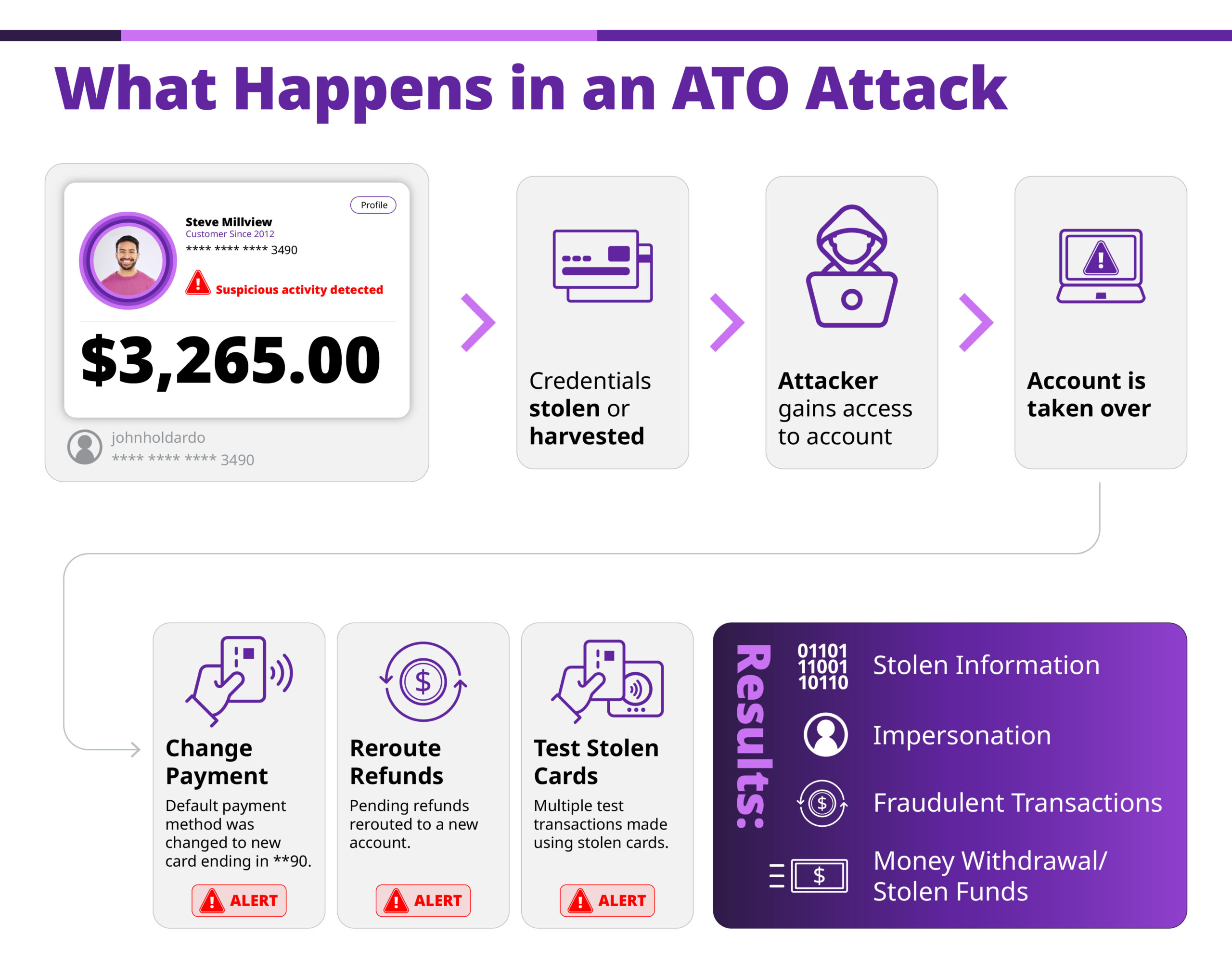
  • Account takeover (ATO) fraud is a business problem, not just a security issue: It drives direct losses, chargebacks and higher support volume while eroding trust in your portals and digital channels.
  • The FORTE framework gives you a simple way to organize defenses: Firewall and front-door controls, OTP, risk-based monitoring, tokenization and encryption give risk and ops leaders a shared language to discuss gaps and priorities.
  • You do not have to implement everything at once to make progress: Start by reviewing login flows, high-risk actions and how your payments partners handle tokenization and encryption, then build a phased roadmap to strengthen ATO defenses over time.

Account takeover (ATO) fraud is one of the most costly—and least visible—ways organizations lose customers and revenue. Instead of headline-grabbing breaches, ATO fraud often shows up as disputed payments, frustrated account holders and support teams left without answers. Why? Because on paper, the logins looked legitimate.

Attackers have learned that if they can get into a user’s account, they can move money, change contact details, enroll new cards and set up recurring payments—often without touching your core systems. That makes ATO fraud a high-impact threat for any organization that offers bill pay portals, customer portals or embedded payments inside software platforms.

Without E2EE, passwords stored in a database could be exposed to a breach, which puts users at risk of identity theft and financial fraud.

The FORTE framework introduced in this blog covers firewall protections, one-time passwords, risk-based monitoring, tokenization and encryption. This easy-to-follow framework gives risk, security and operations leaders a practical way to organize defenses. Read on to learn more.


The FORTE framework: 5 layers of ATO fraud defense

For risk, security and operations leaders, ATO fraud is a cross-functional problem. That is why it’s useful to have a simple way to explain defenses and tradeoffs to stakeholders who do not live in security tools all day. The FORTE framework is one way to do that.

F – Firewall and front-door controls: keeping bad traffic out

Your first line of defense is keeping obvious bad traffic away from your login pages and account features. You don’t need to be an infrastructure expert to understand the basics:

  • Web application firewalls (WAFs) block common attack patterns and suspicious requests before they reach your application.
  • Rate limits and velocity checks slow or stop bots that hammer your portal with credential stuffing attempts.
  • IP reputation and geolocation filters flag traffic from known bad networks or regions where you have no legitimate users.

Together, these front-door controls reduce automated attacks that ever reach your authentication logic. They won’t stop a targeted phish against a specific user, but they make bulk ATO campaigns much harder and more expensive to run. A practical first step is to ask your teams and providers:

  • Which WAF and front-door protections do we have in place today?
  • How do we tune rate limits to avoid locking out real users while frustrating bots?
  • How do we monitor for sudden spikes in login failures or suspicious requests?

O – OTP and stronger authentication: making stolen credentials less useful

If a password is the only barrier between an attacker and a customer account, you’re relying on the weakest link. Stronger authentication doesn’t have to add endless friction—it simply makes credentials alone insufficient for high-risk actions. Core options include:

  • One-time passwords (OTPs) by SMS or email for logins from new devices or locations
  • App-based or push authentication in a trusted mobile app
  • Step-up checks for sensitive actions like changing payment methods, updating contact info or enrolling in autopay

Used well, these controls make ATO far harder because stolen credentials are less useful without access to a device or inbox. Good questions to ask include:

  • Where do we use OTP or stronger factors today?
  • Do we challenge only at login, or also for high-risk actions?
  • How often do users abandon sessions due to friction?

The goal is to balance friction with risk.

R – Risk-based monitoring: spotting suspicious behavior before it becomes loss

Even with strong front-door controls and OTP, some takeover attempts will slip through. Risk-based monitoring helps catch them by assigning risk scores based on behavior and context. Key signals include:

  • New devices or browsers
  • Logins from unusual locations or networks
  • Sudden shifts like many failed logins, rapid password changes, or adding multiple new payment methods

With these signals, you can:

  • Prompt for extra verification when risk is high
  • Flag sessions for manual review
  • Temporarily limit high-value payments or changes to stored data

Behavioral analytics, device intelligence and simple rules can all support this layer. The goal is to move from a one-time yes/no login decision to an ongoing evaluation of whether a session still looks legitimate.

T – Tokenization: limiting the damage if accounts or data are compromised

No defense is perfect. If an attacker does manage to take over an account, the question becomes how much damage they can actually do. Tokenization helps answer that question in your favor.

Instead of storing raw card numbers or other sensitive payment details in your systems, tokenization replaces that data with tokens that are useless outside a specific context. A token replaces the underlying card information when you initiate payments, yet the actual card number lives in a secure vault managed by a trusted provider.

For account takeover scenarios, tokenization offers several advantages:

  • Even if an attacker gains access to an account, they cannot see or exfiltrate raw card data.
  • Backend systems that only work with tokens hold less sensitive information, reducing the blast radius if something goes wrong.
  • You can revoke or rotate tokens without forcing users to reenter full card details in many cases.

In a world where ATO is a persistent threat, limiting what an attacker can steal if they get in is just as important as keeping them out in the first place.

E – Encryption: protecting data in motion and at rest

For ATO, encryption matters in several ways:

  • Transport-level encryption (such as TLS) ensures that credentials and session cookies are not exposed to eavesdroppers as users log in or perform actions
  • Database and disk encryption make it harder for attackers to read sensitive data if they gain access to infrastructure or backups
  • Key management practices determine how easy it would be for a criminal to misuse encrypted data if they obtain partial access

When combined with tokenization, strong authentication and risk-based monitoring, encryption helps ensure that even successful account takeovers do not automatically turn into catastrophic data breaches.


Practical steps to strengthen your ATO defenses

No organization flips a switch and implements every element of the FORTE framework overnight. The point is not perfection. It is clarity.

The important thing is to move deliberately. ATO fraud is not going away, but you are not starting from zero.
If you rely on a payments platform or embedded payments provider, bring them into the conversation early. Ask how they support FORTE-style defenses and where they can take work off your plate so your teams can focus on the parts of account takeover fraud defense only you can own.

Taking these steps not only protects your customers and sensitive data, but also empowers your organization to outsmart fraudsters at every turn—because building your fraud-fighting FORTE is the strongest move you can make in today’s threat landscape.

Get Protected with CSG Forte

Ready to put FORTE to work and fortify your defenses against account takeover fraud? Check out what CSG PaymentsProtection.ai can do for you, then reach out to talk to the experts at CSG Forte to learn how to implement firewall protections, OTP authentication, risk-based monitoring, tokenization and encryption.


FAQS

Q1: What is account takeover fraud?

Account takeover fraud happens when a criminal gains control of a legitimate user’s account and uses it to make changes or perform transactions without permission. Instead of breaking your systems, they log in with stolen or guessed credentials, then update contact details, swap stored payment methods or move money. Because the activity often looks like a normal login, ATO can be hard to spot until customers complain or losses pile up.

Q2: How do you prevent account takeover fraud?

Preventing account takeover fraud starts with hardening the front door, then layering in smarter checks as activity unfolds. That means putting controls like web application firewalls, rate limits and IP reputation in front of your portals, then adding stronger authentication such as OTP or step-up challenges around high-risk actions. From there, risk-based monitoring, tokenization and strong encryption help reduce both the likelihood and the impact of ATO when it does occur.

Q3: How do you stop account takeover fraud in real time?

Stopping ATO in real time depends on your ability to spot risky sessions quickly, not just bad passwords. Risk-based monitoring that looks at device, behavior, location and velocity can flag suspicious logins or actions as they happen, then trigger extra verification, temporary limits or blocks. When your payments platform and security tools work together, you can challenge or shut down high-risk activity before it turns into confirmed loss.

Q4: How can enterprises prove account takeover fraud prevention reduces losses?

Enterprises can show the impact of ATO defenses by tying security metrics to business outcomes. That includes tracking ATO attempts versus successful takeovers, measuring changes in fraud write-offs and chargebacks over time and comparing loss rates before and after key controls like OTP, behavioral analytics or tokenization go live. When you line those numbers up with support volume and customer complaints, it becomes much easier to show how account takeover fraud prevention contributes directly to lower losses and a healthier digital business.

What You Need to Know About Multichannel Payments

Payments aren’t a “channel” anymore—they’re the connective tissue of the whole customer experience. Customers want to move from reminder to checkout to confirmation in a few taps. If they can’t, they’ll delay or abandon the transaction.

Today, customers use multiple channels to engage, transact and pay bills—and their expectations keep rising. McKinsey’s 2024 Digital Payments Survey found that 92% of U.S. consumers reported making some form of digital payment over the past year, a new high. These digital payments include transactions made in websites or apps, as well as in-store payments through digital wallets, alongside adjacent behaviors like person-to-person (P@P). This underscores why organizations need a consistent, low-friction experience across every touchpoint.

Customers appreciate the convenience and ability to make payments in multiple ways when transacting. They also expect seamless, personalized experiences from your business. Providing multichannel payment options is one way you can meet their needs.


What are multichannel payments work?

Multichannel payment processing refers to the ability to accept customer payments across various channels. It offers your customers the freedom and flexibility to make payments using their preferred methods and platforms. That could mean paying in-store, on a mobile app, over the phone, or online. Multichannel payments provide your customers with a consistent, streamlined experience while making things easy for you to manage with one synergized vendor and solution.

Efficient multichannel payment processing also makes it easy to track customer behavior, preferences, and purchase history across various channels. With that info, you can deliver better customer service, marketing, and overall experiences.


How do multichannel payments work?

Multichannel payments offer a convenient experience no matter the path your customers choose. A customer may use your services or purchase your products and want to transact in a unique way. With a multichannel payment solution, you can make the switch between channels seamless.

Your customers can pay on their preferred channel—email, text, interactive voice response (IVR) or via a live agent—and switch at any point. You can simplify the payment process for your customers and merchants while keeping interactions personalized.

Multichannel payments link all your touchpoints through an integrated platform. This makes payments highly personalized and focused on your customer’s preferences.


What Are Multichannel Payment Processing Channels?

Typical multichannel payment processing channels include phone, in-person, email, and text.

1. Phone payments

Pay-by-phone IVR solutions allows you to accept payments 24/7. Leverage innovative speech-recognition and touch-tone technology to empower customers to make rapid payments using self-service capabilities.

Your customers can connect to your system at any time from any phone, following prompts to complete transactions. IVR payment methods provide frictionless payments and shorten your collection time. The self-service functionality will free your staff to focus on more urgent matters.

2. In-person payments

Speed up in-person payment processing with advanced contactless payment technology that makes point-of-sale (POS) purchases a breeze. Digital bill payment methods will continue to grow, but in-person transactions are still the preferred pay point for many consumers.

A contactless system enhances the offline payment experience, helping customers pay bills securely and efficiently while on the go. You can opt to integrate award-winning POS solutions with your current system or use the enterprise-grade POS terminals as standalone devices.

3. Email payments

Leverage email payment link technology to streamline billing for your customers. To accept payments through this channel, you need a trusted payment services provider (PSP) to set up a secure system that enables you to send customers a safe email link. This email link will take customers to an encrypted hosted page or NanoSite where they can make payments online. The link will also work when sent via text or through social media.

You can accept email payments even if your business doesn’t have a website. Email payment processing is versatile and quick. It removes barriers to sale and reduces late payments by supporting them via multiple methods, including:

  • Digital wallets
  • Credit cards
  • Debit cards

4. Text payments

Text-to-pay capabilities enable customers to make payments via SMS and MMS. When a customer initiates a bill payment, they’ll receive a message with a secure link. This encrypted link will take the customer to a secure gateway or NanoSite to complete the transaction, offering a seamless payment solution.

Text payments are opt-in services that help customers conveniently pay when you message them, reducing your past-due payments.


What is a multichannel payment platform?

A multichannel payment platform helps you manage multiple types of payments in one place. CSG Forte Engage provides secure, frictionless payment methods, allowing your customers to pay using their preferred channel anytime. This integrated platform offers:

  • Multichannel payments: Give your customers the power to pay at multiple touchpoints and via email, text, IVR, or live agents—with the option to switch throughout the payment process seamlessly. Enable customers to select payment options like autopay for recurring fees or installment payments.
  • Secure payment options: The live agent assist feature allows your contact center staff to create online invoices and send them directly to customers. With cutting-edge NanoSite technology, clients can securely complete transactions without sharing banking details or credit card information across multiple channels. This approach reduces the risk of sensitive information leaking.
  • Customized payment journeys: Rapidly deploy personalized payment journeys for your customers. Branded payment journeys can be activated for one-time, recurring, or future-date payments. You can send invoices with payment prompts, confirmations, or late payment notifications to a customer’s channel of choice.


The benefits of CSG Forte’s multichannel payment platform

Innovative multichannel payments offer your business several advantages. When you leverage our platform for multichannel payments, you can benefit from:

  • Fast implementation: Advanced solutions enable low-to-no coding, meaning integration takes days, not months.
  • Convenient automation: Multichannel payments reduce repetitive tasks through automation while still providing highly personalized customer experiences.
  • Secure transactions: Custom payment pages or NanoSites allow customers to transact with your business quickly and securely, reducing late payments.
  • High adoption rates: Multichannel payments increase self-service capabilities and encourage the adoption of digital payments, minimizing the costs associated with some offline payments.
  • Seamless testing: Your business can leverage multichannel payment capabilities to split-test elements of the payment journey. See what best works for your customers and use it to enhance their experience.


Partner with CSG Forte for secure multichannel payments

At CSG Forte, we leverage decades of experience to help your business scale payments and grow with smart, unified payment solutions. Our payment platform is designed to meet your ever-changing needs and customer preferences.

Want to learn more about how we can help you simplify and scale your multichannel payment capabilities? Get started by connecting with our team.

Modernize the Government Payment Experience for Residents by Adding Online Payments

Key Takeaways

  • Modern government payment experience drives on-time revenue. When agencies integrate web, mobile, IVR and text-to-pay into a single platform, residents can move from reminder to payment in a few clicks—reducing delinquencies and call volume.
  • Secure, user-friendly portals build public trust. A modern online bill pay experience that’s mobile-first, PCI-compliant and easy to navigate makes residents more likely to pay your bill before less convenient ones.
  • Multi-channel reminders boost engagement and collections. Letting residents choose email, text or automated voice reminders—and pairing those with personalized payment links—helps governments reach more people, increase completion rates and lower staff workload.

Providing a smooth payment experience is key if you want residents to pay taxes, utilities, fees and fines on time. But meeting public expectations is easier said than done.

People increasingly expect payments to be digital, fast and easy—70% of U.S. consumers prefer to receive payments digitally, and 73% prefer to shop and pay using digital methods, according to recent research. At the same time, security and convenience are now the top decision factors in how people choose to pay their bills.

In 2023, more than nine in 10 consumers used at least one form of digital payment over the course of the year. And even though U.S. households received about 9.1 billion bills by mail in 2023, 80% of those bills were ultimately paid electronically. What’s more, for the first time, more than half of all household bill payments were made online. The good news: a few practical changes can dramatically improve your residents’ experience and help your agency collect revenue more reliably. Follow these four best practices to deliver a secure, convenient digital payment experience that reduces friction and supports on-time payments.


4 best practices to improve the government payment experience

Modernizing the government payment experience doesn’t have to be overwhelming. By focusing on practical, resident-centered improvements, agencies can make paying bills simpler and more secure—encouraging on-time payments and reducing frustration for both residents and staff. Here are four actionable strategies to help your organization deliver a modern digital payment journey.

1. Seamlessly integrate your payment channels

  • Aim for a flow where a resident gets a text or email with a secure link, taps once and lands on a mobile-friendly page where they can pay in just a few clicks.
  • When you integrate web, mobile, IVR, text-to-pay and agent-assisted payments into a single platform, staff see one source of truth, residents move directly from reminder to payment, and your agency fields fewer “how do I pay this?” calls.

The payoff: more completed payments, fewer delinquencies and less time spent chasing balances.

2. Treat the payment portal like a critical service touchpoint

For residents, your payment portal is one of the most visible ways they experience their city, county or state.

  • Security and convenience are two top factors consumers often cite when choosing how to pay their bills.
  • If your portal is slow, cluttered or not optimized for mobile, many residents will delay paying or prioritize “easier” bills first.
  • Accessibility issues—language, readability, mobile responsiveness—can hit lower-income and older residents hardest.

A modern, mobile-friendly portal with clear steps, plain language and saved payment methods makes it more likely your bill moves to the top of the stack instead of the bottom.

3. Earn public trust with a secure payment platform

Agencies handle sensitive resident data every day. If people don’t trust your payment system, they’ll avoid it and fall back on more manual, expensive channels.

  • Card-not-present fraud (online and phone payments) now accounts for roughly 71% of all card fraud losses, or about $10 billion in 2024, and is expected to remain about three-quarters of total card-payment fraud.
  • Security has become the single most important feature for many bill payers.

Look for a platform that:

  • Uses IVR and self-service to protect card data.
    • Inbound IVR: residents enter card or bank details via keypad instead of reading them aloud.
    • Outbound IVR: residents receive an automated balance reminder and can pay securely in the same call.
  • Keeps agent-assisted payments secure by letting staff send one-time, secure payment links via text or email so residents enter card data directly—staff never see or handle it.
  • Leans on built-in PCI compliance and tokenization, so sensitive data is secured by a specialist provider, your compliance scope shrinks and staff can focus on serving residents, not managing security configs.

4. Reach residents on the channels they actually use

If you’re only sending reminders through a channel residents rarely check, you’re increasing the odds of late payments.

  • Text messages have open rates around 90–99%, compared to roughly 20–33% for email.
  • About 79% of consumers are opted in to receive texts from businesses, signaling a strong preference for text-based communication.

For governments, that means:

  • Residents are far more likely to see a text about a tax deadline, court date or utility bill than a single email or mailed notice.
  • Multi-channel outreach—text, email and automated voice—dramatically improves the chances reminders arrive before the due date.
  • Let residents choose their preferred channel and use it consistently for reminders, confirmations and past-due notices.


How CSG Forte helps public agencies modernize the payment experience

CSG Forte’s payment platform is designed to meet residents where they are—whether they’re paying property taxes, utility bills, permitting fees or court fines.
With one secure, low-code platform, your agency can:

  • Enable any-time, any-way payments: online, mobile, IVR, text-to-pay and agent-assisted.
  • Manage invoice creation, payment processing and notifications across channels from a single interface.
  • Reduce your exposure to sensitive card data with PCI-compliant processing and tokenization.

Give residents a consistent, user-friendly experience whether they’re on a phone, laptop or at the counter.

You can invite residents to opt in to reminders, confirmations and late notices on their preferred channels, then use calendar-aware workflows to send personalized payment links when you know they’re most likely to see—and act on—them.

If your city, county or state agency is looking to simplify bill payments, improve the resident experience, reduce fraud exposure and encourage on-time payments, CSG Forte can help. Check out our eBook focused on improving government payment services.

Contact us to learn how CSG Forte can support your team and your community.

Defending Payments in an AI Fraud Era

Key Takeaways:

  • Payment fraud is accelerating and evolving. Losses are projected to reach $91 billion in 2028, and nearly 80% of organizations reported attacks or attempts in 2024. Fraud is no longer occasional; it’s global, complex and relentless.
  • AI is a double-edged sword. Businesses use AI to fight fraud, but bad actors also leverage AI to automate fraud, create synthetic identities and launch sophisticated phishing campaigns that evade traditional detection.
  • Modern fraud protection requires agility and intelligence. Businesses need solutions that deploy quickly, adapt to unique transaction patterns and provide full visibility with customizable controls—backed by expert support to stay ahead of evolving threats.

The payments industry is under siege. Fraud is no longer an occasional nuisance. It’s accelerating at unprecedented speeds, becoming increasingly sophisticated and harder to detect. For businesses that accept online payments, it often feels like playing a relentless game of whack-a-mole. As soon they address one threat, another emerges.


The cost of payment fraud is growing

Scams, account takeovers and fake identities drive most payment fraud schemes. Recent industry research underscores the scale of the problem:

  • $362 billion: Projected global losses from online payment fraud between 2023–2028, with $91 billion expected in 2028 alone.
  • 79% of organizations reported being victims of payment fraud attacks or attempts in 2024.
  • $534 billion: Average amount forfeited in 2024 among business leaders surveyed. This is equal to 7.7% of annual revenue.

The bottom line: Fraud is not just costly, it is evolving, complex and global in scope.


Even fraudsters are using AI

Businesses are increasingly seeking partners who are leveraging artificial intelligence (AI) in their fraud protection tools.

Unfortunately, bad actors are also tapping AI to steal billions of dollars. Fraudsters employ machine learning algorithms to identify patterns in transaction data, initiate account takeovers and automate fraud schemes. They can also generate synthetic identities that are difficult to detect, even with newer fraud protection tools.

AI tools also enable fraudsters to launch sophisticated phishing campaigns that optimize the timing and volume of fraudulent transactions. These tools even evade traditional rule-based detection systems that cannot effectively respond to novel attack patterns. This means that fraud is no longer just opportunistic; it’s intelligent. That’s why having proper security mechanisms in place is paramount for businesses. Fraudsters are calculated and adaptive, and they are scaling at the same speed as legitimate digital payments.


Prominent payment fraud types

The types of payment fraud emerging today are highly diverse, targeting businesses of every size and across all industries. Businesses, merchants and independent software vendors must understand common attack methods fraudsters use. This is a key first step to integrating fraud protection capabilities.

Common threats

  • Excessive payment fraud/refund fraud
    • What it is: Customers deliberately or accidentally submit payments exceeding owed amounts, later requesting refunds.
    • Why it matters: It creates significant financial losses through credit card and Automated Clearing House (ACH) chargebacks. It also damages processors’ and merchant networks’ credibility.
  • Merchant bust‑out fraud
    • What it is: Fraudulent merchants or impersonators rapidly process a high volume of irregular transactions before disappearing.
    • Why it matters: Merchants risk chargebacks, inflated fees and refund abuse. This disrupts cash flow and causes financial distress. It is especially problematic when high-dollar amounts funnel to unauthorized accounts.
  • Merchant credit events/defaults
    • What it is: Intended or unintended payment defaults by a merchant. Causes include disputes, chargebacks, returns, mismanaged cash flow and weak financial positioning.
    • Why it matters: Defaults lead to financial instability, credit events, missed payments and bankruptcies.
  • Customer payment fraud
    • What it is: Customers or impostors initiate payments with fraudulent intent, followed by recalls or refund requests that redirect funds to illegitimate channels.
    • Why it matters: Leads to refund leakage, chargeback disputes, and erodes trust in payment integrity.

More advanced fraud

  • Account takeover (ATO) fraud
    • What it is: Fraudsters steal credentials or run phishing scams to access merchant or customer accounts.
    • Why it matters: Causes direct financial theft, reputational damage, financial losses, potential bankruptcies and regulatory exposure.
  • Anti-money laundering (AML) violations
    • What it is: Illegally obtained funds move through legitimate payment channels to obscure their origins.
    • Why it matters: Brings serious compliance and regulatory consequences, including mandatory reporting, penalties, closures and reputational damage.
  • Card testing fraud
    • What it is: Fraudsters test stolen or generated card numbers with small transactions to identify valid working accounts.
    • Why it matters: It increases payment declines and makes processing more expensive. It also opens doors to bigger attacks that can lead to serious financial problems.


Where today’s solutions fall short

Many businesses rely on established fraud prevention tools. They often fall behind increasingly sophisticated fraud attacks. The biggest gaps in traditional systems include:

  • Slow response times: Older systems cannot keep up with fast-growing payment volumes. Without real-time detection, threats slip through and cause losses.
  • Poor customer experience: Outdated models often flag legitimate transactions as fraud. This leads to delays, declined payments and frustrated customers who expect smooth, secure payments.
  • Generic tools: One-size-fits-all solutions do not match the unique risks of different industries. Without customizable rules and thresholds, businesses either block good payments or miss high-risk ones.
  • Rigid systems and long deployments: Many “customizable” tools take months to implement, cost a lot to maintain and require internal teams for every update. Adapting to new fraud patterns becomes slow and expensive.
  • Costly in-house builds: Some businesses try building their own solution. They quickly discover that it demands constant investment, specialized skills and resources that pull focus from core operations.
  • Fragmented protection: Digital payments span multiple channels and regions, but many tools only cover part of the fraud landscape. Disconnected systems create blind spots, delays and inconsistent results.


What businesses need in modern fraud protection solutions

Risk management has transformed from a back-office function to strategic necessity and businesses need better support. Fortunately, new providers are challenging the status quo. They are taking a different technological and process approach to fight payment fraud. Key capabilities to look for in a fraud tech partner include:

  • Ever-learning technology: AI-powered platforms that continuously adapt to emerging risks. These platforms learn from new, diverse data without requiring heavy technical overhauls. This significantly reduces false positives, improving customer experience and driving stronger return on investment for businesses.
  • Implementation efficiency: In fraud prevention, speed is critical. Fraudsters exploit any delay. It is important to set up quickly with little effort required from the client. After implementation, ongoing support and expert guidance help businesses stay ahead of fraud.
  • Nimble customization: Customizable systems that adapt to unique transaction patterns and industry needs give businesses detailed, optimized protection.
  • Comprehensive coverage: Robust protection across fraud vectors, payment types, channels and geographics with processor-agnostic deployment gives businesses maximum flexibility as their priorities evolve.
  • Transparency and control: Clear decision logic, adjustable risk thresholds, detailed reporting and API integration deliver actionable insights for effective payment fraud prevention.


Partnering for protection

The payments landscape will only grow more complex. Businesses should look for a partner that offers intelligent technology with these key attributes. They should also look for consultative risk management that improves their tools and processes without the outsized price tag.

CSG Forte is on the forefront of addressing payment fraud schemes. Our payment fraud protection tools can help your business stay ahead of bad actors. Learn how to keep legitimate payments flowing smoothly while stopping fraudulent activity in its tracks. Explore the CSG Forte website and sign up for a demo.

How to Improve the Customer Payment Experience

Key Takeaways:

  • Simplify payment processes without sacrificing security. Modern solutions streamline transactions while maintaining robust fraud protection.
  • Flexibility drives better customer experiences. Tailored tools and consultative support help organizations adapt quickly to changing needs.
  • Efficiency impacts the bottom line. Faster deployment and integrated insights reduce costs and improve operational performance.

Customers today have more ways to pay than ever. Credit and debit cards, ACH, digital wallets and pay-by-text continue to gain popularity. But that doesn’t mean interactive voice response (IVR), cash or paper checks have become obsolete (yet). That abundance of choices comes with higher expectations. Your customers don’t just compare you to your competitors; they compare you to the best digital payment experiences they use every day.

One of the most powerful ways to set your company apart is to make paying you simple, secure and stress-free. That’s what a modern payment solution does.


What is the payment experience?

The payment experience is the part of the customer journey where intent becomes revenue.

It’s everything that happens from the moment a customer decides to pay—whether that’s checking out online or paying a bill—to the instant they receive a confirmation. A strong customer payment experience feels almost invisible: customers glide from “I owe a payment” to “I’m done” without friction, confusion or worry.

A complete customer payment experience includes:

  • Accepted payment methods: Cards, ACH, digital wallets and other flexible payment options that match how your customers prefer to pay.
  • Saved payment preferences: The ability to securely store cards or bank accounts, set defaults and avoid retyping information every time.
  • Automation and flexibility: Options like autopay, recurring payments, payment plans and installments that reduce effort and late payments.
  • Security and trust signals: Visible assurances that payment data is protected—PCI compliance, encryption, recognizable payment brands and clear privacy messaging.
  • Notifications and transparency: Proactive reminders, real-time confirmations and easy access to payment history so customers always know what’s due and what’s been paid.

When these components work together, paying becomes a natural extension of the customer relationship instead of a stumbling block at the finish line.


Why optimize the payment experience?

Picture this: you’re shopping online and you’ve built a cart you’re excited about. At checkout, you look for your preferred payment method—a digital wallet you use everywhere else. But the only option available is a physical card you left in another room.

You could get up and grab it. But there’s a good chance you’ll tell yourself you’ll “come back later” and abandon the purchase instead.

The same thing happens in bill pay. If customers need to dig up an account number, remember a login or call a number between 8 a.m. and 5 p.m. just to pay, many will delay—or not pay at all.

That’s why optimizing the customer payment experience has a direct impact on your business.

Build security and trust into every transaction

Customers are more cautious about sharing payment information than ever. They want to know:

  • Who is processing their payment
  • How their data is being protected
  • Whether your site or portal is legitimate and trustworthy

If your payment flow looks outdated, redirects to unfamiliar domains or fails to clearly communicate security measures, customers may hesitate or abandon the process altogether.

A strong customer payment experience:

  • Keeps sensitive data out of your environment using tokenization and secure vaults.
  • Displays clear security indicators and recognizable payment brands.
  • Uses trusted, PCI-compliant providers behind the scenes.

When customers trust your payment experience, they’re more willing to store credentials, set up autopay and come back again.

Increase customer satisfaction (and reduce frustration)

Customers rarely separate “the payment part” from “the rest” of their experience with you. If the checkout or bill pay process feels hard, that frustration colors their view of your entire brand. And it could lead to cart abandonment.

Common pain points include:

  • Having to re-enter the same information over and over
  • Long, confusing forms and multiple steps
  • Poor mobile experiences
  • Limited payment options that don’t match how they normally pay

On the other hand, when the payment experience is fast, intuitive and available wherever they are—on their phone, laptop or via text—customers remember it as a brand that is easy to do business with. That directly influences satisfaction scores and future purchasing decisions.

Reduce late payments and abandoned carts

Friction causes delay. Every additional step, login or channel switch becomes another reason for a customer not to finish the payment right now.

A better payment experience:

  • Stores payment methods securely for one-click checkout or bill pay.
  • Offers autopay for recurring obligations so customers don’t have to remember due dates.
  • Makes it easy to pay from a reminder—click a link in a text or email and complete payment in seconds.

That translates into fewer abandoned carts, fewer late or missed payments and more predictable cash flow for your business.

Accelerate cash flow and reduce operational cost

When it’s easy to pay online, fewer customers rely on paper checks, call centers or in-person visits. That:

  • Speeds up the time from invoice to cash.
  • Reduces manual processing and reconciliation.
  • Lowers the volume of “how do I pay this?” calls to your team.

In short, a seamless payment experience supports both top-line growth and operational efficiency.


How to create a seamless payment experience

Building a better payment experience isn’t about adding a long list of features. It’s about designing a simple, flexible journey that matches how your customers already live and pay.

Here are key steps to get there.

Accept the payment methods your customers expect

Don’t lose customers at the last step because you only accept one or two ways to pay. The right mix depends on your industry and audience, but often includes:

  • Credit and debit cards
  • Automated Clearing House (ACH)/bank transfers
  • Digital wallets (like Apple Pay or Google Pay)
  • Pay-by-text or pay-by-link options

Give customers the ability to choose what fits their needs today, and change it later as their preferences evolve.

Make paying effortless with stored credentials and autopay

Every time a customer has to find a card, type long numbers on a mobile screen, or look up a routing number, you introduce friction.

You can reduce that friction by:

  • Letting customers securely store their preferred payment methods
  • Offering autopay for recurring bills or subscriptions
  • Supporting installment or partial payments where appropriate
  • Allowing customers to switch between payment methods when cards expire or accounts change

Customers get convenience and control. You get more on-time, completed payments.

Put security and compliance front and center

Security isn’t just a behind-the-scenes requirement—it’s a visible part of the experience that shapes customer confidence.

A modern payment platform should:

  • Use tokenization so your systems never store raw card or bank data
  • Maintain PCI compliance and other required certifications
  • Support strong customer authentication where needed
  • Provide tools to detect and mitigate fraud without adding unnecessary friction

Communicate this clearly in your payment experience with reassuring copy, recognizable trust marks and consistent branding across all payment pages.

Meet customers on their preferred channels

Your customers don’t live in a single channel, and your payment experience shouldn’t either.

Look for a solution that supports:

  • Online payments through your website or portal
  • Mobile-friendly checkout on phones and tablets
  • Pay-by-text (SMS) with secure links that go straight to a hosted payment page
  • IVR and phone payments for customers who prefer to call in
  • Agent-assisted payments where staff can send secure links without ever seeing card data

When customers can move from a reminder in their inbox or text messages directly to a secure payment screen, you eliminate extra steps and excuses.

Keep customers informed with clear notifications

Communication is a core part of the payment experience. Customers should always know:

  • When a bill is due
  • When a payment is successful or fails
  • What their current balance and history look like

Use automated notifications to send reminders, confirmations and alerts across channels. Make it easy for customers to view their history and update preferences without contacting support.


Payment experience in action

Organizations that move from fragmented tools to an integrated payment platform see tangible results:

  • A financial services company that introduced coordinated text and email reminders with secure payment links saw millions of dollars in additional collected revenue from previously past-due accounts.
  • A security services provider that expanded its digital payment options and streamlined its checkout flow recorded an 85% reduction in payment arrears in just one month, simply by making it easier for customers to pay on time.

While every business is different, the pattern is consistent: when you reduce friction and increase choice, customers respond.


Choose CSG Forte to modernize your payment experience

Modernizing the payment experience doesn’t have to mean rebuilding everything from scratch. With the right partner, you can add powerful capabilities while keeping your existing systems in place.

CSG Forte Engage, our payer engagement platform, is built to help you:

  • Offer any-time, any-way payments—online, via SMS, by phone and through IVR
  • Manage invoices, notifications and payments from a single secure platform
  • Reduce friction with stored payment methods, autopay and email experiences
  • Protect sensitive data with PCI-compliant, tokenized processing
  • Deliver a consistent, branded payment experience across every channel your customers use

A great payment experience doesn’t just help you get paid faster. It’s a powerful way to differentiate your business, deepen customer loyalty and make every interaction feel easier.

Ready to make paying your business the easiest part of your customers’ day?

Contact CSG Forte to see how we can help you streamline your payment processes and deliver a seamless payment experience from the very first transaction.

How CSG Forte Powers Long-Term Growth: The NCMS Success Story

Key Takeaways:

  • CSG Forte’s stability and innovation help partners like National Cash Management Systems (NCMS) achieve long-term growth and peace of mind.
  • CSG Forte’s single-source platform simplifies payments, reduces risk and streamlines compliance.
  • CSG Forte’s commitment to continuous improvement ensures partners are ready for the future of online payments among several industries, including healthcare providers.

When it comes to accepting secure online payments, uncertainty is the enemy of progress. For many organizations, the difference between thriving and merely surviving comes down to the reliability of their payment partner. And while payment processors come and go and industry shifts can upend businesses overnight, National Cash Management Systems (NCMS) founder Scott Lewis has long relied on CSG Forte as a constant in the often-unstable payments industry—delivering stability, innovation and peace of mind year after year.

The story of CSG Forte’s 26-year partnership with NCMS is proof that partnering with a secure online payments provider can transform how businesses operate, adapt and grow. Through market upheavals, regulatory changes and evolving customer expectations, CSG Forte has empowered NCMS to not only weather the storms but to accelerate growth and simplify complexity.

The NCMS and CSG Forte success story isn’t just about payment technology—it’s about trust, partnership and results. This article will explain how CSG Forte’s commitment to reliability and forward-thinking solutions help NCMS stand out in a competitive market. This includes one of NCMS’s customers that was able to triple monthly transaction totals, achieve a 125% increase in volume and deliver the kind of seamless payment experiences that today’s organizations demand.


CSG Forte: Stability and security that lasts

CSG Forte provides the backbone of NCMS’s payment operations with its secure, scalable payment platform that adapts to industry changes. When other processors faltered, Scott said, CSG Forte continued to deliver consistent reliability—helping NCMS and its clients avoid costly disruptions and focus on what matters most: their customers.

Key capabilities in the CSG Forte and NCMS partnership includes:

  • Single-source payment platform: CSG Forte’s all-in-one solution simplifies operations, reduces risk and streamlines compliance for partners like NCMS.
  • Continuous innovation: CSG Forte integrates new payment methods and technologies, ensuring partners stay ahead of industry trends and regulatory requirements.
  • Dedicated support: CSG Forte’s hands-on service helps partners resolve issues quickly and optimize their payment strategies for long-term success.


Navigating an unstable payments industry

NCMS’s experience reflects a common challenge: instability among payment processors. Frequent changes and failures forced merchants to juggle multiple providers, increasing complexity and risk. CSG Forte’s partnership with NCMS solved this problem by offering a stable, reliable platform that could grow with their business.


A modern, single-source platform in action

By leveraging CSG Forte’s technology and expertise, NCMS was able to:

  • Consolidate payment channels for greater efficiency.
  • Simplify onboarding and reporting for easier compliance.
  • Benefit from ongoing product improvements and responsive support.

This partnership empowered NCMS to deliver seamless, secure payment experiences to its clients while maintaining the flexibility to adapt as needs evolved.


Clear growth driven by CSG Forte

NCMS shared volume and revenue metrics from one of its merchant clients that accepts online healthcare payments. The impact of CSG Forte’s platform includes:

  • Average monthly transaction growth: from 40,820 in 2021 to 91,831 between 2021 and 2025.
  • Monthly transaction total increases: from $3.93 million to $12 million.
  • Continuous improvement:
    • ~20% annual growth rate increase
    • 125% increase in transaction volume
    • 3X growth in monthly totals.


Why choose CSG Forte?

  • Reliability: CSG Forte’s platform delivers consistent, secure payment processing that partners can trust.
  • Innovation: Stay ahead with integrated solutions and new payment methods.
  • Support: Dedicated, hands-on service to simplify compliance and resolve issues quickly.
  • Growth: Proven results—partners see increased transaction volume, streamlined operations and lasting peace of mind.

The online payments landscape is known as one where the only certainty is constant change, and finding steadfast partners can seem elusive. That’s why the collaboration between NCMS and CSG Forte is particularly illustrative of the transformative power shared vision and commitment brings to a partnership. The shared journey is not just a story of improved payment operations; it’s a blueprint for organizations eager to embrace innovation without compromising reliability.

By combining cutting-edge technology with personalized service, CSG Forte and NCMS have built a partnership that not only meets today’s complex demands, but also anticipates the challenges merchants will face tomorrow. For organizations that aspire to minimize risk, maximize efficiency and drive sustainable growth, the choice of partner is more crucial now than ever before—and NCMS and CSG Forte demonstrate exactly what’s possible when trust and innovation converge.

Are you ready to redefine what’s possible in your payment partnership? Whether you’re looking to accept online healthcare payments or secure online payments in another industry, it’s time to take the first step. CSG Forte’s experts can guide you toward seamless transactions, robust support and future-ready solutions. So, reach out today; whether you’re seeking to streamline operations, safeguard your revenue or unlock new avenues for expansion, our team is here to empower your organization every step of the way.