How Can Embedded Payments Improve Your Business?

Many new businesses and entrepreneurs face problems with payment processing. This is mainly because they do not know about the different payment solutions available. Because payment technology constantly evolves, selecting a solution that offers the most advantages to your operation is critical.

Using a reliable payment service provider is helpful. It lets you enjoy in-house payments. You don’t have to set it up on your own.

CSG Forte can help your company accept many payment methods. This is true no matter how you do business with your customers. Our cloud-based solutions let you manage all your payments in one place. This includes debit cards, credit cards, in-person purchases, and ACH transactions.


What is an embedded payment solution?

Embedded payment solutions allow businesses to accept credit or debit card payments directly into their existing software platform. They can link your payment systems to other important parts of your business. This includes your customer service management (CRM) program, payroll, and accounting functions.

One main benefit of these solutions is that they reduce the steps needed to manage your payments. They do this through automated accounting and recordkeeping.

Because the system posts payments for you, there’s no need to reconcile invoices or balance your general ledger later. Integrated payment solutions also work with banks to automatically process the incoming payment information.


Why should companies switch to Embedded payment solutions?

Businesses that implement embedded payment solutions into their operations experience instant benefits, including:

  • Security: Integrated payment solutions require fewer people to access your most sensitive financial data. They also eliminate manual entry, making them less susceptible to theft or interception. These systems have safeguards that make it safer to store valuable data. They use encryption to deter cybercriminals.
  • Revenue optimization: Companies can complete transactions and process invoices instantly using integrated payment solutions. Getting and posting payments quickly helps cash flow. This allows companies to build better relationships with customers, vendors and banks. It also boosts profitability.
  • Fewer errors: Calculation errors often lead to significant accounting problems and inaccuracies with revenue reporting. Integrated payment processing reduces these issues by eliminating double transactions and automatically relaying transaction information to the proper destination.
  • Streamlined operations: With integrated payments solutions, businesses can improve efficiencies in their accounting processes, eliminating the need to enter and reconcile transaction data manually. The platform automatically posts payments at the time of the sale. It shows transactions in real time. This makes accounting easier and more accurate. It also gives quick access to sales data.
  • Better customer experience: Quick transactions are a major concern for customers. They often affect how satisfied they feel and if they will come back to do business again. Customers often leave a store when they encounter long lines or potential checkout problems. An integrated payment solution helps increase checkout times by eliminating many time-consuming factors associated with manual checkout.


Benefits of partnering with CSG Forte

CSG Forte’s cloud-based solutions enable you to streamline payment management and increase your operational efficiency, including transaction monitoring, enhanced analysis and dispute management. Programs like Dex allow you to manage your payment operations in one location to save time and money. You can see your payment processes more clearly. This helps you do things like:

  • Cancel charges
  • Give refunds
  • Change payment methods
  • Meet other customer needs

At CSG Forte, we help our clients grow their businesses quickly and profitably. We do this by offering great payment platforms.

We create solutions that work well with your current network. We use our top technology and many years of experience. We provide everything you need to accept and manage payments anytime or anywhere.

We also offer customer support options to fit your needs, from intuitive self-service to round-the-clock assistance.


Contact the professionals at CSG Forte today

CSG Forte works with top software companies. They provide the best business automation, payment processing, and other solutions. Let our experts show you the advantages our integrated payment solutions can offer your business. Connect with us today to get started.
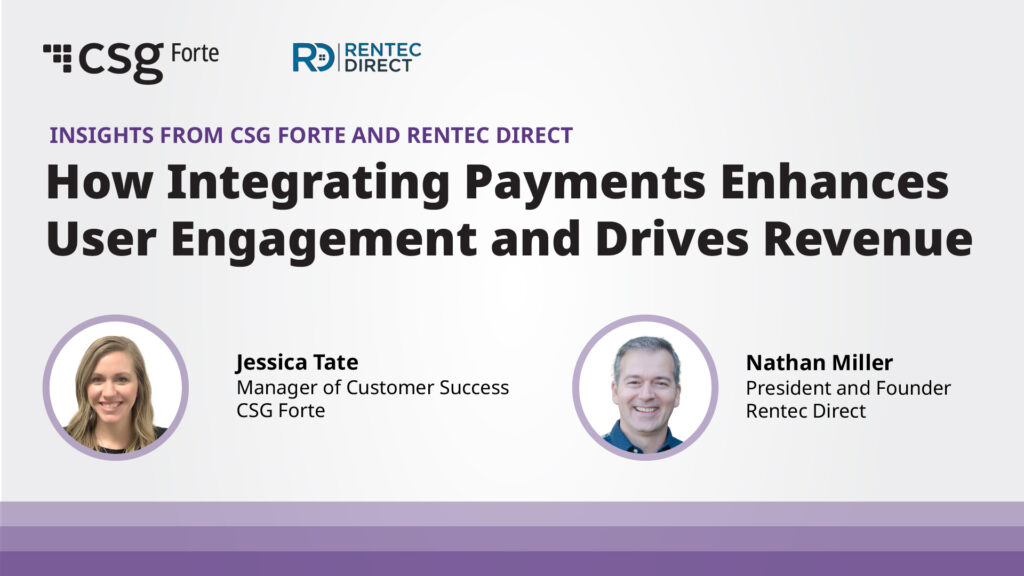

How Integrating Payments Enhances User Engagement and Drives Revenue: Insights from CSG Forte and Rentec Direct

Seamless payment integration is no longer a luxury; it’s a necessity for software companies. By embedding payment capabilities directly into their platforms, businesses can offer a more streamlined and efficient user experience, ultimately driving engagement and revenue.

In a recent podcast featured in Payments Journal, Jessica Tate from CSG Forte chatted with Nathan Miller, president and founder of Rentec Direct, and Don Apgar, director of merchant payments at Javelin Strategy & Research, about the transformative power of integrating payments into software platforms. The podcast, titled “How Integrating Payments Enhances User Engagement, Drives Revenue,” highlighted the numerous benefits of payment integration and why CSG Forte is the ideal partner for software companies looking to enhance their offerings.

Jessica, Nathan and Don shared their insights on how payment integration can revolutionize software platforms and why partnering with a reliable payment processor like CSG Forte is crucial for success.


Enhanced User Experience

One of the primary benefits of integrating payments into software platforms is the enhanced user experience. As Jessica explained, “There are a multitude of benefits for software businesses to work with a partner in integrating payments into their business, one of them being the enhanced user experience seamless transactions, where the capabilities are embedded directly into their software and allows users to make payments without leaving the platform a one stop shop improving the user experience.”

By offering multiple payment options—such as Automated Clearing House (ACH), credit card and debit card—software companies can accommodate diverse customer preferences, making it easier for users to complete transactions.

Nathan echoed this sentiment, emphasizing the importance of simplicity and ease of use. “One of the challenges we’ve had is, how do we make this technology and make it easy for someone to make a rent payment, or, better yet, schedule a rent payment online without having to learn a system or learn a payment processing system, and just make it a couple clicks—really, really easy.” By integrating payments, software companies can provide a seamless and intuitive payment experience, reducing friction and enhancing user satisfaction.

“Especially in the software space, when we talk about customer experience, there are really two layers of the customer experience—the merchant … and the end user,” Don said. “And this is pretty typical in the software space. The software provider has a double-pronged challenge: to make it easier for the merchant, who is their direct customer, and also easier for the end user, who is their indirect customer.”


Increased Revenue Opportunities

Integrating payments into software platforms also creates new revenue opportunities. Jessica highlighted the potential for revenue sharing models and upselling additional products or services. “Some payment partners offer revenue sharing models while others were billing the merchant directly,” she explained. “Or we can build a partner, and the partner will, in turn, build their merchants. That also comes into upselling and cross selling, whether there are different opportunities offering additional products or services.”

Don reported that Javelin research indicates that more software companies are realizing accepting payments online can be a revenue driver for their business. By working with a reliable payment partner, software companies can unlock new revenue streams and drive growth. Nathan shared how Rentec Direct has experienced significant growth by integrating payments into their platform. Companies like Rentec, which handles all aspects of property management between landlords and tenants, are able to scale rapidly by beginning to accept payments, Nathan explained. “The number one reason [property managers] come to us is to accept online payments. We have more people signing up for the Payment Capabilities than anything else.”

By offering integrated payment capabilities, Rentec Direct has not only attracted new customers but also helped their existing customers grow.


Improved Security and Compliance

Security and compliance are critical considerations when integrating payments into software platforms. Jessica Tate emphasized the importance of data encryption and compliance with industry standards. “We also have data encryption, and compliance ensures secure handling of sensitive payment data, and it helps maintain trust with the users as well.” By partnering with a payment processor like CSG Forte, software companies can ensure that their payment solutions adhere to all necessary security and compliance requirements, protecting both their business and their customers.

Don agreed with Jessica that businesses, such as Rentec Direct, benefit from partnering with an existing payments provider, and he says he’s seeing more and more businesses request payments capabilities be included in their software “because it’s such a critical part of the workflow.”

“There’s so much good payments capability in the market today that it very rarely if ever pays for a software company to build its own payments interface,” Don said. “It’s better to find a partner that already has the right connectivity through the right payment links and the right technology.”

Nathan Miller also highlighted the importance of fraud detection and prevention. “It’s really comforting to know that we’ve got our filters and our checks, and then forte has a whole different level of experience with the payment processing, and they’re catching everything that we might miss.” By leveraging the expertise of a trusted payment partner, software companies can enhance their fraud detection capabilities and provide a safer payment experience for their users.


Why CSG Forte?

Integrating payments into software platforms is a game-changer for businesses looking to enhance user engagement and drive revenue. By offering a seamless and intuitive payment experience, unlocking new revenue opportunities, and ensuring robust security and compliance, software companies can stay ahead of the competition and meet the evolving needs of their customers. CSG Forte, with its comprehensive payment solutions and industry expertise, is the ideal partner for software companies looking to integrate payments into their platforms.

To gain more valuable industry insights from Jessica, Nathan and Don, listen to the segment in its entirety on the PaymentsJournal Podcast. To learn more about how CSG Forte can help your business enhance user engagement and drive revenue through integrated paymentscontact us today. Our team of experts is ready to assist you in implementing a seamless and secure payment solution tailored to your needs.

Understanding 3 Types of Payment Processing Partners

“Partners” can mean a lot of things in commerce and software. That’s certainly true of payment processing partners, and for businesses, it can get confusing exactly what a payment partnership is. What’s the difference between an ISO vs. ISV, for example?

Let’s say you want to offer ACH or credit/debit card processing to your customers, but you don’t have a payments solution of your own. You’ll likely need to enter into a partnership with a payment facilitator who does. A payment facilitator, or PayFac, is a vendor that provides the payment processing software and handles other services such as onboarding and underwriting merchants on the payment platform. The type of partnership you have with that provider, however, makes a huge difference in what you control and how it affects your revenue.

We’ll explain three main types of partnerships in payments: integrated partnerships, reseller partnerships and referral programs.


What Are Integrated Partnerships?

An integrated partnership is when you plug a payment processing provider’s software directly into the platform you offer merchants. This allows the merchants’ end-users to make payments within the partner’s solution without needing to leave your platform or application. This is the type of partnership we offer independent software vendors (ISVs), with CSG Forte as the embedded payment solution within their platform.

An ISV is a software company that builds a CRM (customer relationship management) platform, usually for a specific industry like property management or medical office management. When the ISV wants to enable their platform to take payments within the application, the ISV often integrates a payments platform. The ISV could select from different types of payment gateways to integrate, or it can hard-code to a payment gateway (like CSG Forte) in an exclusive partner relationship. 

Advantages of Integrated Partnerships

  • Seamless user experience: End-users enjoy a smooth, uninterrupted workflow. How they make payments feels like how they handle other tasks on your platform—they don’t have to shift to a different site, application or channel.
  • Increased revenue: Independent software vendors who offer payments through their platforms have a marked revenue advantage over those that don’t. A PYMNTs.com survey found that 83% of ISVs said they’ll see an increased revenue share from payment acceptance over the next 12 months–a sign that ISVs show a high degree of trust toward the results they can get from partnering with payment providers.
  • Strong merchant retention: When ISVs can offer integrated payments, it bolsters their platform’s value and increases its “stickiness” for vendors.

Not all integrated partnerships are created equal, and ISVs that work with them have clear ideas on what makes them successful. In a survey by the Strawhecker Group (TSG), the three payment processer attributes that ISVs most often cited as important were:

  • Competitive economic split
  • Easy merchant onboarding
  • Quality customer support


What Are Reseller Partnerships?

In a reseller partnership, a company (the reseller) buys payment processing services from a payments provider and resells them to its customers. The reseller usually rebrands the services as its own, providing a turnkey solution to its customer base it wouldn’t otherwise offer. The reseller is often referred to as an independent sales organization (ISO).

The ISO model is a common starting point for businesses entering the payments space. These organizations may even begin as a small group of sales reps who join to sell point-of-sale devices for brick-and-mortar stores to use (which may or may not be integrated into a checkout application). 

Advantages of Reseller Partnerships

  • Brand control: The reseller, or ISO, can market the payment services under its own brand, so it maintains direct control over the customer relationship.
  • Revenue generation: ISOs can set their own prices and margins, giving them more control over the potential profits they’d see from offering the payment services.
  • Turnkey solutions: It’s relatively quick to launch these capabilities once the business has selected the provider and then branded the solution.

With reseller partnerships, it’s important to note which aspects your business can control and which it can’t. ISOs are responsible for branding and marketing the payment services, for example. While they benefit from the payment provider’s product support, they have little to no influence over the product itself—its functionality, its user interface and other qualities of the actual payments software.


What Are Referral Partnership Programs?

Referral partnership programs involve referring potential customers to a payment processing provider in exchange for a commission or fee. The referring business doesn’t handle the payment processing directly. Instead, it leverages its network to bring new business to the provider.

Advantages of Referral Partnerships

  • Low overhead: Since there’s no need to manage the payment processing infrastructure, the referring partner bypasses the operational costs associated with that.
  • Commissions: Earning referral fees or commissions can be a lucrative revenue stream without the complexities of direct sales.
  • Focus on core business: Referral partners can keep focusing on their primary business while benefiting from additional income.

Entering a referral partnership program with a payments provider can be advantageous when you have a strong network of businesses that need payment solutions, but you don’t want to take on the cost and complexity of offering those solutions yourself.


Comparing the Payment Processing Partnerships

Another way to distinguish among partnership models is comparing how they leverage different strengths and fulfill different needs. We can look at three categories: the integration depth of the partner’s software, the revenue potential the partnership provides, and the nature of the relationship the business maintains with the end customer.

Integration Depth

  • Integrated partnerships: High degree of technical integration—embedded within the partner’s software
  • Reseller partnerships: Moderate level of integration—with rebranded services
  • Referral partnerships: Low to no integration—primarily based on lead generation

Revenue Potential

  • Integrated partnerships: High revenue potential through value-added services
  • Reseller partnerships: High revenue potential through markup on resold services
  • Referral partnerships: Moderate revenue potential through referral commissions

Customer Relationship

  • Integrated partnerships: Direct relationship with end-users, maintaining long-term engagement
  • Reseller partnerships: Direct relationship with customers, with control over branding and support
  • Referral partnerships: Indirect relationship, with the primary interaction handled by the payment provider


Choosing the Right Payment Processing Partner

Hopefully this clears up the (all too common) ISO vs. ISV confusion of terms. One thing to keep in mind: Businesses often start off with one type of partnership and mature into another one over time. They might begin by referring payment solutions, and then they eventually decide to offer them directly to customers in a white-label reseller model. ISVs might start off by integrating a payment provider’s software, then eventually embark on the journey toward becoming payment facilitators themselves to increase their revenue.

CSG Forte helps organizations of all kinds provide payment solutions in ways that meet their individual goals. Get a trusted vendor in your corner. Become a partner today.

Think Outside the Square: How QR Codes reshape payments

From telemedicine to bread baking, there’s a list of things that enjoyed a surge in adoption during the pandemic. For businesses, that includes the use of contactless payments and QR codes—which turned out to be no passing trend.

More than half of U.S. consumers now use some form of contactless payment, according to a Mastercard poll. In 2022, QR code payments accounted for $2.4 trillion in global spend, and that number is projected to keep growing past $3 trillion by 2025.

Previously, QR codes were used mainly for marketing purposes. Now they have found mainstream adoption beyond the pandemic as a tool to facilitate contactless payments. With convenience being a top priority among consumers, QR codes have proven to be a seamless and secure payment method for both businesses and customers alike.

We’ll delve into the benefits of incorporating QR codes into your multichannel payment processes and offer examples on how to effectively implement them, enhancing the payment experience for your customers.


WHAT ARE QR CODES?

QR (short for “quick response”) codes are two-dimensional barcodes that store information in a readable pattern. Traditional barcodes can only hold limited data like product numbers. QR codes, with their added dimension, can store various types of information including URLs, contact information and payment details (e.g., an invoice).

QR codes encode data into a grid of black squares on a white background, which can then be scanned by a smartphone or QR code reader. The scanning device then instantly accesses the encoded information, letting users quickly access websites, make payments or retrieve other information automatically.

You can think of QR codes as a bridge between physical and digital commerce. They offer a quick way to interact with content and perform tasks using a smartphone camera.


TYPES OF QR CODES

The QR codes that businesses use can be split into two types: static and dynamic. Each type differs in content and function.

STATIC QR CODES

These QR codes contain fixed data—the data can’t be changed once the code is generated. You often see these used to contain simple, unchanging information like website URLs, business card details or product information.

DYNAMIC QR CODES

Dynamic QR codes can be modified after creation. They’re often used in conjunction with a web service or platform that lets a user update the content linked to the code. This means the QR code can be personalized to specific users—linking to different URLs or displaying different text. This is why dynamic QR codes are often used in situations that require real-time updating, like marketing campaigns, inventory management and—as concerns us here—payments.


HOW QR CODES WORK IN PAYMENTS

Here, we’ll focus on one of those tasks that QR codes facilitate—initiating transactions—which merchants can use to offer contactless payment at a store or settle an invoice remotely.

Take retail transactions, for example. Merchants can generate QR codes to represent a specific payment amount. At the point of sale, a customer can simply scan a displayed QR code using their smartphone. This usually directs them to a secure payment portal where they can confirm the transaction and choose their preferred payment method—credit/debit card, mobile wallet, bank transfer, etc. The process makes it easy for customers to pay on the go, and merchants don’t need to have a cash register or payment terminal to accept payment.

Beyond retail transactions, QR codes can also facilitate invoicing with reduced friction. Businesses can generate a QR code for each invoice, embedding payment details such as the invoice number and amount due. When recipients receive the invoice, they can simply scan the QR code to access the payment portal, where they can review the details and complete the transaction with a few taps on their device. This streamlines the payment process by eliminating manual entry of payment information and reduces the risk of errors.

Essentially, QR codes are digital keys that unlock seamless payment journeys, whether they involve in-store purchases, ecommerce or invoice payments. They’re versatile and easy to use, making them an appealing tool for businesses looking to simplify their payment processes and improve the payment experience.


EXAMPLES OF QR CODE USE CASES FOR PAYMENTS

As mentioned, QR codes are versatile, and they help customers make quick, secure payments in a variety of ways. Here are just a few examples.

STREAMLINING PAYMENT VIA MONTHLY BILLING STATEMENTS

If your company sends out monthly billing statements, chances are you encourage customers to make payment online or through your app. You can take them straight to a payment portal by printing a QR code on the bill encoded with that URL. This saves the customer time in having to navigate to that portal through several clicks or even having to enter the URL. Not only that, but you can also encode the QR code to include the account number and amount due, which pre-fills the payment information for a faster checkout. It’s a great way to combine a traditional communication channel—the paper statement—with an easy digital payment experience.

ACCEPTING IN-PERSON PAYMENT MORE EASILY

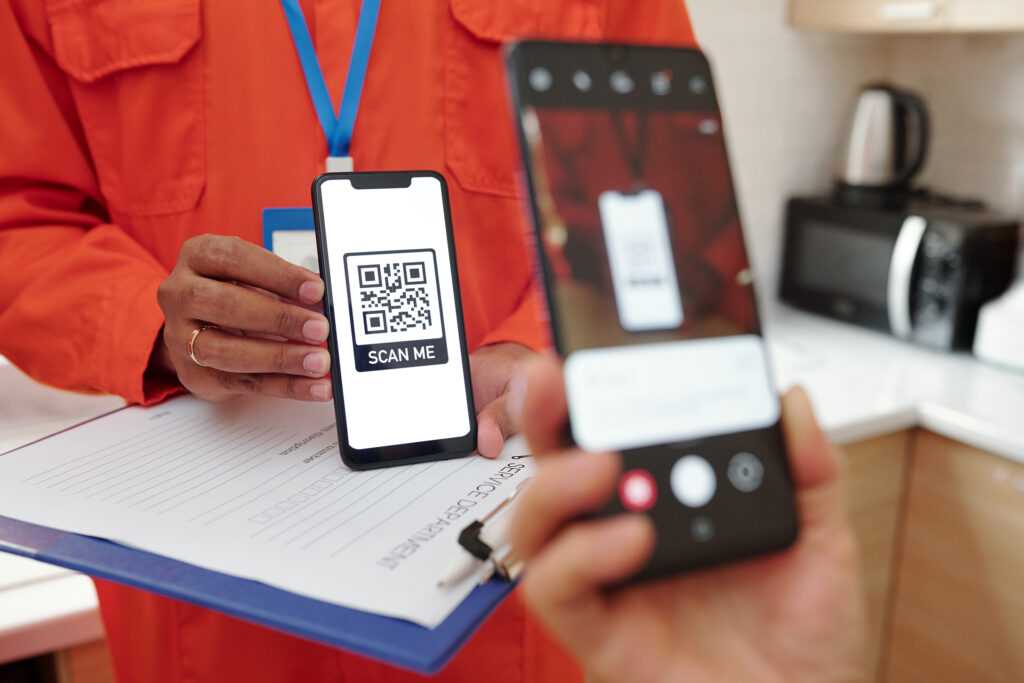
Imagine you’re a field technician installing a new internet router in a customer’s home. As you’re setting it up, the customer shows interest in upgrading to a better router on the spot. With a few taps on your tablet, you quickly generate a personalized invoice reflecting the upgrade cost. Instead of fumbling with cash or card readers, you simply present the QR code on your device screen. The customer scans the code with their smartphone, and just like that, the payment is processed. You install the upgrade then and there, leaving the customer satisfied with faster internet connection. The best part is the QR code ensured payment right away—you didn’t have to invoice them and wait for the payment via the monthly bill.

REPLACING PAPER INVOICES

Suppose you’re a home repair service worker who has just completed a job for a customer. Instead of the traditional route of handing over a paper invoice and waiting for a check, you offer a more secure and efficient payment option: a QR code. The customer scans the code with their smartphone, securely processing the payment electronically. This not only saves time and reduces the risk of errors associated with manual payments, but it also provides a better payment experience by using a modern payment solution.


ADD QR CODES TO YOUR PAYMENT CHANNELS

Incorporating QR codes as a payment channel offers businesses a practical and efficient way to interact with customers. With CSG Forte Engage, our intuitive payments solution, organizations can seamlessly integrate QR codes into their operations, providing customers with personalized and secure invoices for hassle-free transactions. By leveraging QR codes, businesses can streamline their payment processes and enhance customer satisfaction with a secure and convenient digital payment channel.

Take the next step in offering this convenient, secure method and contact us today.

Empowering SMBs With Embedded Financing

Small- and medium-sized businesses (SMBs) play a crucial role in driving our economy through innovation, job creation and the contributions they make to their local communities. But SMBs can face obstacles when trying to access working capital through traditional financing sources, including high rejection rates, varying annual percentage rates (APRs) and lengthy application processes.

Enter: embedded financing, which has emerged as a powerful alternative for SMBs that may apply for capital through traditional lending methods. Embedded financing offers SMBs a streamlined approach to accessing capital by allowing them to bypass banks and other traditional lenders and instead receive needed funds through their software vendors. This fast and flexible financing option offers SMBs fair pricing on quickly available financing terms that can be seamlessly integrated into their existing business solutions.

Many SMBs are taking advantage of the ease of using embedded financing, as industry growth continues to rise. Current estimates suggest a 125% year-over-year increase, reaching $500 billion in annual originations by 2030.

An AI-Driven Solution Tailored for ISV Partners and Their Merchants

Traditional small business loans can be expensive, carrying APRs as high as 99%. But businesses may find significant savings via the reduced rates embedded finance programs offer. How? Embedded finance programs leverage private datasets and AI automation when assessing risk, facilitating more accurate and faster underwriting. Among other advantages, this innovative underwriting method cuts customer acquisition costs.

By leveraging technology, embedded finance can revolutionize the underwriting process and provide fair, affordable financing options for SMBs. The lower rates not only benefit merchants, but also foster a stronger sense of loyalty within the Independent Software Vendor’s (ISV) merchant base.

The power of artificial intelligence (AI) is at the forefront of most of today’s innovative technology, including embedded financing. AI-driven credit underwriting—which is fueled by rich, embedded datasets—offers a level of sophistication that’s unmatched.

Embedded AI lending leader Lendica and has partnered with CSG Forte to introduce a unique credit solution for SMBs: the iBranch. This innovative embedded financing offering allows merchants to connect to financing offers through their software vendors, opening a new avenue for SMBs to conveniently access credit for necessary capital investments in their business. CSG Forte and Lendica are extending this solution to ISV partners and their end-merchants.

Benefits Beyond Basics

The advantages of embedded financing extend beyond just the SMBs. ISV partners stand to gain significantly from this innovative financing model. By participating in embedded financing programs, ISVs create an additional revenue stream for their business that is often operations-free (meaning they don’t need to handle the customer support or marketing internally and can leverage an embedded financing partner). Moreover, the enhanced merchant loyalty resulting from fair and affordable financing options strengthens the bond between ISVs and their end-users.

Embedded financing also has the flexibility to cater to a diverse range of ISV partners and their merchants, spanning various industries such as field services and property management. For example, property management merchants can leverage this user-friendly solution to access capital for building repairs, procure necessary supplies, or invest in professional services to promote their business. Quick access to capital empowers merchants and fosters an environment that’s conducive to future growth and prosperity.

Game-Changing Potential

Embedded financing is proving to be a game-changing solution for ISVs and their merchants, providing fast, flexible and competitive financing options. This streamlined approach addresses some of the pain points of traditional lending, offering competitive rates and an enhanced end-user experience. The growth trajectory of embedded business financing suggests a transformative future for SMBs, fostering an ecosystem where businesses can thrive and achieve their full potential.

As we move to the future, the era of embedded financing is redefining the landscape of SMB financing, unlocking new possibilities and opportunities for growth.

Thanks to the recently established strategic partnership between CSG Forte and Lendica, an embedded AI-lending company, your software organization can provide merchants with quick access to capital, removing time delays and other barriers SMBs often encounter. Contact our team to start offering your merchants a competitive, embedded financing offering in as little as two weeks.

4 Reasons You Need a Scalable Payment Platform

The best payment platforms are rigorously designed to include or address several specific factors, including security, speed, reliability and more. But although those features are important, one of the most integral factors for any payment platform isn’t any of those. And it’s probably not what you think it should be—it’s scalability.


What Is a Scalable Payment Platform?

What makes a platform scalable is its ability to handle oncoming work that grows and develops. Much like the advantages of offering flexibility, providing scalability allows users from either end of the platform to transform and change their businesses with the knowledge that the platform will adjust quickly to maneuver successfully through new challenges.

On the other hand, platforms that are not scalable will suffer. Static platforms fizzle and die, unable to keep up with the growing trends and industry challenges. Look, for example, at the mobile payments industry. The highly scalable applications like Starbucks find themselves responding quickly and adeptly to consumer wants and needs. Mobile pre-ordering, built-in rewards, music applications, and payments are all part of that ever-changing platform, and it doesn’t seem likely that will end soon.

On the other hand, a great number of other mobile applications didn’t meet ever-expanding customer demands or beat out competitor capabilities. Unable to accommodate user demands and requests, these platforms failed to drive forward. As a result, they lost users and sales. The platform dies.

Payments platforms are specifically sensitive to scalability because of the nature of the payments industry. With ever-expanding challenges and disruptions, platform creators are now required to do more than troubleshoot. They are almost asked to intuit the new big wave, creating solutions before problems occur.

But such is the life for any tech industry, including the financial technology (i.e., fintech) industry.


Why Your Business Needs a Scalable Payment Platform

Payment platforms that cannot scale risk losing users on either side of the platform. Here are four important why merchants and other users should consider scalability on their list when shopping for a payment platform:

1. Plan for Growth

As a merchant, your aim is for business to grow, not shrink. Your payment platform should be able to adjust with you. As you increase volume, you should be able to easily move into higher processing levels without much issue. Be sure that your processor can accommodate changes in volume and speak to them about potential contract savings, as well. Many processors offer discounts the more you process.

2. Expect High Functionality

The platform should not be disrupted no matter how little or how much you are processing. You should still be able to perform all of the functions you need regardless of your business size. There’s no reason any of the features you’ve been using at one level cannot translate to another.

3. Lower Risk During Business Fluctuations

Scalable platforms are more than just flexible. Because they can adapt, if you need to make changes because of a hardship or short-term change, a scalable system is going to help you adjust through this time. In lieu of terminating contracts or being forced to switch processors, which is a lengthy and arduous process, a scalable platform will allow you to tighten the reins momentarily without much cost.

4. Increased Opportunity for Newer Features

Scalable platforms are usually more likely to receive system updates and changes as trends come, which increases your opportunity to test out newer features as they are making waves. Static platforms are less inclined to update frequently and most likely will not adopt newer technologies. If you’re interested in the new and shiny, a scalable solution gives you a better opportunity, and it’s much easier to test out than transferring everything to an all-new system or processor.


Choose CSG Forte For Scalable Payment Solutions

Scalability is one of the most important features for payment platforms, landing high on the list for merchant shoppers. CSG Forte offers a scalable platform that adapts to changing business and takes both cards and eChecks. For more information, contact us.