
Convenience Fee vs Surcharge: Choosing the Right Fee Strategy

Key Takeaways

  • Surcharges apply only to credit card transactions in the U.S., and are usually a percentage fee meant to offset card acceptance costs.
  • Convenience fees apply when a payer uses a nonstandard payment method or channel and are often flat fees designed to recover the cost of offering extra options.
  • Both fee types are heavily regulated by card brands and state laws, so any program must be designed and monitored in partnership with legal counsel, your acquirer and a payment partner like CSG Forte.

Card processing costs have been rising for years, especially for credit cards and rewards products. For organizations that collect recurring payments at scale—such as city governments, utilities, property managers, healthcare providers and independent software vendors—those fees can add up fast.

That’s why it is no surprise more merchants and partners continue asking a version of the same question: “Can we pass card costs back to payers? And, if so, should we use a convenience fee or a surcharge?”

The terms often get used interchangeably, but they are not the same. They are governed by different rules, affect customer perception in different ways and carry different operational risks.

Choosing a payment platform that supports both convenience fees and surcharges—configured separately and never on the same transaction— gives you the flexibility to adapt to changing regulations and customer needs. This article will walk through how each fee works in the United States, when each can make sense and how to think about the right strategy for your organization.


What’s a surcharge?

A surcharge is an additional fee that a business adds when a payer chooses to pay with a credit card. It is usually calculated as a percentage of the transaction amount and appears as a separate line item on the receipt.

At a high level, a surcharge is designed to pass some or all the cost of credit card acceptance back to the cardholder instead of absorbing it into your operating budget.

Key characteristics of surcharges

In the U.S., surcharging is governed by a mix of federal law, state law and card brand rules. Several common elements apply almost everywhere:

  • Credit cards only: You can only surcharge eligible credit card transactions. Surcharging debit or prepaid card transactions is prohibited under federal rules that implement the Durbin Amendment to the Dodd‑Frank Act, even when the card is run “as credit.”
  • Percent‑based and capped: Visa and Mastercard typically cap credit card surcharges at the lower of your actual cost of acceptance or 4% of the transaction. In practice, many merchants choose a lower percentage to reduce customer friction.
  • State law limits: Some states restrict or ban surcharging altogether. For example, current guidance shows surcharges are not allowed in states such as Connecticut, Maine and Massachusetts, while states like Colorado allow surcharges but cap them at 2% and require specific disclosures. The National Conference of State Legislatures maintains an overview of state surcharge statutes.
  • Registration and disclosure: Card brands require advance notice before you start surcharging and specify how signage and receipt disclosures must look. You must clearly tell payers that a surcharge applies to credit card transactions and show the surcharge amount or percentage before they commit to pay.

During implementation, surcharges are configured at the merchant location level, apply only to eligible credit cards and are passed in a dedicated field on the transaction so they can be reported separately.

Surcharge example

A county utility district allows residents to pay water bills online by bank transfer or credit card.

  • If a resident pays a $200 bill with an ACH transfer, there is no additional fee.
  • If a resident pays with a credit card, the district adds a 2.5% surcharge ($5) that appears as a separate line item on the checkout page and receipt.

In states where surcharging is permitted, this can help offset credit card costs, but requires careful compliance with state and card brand rules.


What are convenience fees?

A convenience fee is an additional fee you charge when a payer chooses a payment method or channel that is different from your standard option, such as paying online or by phone when your normal flow is in person or by mail.

Unlike surcharges, convenience fees are not limited to credit cards. They can apply to other methods like ACH or eCheck so long as they are tied to the “convenient” channel or method rather than to the card itself.

Key characteristics of convenience fees

There is no single federal statute that defines convenience fees, but a few patterns are common across card brand rules and state law:

  • Tied to a nonstandard channel or method: A convenience fee is charged because the payer uses a channel that is different from your normal flow, such as paying a tax bill online instead of mailing a check.
  • Often a flat fee: Many organizations use a flat dollar amount (for example, $2.95 per transaction) rather than a percentage, especially on higher‑value items like tuition or tax payments.
  • Channel restrictions: Some card brands limit when and where convenience fees can be used. For example, certain Mastercard rules allow specific types of convenience fees mainly in verticals such as government, education and tax.
  • Disclosures and fairness: Just like surcharges, convenience fees must be disclosed before the payer completes the transaction and must be reasonable in light of the service you are providing and applicable state law.

CSG Forte’s platform supports convenience fee models across channels, with split funding and detailed reporting to ensure compliance and transparency. They offer the ability to absorb the fee yourself, pass it through to the payer or split it, depending on your program design.

Convenience fee examples

Common U.S. examples include:

  • A city that normally collects property taxes by mail adds a flat convenience fee for paying online with a card or ACH instead of mailing a check.
  • A property manager that typically receives rent checks in an office charges a convenience fee for tenants who prefer to pay by phone with an agent.
  • A healthcare provider that normally accepts in‑office payments offers an online portal with a small convenience fee to offset the cost of hosting and maintaining digital channels.

In each case, the fee is associated with the convenience of a different channel, not solely with using a credit card.


Convenience fees vs surcharges: compliance and key difference

Both fee types help you manage payment costs, but they differ in how they work operationally and how payers experience them.

Who and what they apply to

  • Surcharge: Applies only to eligible credit card transactions and is directly tied to card acceptance costs.
  • Convenience fee: Applies when a payer uses a nonstandard channel or method (such as online, IVR or phone) and can apply to cards or other methods, depending on rules.

How the amount is set

  • Surcharge: Nearly always a percentage of the transaction, capped by card brands and in some states by statute.
  • Convenience fee: Often a flat dollar amount per transaction, sometimes a small percentage, subject to card brand and state guidance.

Where they are allowed

  • Surcharge: Not legal in every state and subject to detailed notice, cap and line‑item rules.
  • Convenience fee: Generally permitted when properly disclosed and structured, but some states define when you can charge them and how much you can charge.

Customer perception

Research suggests cardholders are more tolerant of clearly disclosed fees than surprise charges, especially when they understand that other fee‑free options (like ACH) are available. Many organizations find that convenience fees, framed around an optional channel, are easier to explain than surcharges that attach directly to card usage.


How to choose the right fee strategy

There is no single “right” answer. Instead, the better option depends on your goals, your vertical and your payers.

Scenarios where a surcharge might fit

A surcharge can make sense when:

  • Credit card volume is high and card costs are putting real pressure on margins, especially in thin‑margin operations such as utilities or public sector.
  • ACH or check alternatives already exist and are easy for payers to use, so customers who want to avoid the surcharge can switch channels without much friction.
  • State law clearly permits surcharging for your locations and your legal team is comfortable with the requirements.

Example: A utility that already offers a full ACH and bank draft experience decides to add a compliant credit card surcharge in allowed states to offset card costs while investing more in digital self‑service for ACH.

Scenarios where a convenience fee might fit better

A convenience fee is often the better choice when:

  • You want to recover the cost of offering extra channels, not just card costs. For example, supporting staffed phone payments or a high‑availability web portal.
  • Your customer experience team is wary of a fee that appears to “penalize” card usage directly, especially in sensitive contexts like healthcare or rent collection.
  • You operate across many states and want a slightly simpler legal profile than a full surcharging program, while still giving payers fee‑free options like ACH, mail or in‑person payments.

Example: A property management firm that typically receives rent checks and ACH transfers adds an online card option with a small convenience fee, while keeping ACH and check free. Tenants get new options, and the firm covers some of the incremental cost of digital and card acceptance.


How CSG Forte Can Help Build Your Strategy

CSG Forte supports both convenience fee and surcharge programs, but they cannot be combined on the same transaction and must be configured carefully to align with card brand rules and state law.

At a high level, Forte can help you:

  • Design a fee strategy that aligns with your goals, vertical norms and payer expectations across channels like web, POS, IVR and SMS.
  • Configure either surcharges or convenience fees at the appropriate merchant locations so that applicable fees are calculated and passed through consistently in the transaction data.
  • Report on fee performance so you can see how card mix, fee revenue and channel usage change over time, and adjust your strategy as needed.

Because CSG Forte works across acquiring, bill payment and payer engagement, you can approach fees as part of a broader payments strategy instead of a one‑off change at the gateway.

If you are evaluating whether a surcharge, a convenience fee or another approach is right for your organization, CSG Forte can help you weigh your options and design a program that balances compliance, cost control and customer experience. Our modern platform supports both convenience fee and surcharge programs, helping you design a compliant strategy that fits your business and customer needs.

Contact our team of experts to design a compliant convenience fee or surcharge strategy that fits your organization.


Frequently asked questions

  1. Can I charge both a convenience fee and a surcharge on the same transaction with CSG Forte?
    No. CSG Forte supports both convenience fee and surcharge programs, but they cannot be combined on the same transaction. Each program must be configured separately and aligned with card brand rules and applicable state law.
  2. How does CSG Forte’s convenience fee pricing work?
    With CSG Forte’s convenience fee pricing, the transaction is processed as two charges: one for the principal amount and another for the service (convenience) fee. The principal amount is funded directly to the merchant, while the service fee is funded to the processor, helping cover processing costs without additional billing to the merchant.
  3. What channels and payment methods can CSG Forte support for convenience fee programs?
    CSG Forte can support convenience fee models across multiple channels—including web, IVR, SMS, in‑person POS and kiosks—and for various methods such as cards, ACH and eCheck, as long as the fee is tied to the nonstandard “convenient” channel or method rather than the card itself and remains compliant with card brand and state rules.
  4. How does CSG Forte help me design and maintain a compliant fee strategy?
    CSG Forte helps you design, configure and monitor fee programs by:

    • Aligning your strategy with vertical norms and payer expectations.
    • Configuring convenience fees or surcharges at the merchant/location level so fees are calculated and passed consistently in transaction data.
    • Providing reporting through Dex so you can track card mix, fee revenue and channel usage over time and adjust as regulations or business needs change.
      You still need to work closely with your legal counsel and acquirer to validate compliance in each jurisdiction.
  5. How does CSG Forte help me design and maintain a compliant fee strategy?
    Yes. In addition to convenience fee programs, CSG Forte supports absorbed-fee models where the merchant pays processing and service fees instead of passing them to payers. This is common in scenarios where agencies or nonprofits want to encourage digital adoption or temporarily waive fees (for example, Mecklenburg County absorbing convenience fees during COVID-19 so taxpayers could pay online or by phone at no extra cost).

Payment Channels Explained: Offer More Ways to Pay Without Adding Complexity

Payments aren’t getting simpler—they’re getting more varied. Your customers might want to pay online, over the phone, in person or through a link in an invoice reminder. And while offering more ways to pay can increase completed payments and reduce delays, it can also create new headaches if each option lives in its own silo.

That’s why it helps to think in terms of payment channels, not just payment methods. A channel is the full path a payment takes—from the customer’s experience to the technology that securely authorizes the transaction and moves funds. Before you add new ways to pay, you need to understand which channels fit your business, how they differ and how to implement them in your organization in a way that stays cohesive, secure and manageable.


What is a payment channel?

A payment channel is any way a customer might make a payment or anywhere that you, a merchant, might accept a payment. A payment channel includes a payment method, such as automated clearing house (ACH), debit card or a bank account, and the technical infrastructure that allows businesses and financial institutions to verify transactions and send funds. The infrastructure might include steps like securely sending card information entered into a website or checking the transaction for potential fraud.

Retail channels are a similar yet distinct concept. Retail channels cover different ways people can shop, like brick-and-mortar stores, catalogs and online shopping sites. Payment channels are generally related to these retail channels but are more specific to how people make payments. They correlate to retail channels but leave some room for overlap.

For example, at a brick-and-mortar retail channel, you might process payments on a physical point-of-sale (POS) system—a cash register—as well as on smartphones or tablets within the store. Your catalog might accept payments by phone but also integrate into an omnichannel approach. Customers could walk into your brick-and-mortar store to pay at the POS, or they could shop the catalog online and pay via online checkout.

Payment and retail channels closely relate to each other. Since you definitely want to create a cohesive, omnichannel experience, it’s essential to consider what payment channels you might implement. Some of the most popular options include:

Physical POS systems

Most brick-and-mortar stores have a point-of-sale (POS) payment system of some kind. These systems allow businesses to take in-person payments such as credit and debit cards, cash and checks. A physical POS can use more traditional technologies as a standalone system, but mobile POS systems are also common. A mobile POS uses devices such as smartphones and tablets to process payments, often with attached card readers. This option works well for businesses looking for easy-to-implement tech or for those on the move, such as field service providers.

Phone and interactive voice response (IVR) payments

Payments made over the phone can come in one of two varieties. The traditional approach involves talking to an agent to communicate payment details and share card information. An alternative to these contact center payments is to use IVR to walk customers through the process without needing to talk to an agent. The customer can enter specific numbers or say certain words to make the payment. Both methods are popular with service businesses and recurring payments.

Online checkout solutions

Online checkouts can come in many forms for everything from e-commerce and subscription services to rent and utility bills. They might integrate features for managing shopping carts, storing the customer’s information for next time or setting up automatic payments. Supported payment methods might include credit and debit cards and Automated Clearing House (ACH) transactions. ACH is the system used to electronically transfer funds between bank accounts and process electronic checks in the United States.

Contactless payments

Many cards now have integrated chips with near-field communication (NFC) technology. A compatible POS system allows customers to tap their credit or debit card to make payments. Digital wallets like PayPal and Apple Pay can also use NFC technology to facilitate card payments and bank transfers. You’ll find these wallets integrated with online checkouts and supported by physical POS systems, which can collect payment data wirelessly from a user’s smartphone or watch.


How offering multiple payment channels benefits your business

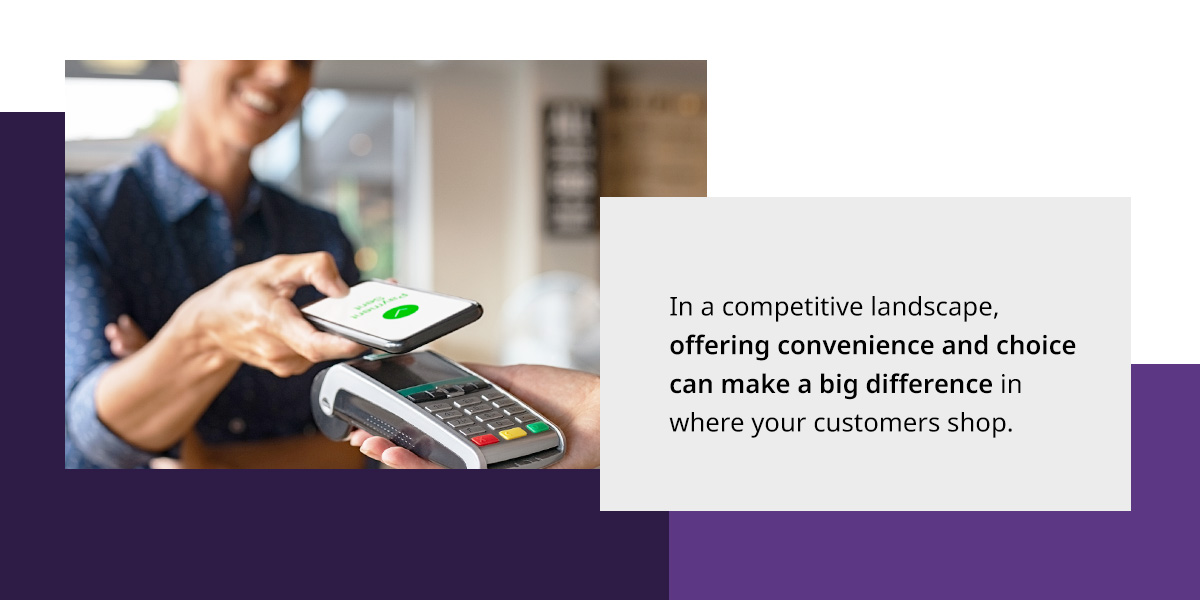
Person paying with a phone on a point-of-sale device. Caption: In a competitive landscape, offering convenience and choice can make a big difference in where your customers shop.

In a competitive landscape, offering convenience and choice can make a big difference in where your customers shop. Credit cards and debit cards are by far the most popular payment methods at the point of sale, but analysts expect digital wallets to become much more common. However, payment preferences can vary widely by industry, geography, customer demographics and other characteristics.

By offering a range of options, businesses and their customers can reap several benefits, including:

Better customer experience

With more choices, customers can make payments how they want. These methods often come with unique advantages. Cash doesn’t have any processing requirements or fees, while credit cards can offer rewards and fraud protection. Online or over-the-phone payments are convenient and fast.

With multiple options, customers can pick the right one for their situation. From a business perspective, a better customer experience from payment channels can make it more likely someone will make a purchase with you or reduce the likelihood that their payment will be late.

More sales opportunities

Different payment channels can create new sales opportunities. Taking online payments can help a local shop reach customers worldwide, while a POS could help a storefront business take payments from customers who don’t typically carry cash.

Flexible payment options can also help customers make payments on time, allowing businesses to maintain steady cash flow.

Additional features

Some payment channels support useful features. For example, online checkout systems can help customers set up automatic recurring payments, which you can’t do with cash payments. Online checkouts also offer branding opportunities. You could even create email or SMS text message payment channels by including a link to an online payment platform in emails and SMS text notifications.


Security and compliance considerations

Protecting customer information and meeting regulations is crucial for any organization collecting payments. Most payment channels use different technological infrastructures, so you’ll need to pay attention to security and compliance requirements. Make sure your solutions follow best practices for technology standards and protocols, like end-to-end encryption, tokenization and fraud prevention methods.

Depending on your industry and the payment channels you use, look for solutions that meet the Payment Card Industry (PCI) Data Security Standard (DSS) and the Health Insurance Portability and Accountability Act (HIPAA). Working with a member of the Nacha Preferred Partner Program can help ensure security with ACH transactions, too.


How to set up multiple payment channels

Setting up multiple payment channels might sound complex, but a merchant service provider and a unified payment platform simplify the process. Here at CSG Forte, we use the Dex Payments Platform, a comprehensive solution for payment processing. Dex integrates with various online, in-person and phone payment systems for simplified management and various tools to meet customer needs.

Your team can integrate this highly customizable platform with application programming interfaces (APIs), or you can work with our experienced team to implement channels for your business. We can also help with hardware requirements.

CSG Forte offers full payment processing support for the following channels:

  • Physical POS: We can help build a physical POS solution and supply the tech, including card readers and our Virtual Terminal that turns existing computers into instant workstations. Our POS systems are PCI-validated with point-to-point encryption for extensive security.
  • Phone/IVR: Our phone and IVR services come with your own toll-free number and script-building assistance. Touch-tone and speech-recognition technology can help you build a great customer experience. We also have solutions to streamline and secure payments received through your contact center.
  • Online payments: Our robust online checkout solution is smart, speedy and stocked with options. Accept credit and debit cards and ACH payments, and allow customers to pay through your app or other platforms through robust APIs.

You can accept both credit cards and electronic checks on any of these channels, and each channel comes with our cloud-based Virtual Terminal for transaction management and our powerful payment gateway services. All of the reports funnel into the Virtual Terminal, so you don’t have to worry about piecing things together on your own.

These payment channels don’t necessarily have to correlate only to retail, as well. For example, government agencies could implement online payments to accept taxes on the web and leverage a POS system for in-office payment collection.


CSG Forte’s payment channel solutions for your business

Smiling man on a laptop. Caption: Payment channel solutions for your business

Whatever your industry, diverse payment channels can transform your approach. Expand options for your customers and your business with simplified payment processing. And what’s easier than setting up all of your channels with one company? Get started with CSG Forte today.

An Insurance Leader’s Guide to Reducing Payment Declines

Key Takeaways

  • Insurance payment declines are a customer experience, retention and compliance problem—not just a billing issue—because failed premiums can quickly lead to policy lapses and involuntary churn.
  • The most effective strategies combine prevention (reminders, ACH, account verification, Account Updater) with smart, mostly invisible recovery tactics and empathetic communication when policyholders must get involved.
  • Modern platforms paired with powerful tools help insurers reduce declines, cut manual work and protect premium revenue across the entire policyholder journey.

Payment failures are problematic for all businesses, but the consequences are particularly harmful for insurance companies and policyholders. Insurance payment declines can cause policy cancellations that decrease revenue and leave customers unprotected from catastrophic events.

Even if the policy is later reinstated, policyholders fed up with payment friction may switch insurers, reducing customer lifetime value. To protect and retain clients and revenue, insurers need effective strategies—and a modern online payments platform—to reduce insurance premium payment declines.


Why insurance payment declines hurt more than you think

When insurance premium payments fail, they set off a chain reaction of customer frustration, operational headaches and financial losses that erode an insurer’s profitability.

Payment friction damages customer experience: In an industry where “peace of mind” is the core product, online payment friction is particularly damaging because it forces the policyholder to do the heavy lifting during a high-stress moment. When communication regarding payment declines is vague (“payment error”), impersonal and arrives a week later by snail mail, customers must scramble to identify and fix the problem before the grace period ends. Paying bills is often the only contact policyholders have with the insurer, so a stressful payment experience may be the deciding factor about whether to switch providers.

Lapsed coverage leads to churn and revenue loss: If an insurance premium payment is declined and the customer fails to remedy the situation within the grace period, the policy is canceled and insurance coverage terminates. This involuntary churn results in a complete loss of future revenue from that customer, decreasing investment income from float. Even if the customer’s policy is reinstated, the frustration and hassles may send the policyholder shopping for another carrier (i.e., voluntary churn).

Payment failures increase operational expenses: Tending to insurance payment declines requires costly internal processes:

  • Policyholder communications (i.e., dunning management)
  • Payment retries
  • Reinstatement

Compliance risk: In many states, property and casualty insurers have specific regulatory requirements for notifying customers before policy cancellation. Failed payments complicate this process, increasing the risk of compliance errors and potential regulatory penalties.


Top causes of premium payment failures

Payment declines may be due to policyholder issues, technical/system failures, or fraud/risk flags:

  • Insufficient funds: The policyholder’s bank account doesn’t have enough money to cover the premium, or the premium exceeds the available credit card limit.
  • Expired or cancelled card: When the card used for recurring payments is no longer valid, the premium payment will fail. The typical life span of a credit card is about three years before it expires or becomes lost or stolen.
  • Invalid payment data (technical error): The payment information (e.g., bank account or routing number, credit card number, CVV or expiration date) was entered incorrectly by the customer or contains a technical error that prevents the payment gateway from processing it.
  • Technical glitches: Issues arise with the payment gateway, processor or card network.
  • Fraud detection/false declines: The issuing bank’s fraud prevention system flags a legitimate transaction as suspicious.


Best practices to reduce declines and retain policyholders

The best way to retain clients is to deliver a more convenient online payment experience. Follow these best practices to improve CX and prevent payment declines:

Send automated payment reminders well before the premium due date. If the reminder arrives the day before payment is due, customers may not have enough time to be sure there’s enough money in their account to cover the premium.

Encourage policyholders to pay via automated clearing house (ACH) instead of credit card. Because bank accounts are typically held for 14 years (meaning account numbers don’t change as often as credit card numbers), ACH transactions have lower decline rates.

Offer flexible payment plans and due dates. Make insurance premiums more budget-friendly by allowing policyholders to spread out payments (e.g., monthly, quarterly or biannual payments). Offer paycheck aligned plans that match customers’ pay dates.

Use a card account updater service. An account updater service automatically updates expired, replaced or reissued card credentials with the card network, eliminating the need for customers to manually refresh their payment details.

Implement an account verification solution. Verify the bank account and routing number for ACH transactions to reduce manual errors at the point of capture and reduce bad checks prior to processing.

Take advantage of payment orchestration. Use a system that intelligently routes payment attempts through different processors or networks if an initial attempt fails, sometimes leading to a successful transaction.


How to recover failed payments without damaging relationships

Payment declines may still occur, despite your best efforts to prevent them. When they do, you need to tread lightly to resolve the problem without pushing customers away.

Start with “invisible” recovery tactics. The best way to preserve a relationship is to fix the payment issue before the customer even realizes there is a problem.

Use a payment recovery service. When insurance premium payment fails due to insufficient funds, a payment recovery service automates and optimizes the process of reattempting and collecting payment, without the customer’s involvement.

Apply intelligent retry logic. The best recovery systems employ a machine-learning-driven process that determines the optimal moment to re-attempt a declined transaction. For example, debit card retries may be most successful at 12:01 AM, when banks refresh daily balances. Or the system may use payday logic, retrying payments on the 1st or 15th of the month.

  • Remove friction. If you must involve policyholders in recovery efforts, communicate promptly, transparently and empathetically—and make it easy for the customer to fix the payment problem.
  • Issue real-time payment decline alerts. Instantly notify customers via their preferred channel (phone, text or email) when a payment fails, explaining the reason (e.g., “Card declined due to insufficient funds”). Keep the tone friendly and supportive.
  • Include a one-click payment link. Make it simple for policyholders to update their payment method or make a one-time payment, without having to log in to the portal.
  • Allow partial premium payments to prevent policy lapses. Personalized messages and solutions are more effective than generic outreach.


CSG Forte: the best policy for insurance payment success

A modern online payment processing platform for insurers simplifies payments and revenue management. CSG Forte is your one-stop solution for accepting payments in person, by phone or online. Payment validation, card updater and NSF Check Recovery Services reduce insurance payment declines, boosting retention and revenue.

CSG Xponent, our customer journey management solution, improves policyholder CX by sending timely, personalized messages—such as payment reminders and claims status updates—via each customer’s preferred channel.

Ready to simplify payments? Let’s chat—reach out to our Forte team today and discover how we can help your business boost retention and revenue.


Frequently Asked Questions

1. What are the most common reasons insurance premium payments fail?

The main drivers are:

  • Insufficient funds or credit limit on the policyholder’s account when the premium is due.
  • Expired, replaced or cancelled cards used for recurring payments.
  • Incorrect or incomplete payment details, such as mistyped account or routing numbers, card number, CVV or expiration date.
  • Technical issues at the gateway, processor or network level that temporarily prevent authorization.
  • Fraud/risk rules and false positives, where the issuer flags a legitimate transaction as suspicious and declines it.

2. How does Account Updater reduce card declines for insurers?

Account Updater automatically refreshes stored card details for participating Visa, Mastercard and Discover cards when those cards are reissued, updated or closed. Instead of a recurring premium failing because the old card on file has expired or been replaced, CSG Forte:

  • receives updated card data from the card networks,
  • matches it to tokenized payment methods on file, and
  • updates the token with the new account number or expiration date.

This reduces declines due to outdated card credentials and lets many recurring premiums continue without the policyholder needing to call in or log into a portal to update their card.

3. Can CSG Forte BillPay integrate with my existing policy admin system?

Yes. CSG Forte BillPay is designed to sit alongside your existing policy admin, billing and claims platforms, not replace them. Insurers can:

  • use REST APIs and/or file-based integrations to exchange data,
  • synchronize balances, payment status and settlement details, and
  • feed reconciliation files and reports into downstream finance and policy systems.

The result is a more modern payment experience without a rip-and-replace of your core insurance systems.

4. What payment methods does CSG Forte support for insurance premiums?

CSG Forte supports a broad mix of payment methods insurers typically need, including:

  • credit and debit cards,
  • ACH/eCheck from bank accounts, and
  • leading digital wallets such as Apple Pay, Google Pay, PayPal and Venmo.

These can be offered across channels like web and mobile portals, IVR and call center payments, text-to-pay and in-person or agent-assisted payments, so policyholders can pay in the way that’s most convenient to them.

5. How can insurers track and improve payment recovery rates?

To manage and improve recovery, insurers should:

  • Track decline and failure rates by channel and payment method (card vs. ACH).
  • Measure recovery rate by value (how much failed premium revenue is successfully collected) and write-off percentage (what’s never recovered).
  • Monitor time to recovery (TTR)—the days from first decline to successful collection.
  • Compare automatic vs. manual recovery, aiming to shift more recovery to automated tools (Account Updater, intelligent retries, recovery services) and reduce labor-intensive outreach.

Improvement typically comes from:

  • strengthening prevention (payment reminders, ACH incentives, account verification, Account Updater),
  • implementing smart retry and recovery logic, and
  • using analytics to refine dunning strategies and channel mix over time.

What’s the Fastest Way to Transfer Money Between Banks? “Instant” Options, Compared.

Key takeaways

  • “Instant” isn’t one thing. Depending on the method, it can mean real-time settlement, same-business-day clearing or immediate confirmation with settlement later—so define what “fast” needs to mean for your use case.
  • The best bank-to-bank transfer method is a tradeoff between speed, cost and control. Same Day ACH and wires can be fast, but fees, cutoffs and limits (like Same Day ACH’s $1M cap) determine whether they’re practical.
  • For most businesses, ACH is the most reliable baseline. It’s widely used, predictable for reconciliation and designed with network rules and security requirements—making it a strong default when you need speed without sacrificing governance.

If you need a bank-to-bank transfer to move money quickly—whether you’re paying a vendor, moving funds between accounts or collecting customer payments—you have more than one “fast” option. The catch is that speed isn’t the only variable. Processing windows, cutoff times, fees, dollar limits and security controls can change what “fast” really means in practice.

Below is a clear breakdown of the most common ways to send cash online, including how “instant” each one actually is, what they typically cost and when each makes sense for businesses.


What is an instant bank transfer?

An instant bank transfer typically refers to a digital transaction where the recipient receives funds (or a confirmation of funds) with minimal to no delay. In common marketing terms, “instant” can imply several different scenarios:

  • Real-time fund transfer: genuine instant settlement, accessible 24/7 on specific networks
  • Same-business-day processing: quick, yet still subject to banking hours and deadlines
  • Immediate approval with deferred settlement: frequently seen in certain app-based services

Therefore, when selecting the quickest method to transfer money between banks, begin by considering: Do I require the funds to settle immediately? Or do I just need a high level of assurance that it’s on its way, with reliable availability?

This approach will help you determine the most suitable option for your needs, ensuring that your financial transactions are both efficient and aligned with your expectations.


How to transfer money from one bank to another instantly (or close to it)

Most “fast” bank transfer methods fall into four buckets:

  1. Automated Clearing House (ACH) transfers (standard or same-day ACH)
  2. Wire transfers
  3. Peer-to-peer and digital wallet apps
  4. Paper checks (not instant, but still widely used)


ACH bank transfers

ACH is one of the most common ways businesses move money electronically using routing and account numbers. It’s widely used for payroll, bill payments, membership dues, vendor payments and recurring billing.

The ACH Network is administered by Nacha, which sets rules and operational standards for participants.

How fast is ACH?

ACH speed depends on how the payment is sent:

  • Standard ACH is often associated with “a few business days,” but Nacha has emphasized that a significant majority of ACH payments settle in one business day or less.
  • Same Day ACH can settle as quickly as a few hours on a banking day.

Same Day ACH limits

Same Day ACH has a per-payment limit of up to $1 million, based on Nacha’s rule change that took effect in 2022 (and remains the stated limit today, though Nacha has recently sought feedback on raising it).

What ACH costs

Costs vary by bank, processor and risk profile, but the general tradeoff looks like this:

  • Standard ACH: usually lower cost per transaction
  • Same Day ACH: typically higher fees in exchange for faster settlement

When is ACH the best option?

ACH is often the best default method for business payments because it offers:

  • Predictable settlement and reconciliation
  • Lower processing costs at scale
  • Strong network rules around handling bank account data

How ACH transfers stay secure

The ACH Network uses bank account and routing numbers, so security is non-negotiable. Nacha’s rules and security framework require protections for sensitive deposit account information.

For example, Nacha has rules that require certain large ACH participants to render account information unreadable when stored electronically (part of its security framework).
In practical terms, strong ACH security programs often rely on controls such as:

  • Encryption to protect data in storage and transmission
  • Tokenization or vaulting approaches to limit exposure of raw account details
  • Masking/truncation so stored or displayed account data is limited
  • Verification and monitoring to reduce fraud and invalid account activity

(Exactly which controls apply can depend on your role in the ACH ecosystem and your volume.)


Wire transfers

Domestic wires can be very fast—sometimes same-day—if initiated before cutoff times and if both banks process promptly. They’re often marketed as instant, but “instant” still depends on banking hours and operational checks.

What wire transfers cost

Wire transfers generally have higher fees than ACH. That can make them a poor fit for frequent, lower-dollar payments—but still useful for high-stakes, high-dollar transfers where timing matters more than cost.

When are wires the best option?

Wires can be a good choice when:

  • You’re sending a large amount and need speed
  • You can justify the higher per-transaction cost
  • You’re okay with stricter requirements and less flexibility


Mobile applications and digital wallets

Apps can be a convenient way to send cash online, especially for person-to-person payments or informal transfers. Depending on the app and the transaction type, transfers can be instant, same-day, or take a few business days.

What makes apps feel “instant”?

Many apps create a fast experience by doing one (or more) of the following:

  • Providing immediate confirmation while settlement happens later
  • Moving funds inside the app’s ecosystem first (wallet-to-wallet), then transferring to a bank
  • Offering an “instant transfer” feature for an extra fee

When are apps the best option?

App-based transfers can make sense when:

  • You’re sending money casually (not for formal invoicing or reconciliation)
  • You’re okay with varying fee models and transaction rules
  • You don’t need enterprise-grade reporting or controls

For many businesses, apps are convenient—but they’re not always ideal as a core receivables strategy, especially when you need reliable reconciliation, audit trails, or structured payment workflows.


Paper checks

Checks are still common, but they’re the opposite of instant.

Downsides of checks for speed and risk

  • Slow delivery and processing
  • Manual handling (printing, mailing, depositing)
  • Fraud risk (stolen checks, altered checks, counterfeit checks)

Checks can work for certain workflows, but if you’re optimizing for the fastest way to transfer money between banks, checks are usually what you’re trying to move away from.


Which is the best way to transfer money between banks?

Truly, it depends on your specific needs. If “best” means earliest reliable availability with a bank-to-bank path, your top contenders are usually:

  • Same Day ACH (fast settlement on a banking day, often within hours)
  • Wire transfers (fast but typically higher cost and banking-hour dependent)
  • Certain app-based instant transfer features (fast, but variable rules/fees)

If “best” means best blend of speed, cost and operational control, ACH—especially Same Day ACH—often wins for businesses because it’s designed for high-volume, bank-account-based payments and has clear network standards.


Accept payments on any channel with CSG Forte

If you’re a business that wants to move beyond checks and build a more modern bank-transfer experience, CSG Forte’s complete payment platform is configured to help you accept and process online ACH payments, digital wallets, credit and debit cards and many more payment types.

Explore CSG Forte’s payment platform to accept ACH (including Same Day ACH), cards and digital wallets—with the security, visibility and flexibility your business needs. Reach out today to talk to a payments expert.


Frequently asked questions

Q1. How long does a bank to bank transfer take with ACH?
Timing depends on whether it’s standard or Same Day ACH. Nacha notes that ACH payments can be processed in hours and that most settle in one business day or less, with Same Day ACH enabling faster settlement. Nacha+1

Q2. Is an instant bank transfer always truly instant?
Not always. Some options are real-time, some are same-day, and some give instant confirmation while funds settle later. Always check cutoffs, weekends/holidays, and any “instant transfer” fees.

Q3. Can I send cash online using routing and account numbers?
Yes. ACH is a common way to send money using routing and account details, and it’s widely used for business payments and recurring billing.

How Registered Payment Facilitators Modernize Patient Payments and Revenue Cycles

Key Takeaways

  • Patchwork payment systems are holding healthcare back. Most organizations are running healthcare payments through a mix of portals, gateways and processors that create friction for patients and risk for revenue cycle teams.
  • The payment facilitator model can offload real risk and complexity. Forte manages onboarding, PCI DSS scope, and ongoing risk management, while providers/ISVs retain shared responsibility for data security and user access.
  • Choosing the right PFaaS partner matters more than ever. A healthcare-ready payment facilitator with deep industry experience, strong payment services and modern payment gateways can turn payment processing from a liability into a growth lever.

Many healthcare billing teams face persistent payment-related inquiries and manual follow-up tasks. Patients call to ask why a payment did not go through, staff bounce between portals and spreadsheets and your revenue cycle team spends more time chasing down missing information than actually improving collections. Everyone keeps saying your “payment system” is digital now, but it still feels like you are stitching together three different eras of technology every time a card gets run.

Most healthcare organizations did not set out to build complicated healthcare payment software. They added a portal here, a card terminal there, maybe a text-to-pay tool on top of an aging practice management system.

Behind the scenes, that patchwork means multiple payment processors, gateways that do not fully sync with clinical or billing platforms and a growing list of compliance acronyms someone on your team is supposed to “own” on top of their day job. The result is familiar: slow cash, clunky patient experiences and constant anxiety that one misstep in payment processing could turn into a security or compliance incident.

That is the gap compliant registered payment facilitation—delivered through embedded payments and Payment Facilitation-as-a-Service (PFaaS) models—is designed to close. Instead of treating payments as a bolt-on afterthought, the payment facilitator model bakes onboarding processes, risk management and compliance into the same infrastructure that moves money.

When that embedded payment infrastructure is the foundation for your payment systems, not an add-on, you have a shot at making healthcare payments easier for patients, more predictable for revenue cycle teams and far less stressful for whoever is currently responsible for payment operations.


The new realities of healthcare payments and the revenue cycle

Healthcare has never been simple, but the way money moves through the system has become especially strained.

Patients now shoulder a larger share of costs through high-deductible plans and coinsurance. They expect the same digital experience they get in retail and financial apps, yet many clinics still rely on mailed statements or in-office terminals that feel stuck in another decade.

On the back end, revenue cycle teams juggle remits from payers, card and Automated Clearing House (ACH) payments from patients and a tangle of adjustments or write-offs. Every disconnected system adds more manual work, more places for errors and more risk to cash flow.

Practice managers sit in the middle of all this. They have to keep front desk teams, billing staff and IT aligned while also dealing with the realities of the payments industry.

That often means negotiating with multiple payment processors, trying to get consistent reporting from different payment gateways and figuring out which vendor is responsible when something breaks.

The common theme is fragmentation. When the tools that handle healthcare payments are not coordinated, the revenue cycle becomes a series of disconnected steps instead of a clear, predictable path from visit to cash.


What modern healthcare payment software needs to deliver

To break out of that fragmentation, healthcare payment platforms have to do more than swipe cards and post files. They need to behave like strategic infrastructure, often delivered through embedded payments and PFaaS models that connect front-end patient experiences with back-end revenue operations. In short, they need to behave like strategic infrastructure.

1. Frictionless, patient-friendly payment services

Patients want simple choices that match their lives:

  • Pay from a mobile device right after a visit.
  • Enroll in a payment plan that fits their budget.
  • Store a card on file for future copays or balances.

Modern payment services should support card and ACH payments, digital wallets and recurring options without forcing patients to hop between different sites. A consistent, multi-channel payment solution is increasingly expected by patients and staff. Increasingly, it is becoming the baseline for a decent patient experience.

2. Seamless integration with clinical and billing platforms

A payment that does not post correctly might as well not exist. Healthcare payment software has to integrate cleanly with electronic health record (EHR) systems, practice management platforms and revenue cycle tools so that staff are not re-keying data or reconciling totals by hand.

That means payment systems need solid application programming interfaces (APIs), clear mappings for codes and departments and reporting that matches how finance and billing teams actually work. When payments live outside the core workflow, teams waste time and confidence in the data erodes.

3. Built-in security and compliance by design

Healthcare is a high-stakes environment for data. Any payment system that touches protected health information or cardholder data has to respect that.

That starts with a Health Insurance Portability and Accountability Act (HIPAA)-compliant design, but extends into the card rails too. Strong tokenization, encryption in transit and at rest and clear Payment Card Industry Data Security Standard (PCI DSS) scope boundaries are table stakes. Providers and healthcare software vendors should not have to become PCI experts just to accept a copay.

This is where the underlying payments architecture matters. If the platform is built on top of a modern Payment facilitator model with smart risk management and clear responsibilities, it is much easier for healthcare organizations to stay in bounds.


A quick primer on the payment facilitator model

To understand why payment facilitation and PFaaS are such a good fit for healthcare, it helps to look at how the payment facilitator model works.

In a traditional merchant account setup, each healthcare provider or software vendor would work directly with a processor and acquiring bank. They would go through underwriting, set up their own account and carry full responsibility for compliance and chargebacks. This made sense when practices ran their own terminals and little else.

In the payment facilitator model, there is a master merchant account controlled by the payment facilitator. Individual providers or software platforms are onboarded under that umbrella as sub-merchants. The payment facilitator handles much of the underwriting, monitoring and connection to acquiring banks and payment gateways.

In plain terms, the payment facilitator sits between thousands of sub-merchants and the broader payments industry. It packages payment services, manages risk and gives those sub-merchants a simpler way to access card networks and bank rails.

For healthcare, where organizations are busy enough just keeping up with care delivery, this abstraction layer is powerful. It lets them plug into modern payment processing without negotiating separate deals, handling every detail of compliance or building direct relationships with multiple processors.


What “compliant payment facilitation” means for healthcare

Not every payment facilitator setup is created equal. In healthcare, compliant payment facilitation has a specific meaning.
First, a healthcare-ready payment facilitator has to understand both PCI DSS and HIPAA realities. That includes reducing cardholder data exposure for providers, designing data flows that respect protected health information and keeping audit trails that stand up to scrutiny.

Second, compliant payment facilitation includes a mature approach to risk management. That means monitoring for suspicious transactions, handling chargebacks efficiently and keeping a close eye on how sub-merchants behave. For healthcare platforms that serve many clinics or providers, this shared layer of risk control is essential.

Third, onboarding processes have to fit healthcare workflows. Providers cannot wait weeks to go live with payments or bounce between multiple portals to submit documents. A strong payment facilitator partner streamlines underwriting, handles KYC requirements behind the scenes and gets organizations transacting quickly without cutting corners.

When those pieces come together, healthcare organizations and healthcare SaaS vendors can rely on the payment facilitator model not just to move money and function as a revenue driver, but to keep them in compliance while they do it.


How to evaluate healthcare-focused partners

Once you decide payment facilitation belongs in your healthcare payment software strategy, the next question is who to trust.

A few practical evaluation points:

  • Compliance and security: Ask about PCI DSS level, independent audits and how the provider supports HIPAA compliant deployments. Clarify which party carries which responsibilities for data protection.
  • Healthcare experience: Look for real references in your segment, not just generic payments industry claims. Do they integrate with the EHR or practice management systems you already use. Do they understand common healthcare payment edge cases.
  • Technology and integration: Review APIs, SDKs and documentation. Make sure your team can embed payment services without months of custom work. Check whether the provider offers tools that fit your stack and development practices.
  • Risk and support: Ask how they handle disputes, fraud patterns and sudden changes in transaction volumes. Clarify who your teams call when something goes wrong and how issues are triaged.

A strong payment facilitator partner should be able to answer these questions clearly and show how their payment facilitator model will support your growth, not constrain it.


Where CSG Forte fits into your healthcare payment stack

A payments partner should not turn your team into full-time payments experts. It should give you reliable infrastructure so you can stay focused on patients and products while improving and scaling your offerings and generating revenue through the payments process.

CSG Forte delivers payment processing, payment facilitator capabilities and security controls through a single platform that can be embedded into healthcare payment software or wired into existing billing workflows. Healthcare organizations and software vendors use CSG Forte to:

  • Accept card and ACH payments in patient portals, in office and through mobile.
  • Offer payment plans and recurring billing that match real-world patient budgets.
  • Reduce exposure to cardholder data with strong tokenization and encryption.
  • Gain clearer visibility into payment activity across locations and channels.

For healthcare platforms that want to keep the experience consistent end to end, Forte also supports white-label capabilities, allowing you to present a fully branded payments experience while our infrastructure handles the complexity behind the scenes.

If you are rethinking how healthcare payments fit into your revenue cycle, this is a good moment to examine the foundation. Updating portals or adding a new payment gateway helps at the margins, but the bigger opportunity is to stand your payment systems on infrastructure that makes compliant payment facilitation part of the design.

Are you ready to explore what that could look like in your world? Reach out to the experts at CSG Forte to learn how we can support your healthcare payment software strategy.


Frequently Asked Questions

Q1: How is PFaaS different from becoming a registered payment facilitator?

The PFaaS model lets healthcare providers and ISVs embed payments and monetize transactions while Forte manages underwriting, risk, and day-to-day compliance operations. Becoming a registered payment facilitator means taking on full regulatory and operational responsibility for those areas in-house.

Q2:Where do embedded payments show up in a typical healthcare workflow?

Embedded payments can power patient portal checkouts, in-office copay collection, payment plans, text-to-pay links, and automated recurring billing—all within the same experience your staff and patients already use for scheduling and records.

Q3: Does using a payment facilitator eliminate my compliance responsibilities?

No. A healthcare-ready payment facilitator like Forte significantly reduces your PCI DSS scope and centralizes many risk and monitoring functions, but providers and ISVs still retain shared responsibilities for protecting access, configuring workflows correctly, and handling PHI within their own systems.

Q4: How fast can organizations typically go live with embedded payments through PFaaS?

Because PFaaS centralizes underwriting and onboarding under a master account, healthcare organizations and ISVs can usually go live much faster than with traditional, one-merchant-at-a-time setups—often in days instead of weeks, depending on integration complexity and requirements.

5 Common Types of Payment Fraud—And How to Stop Them Before They Hit Your Business

Key Takeaways

  • Identifying and understanding various types of payment fraud is essential for businesses to protect their revenue and reputation.
  • Each payment fraud type—such as account takeover, overpayment fraud and card testing—requires tailored prevention strategies and vigilant monitoring.
  • Implementing robust security measures and staying informed on the latest fraud tactics can help businesses stay ahead of evolving threats.

Payment fraud is one of the biggest threats businesses face today. Attacks are evolving fast, becoming harder to detect and even harder to stop. Understanding the different types of payment fraud is the first step to protecting your customers and your bottom line. Each fraud type demands its own tools and defense strategy—generic fraud prevention measures won’t cut it. Keep reading to learn the impact, warning signs and best practices for preventing five common types of payment fraud.


5 types of payment fraud


1. Account takeover (ATO) fraud

What is it?
Cybercriminals gain unauthorized access to a victim’s accounts to steal money or information. Fraudsters access a victim’s online account through phishing emails and websites, brute force attacks, social engineering, data breaches, malware or SIM card swapping.

Business impacts

  • Financial losses: When account takeover fraudsters make unauthorized purchases or transfer funds, individuals and businesses take a financial hit.
  • Chargebacks: After the account holder discovers the ATO, merchants can expect chargebacks (with fees added to each transaction).
  • Higher operational costs: Fraud teams must investigate account takeovers and invest in more robust security measures. Customer service teams field calls from distressed customers, increasing customer care costs.

Warning signs

  • New or unauthorized transactions
  • Large withdrawals
  • Random and sporadic spikes in traffic
  • Requests to change passwords, address, or payment beneficiary
  • Multiple failed login attempts—especially from an unusual location or time of day
  • New or unrecognized devices accessing an account

Ways to prevent ATO fraud

  • Implement front-door controls to stop fraudsters and bots before they gain unauthorized access to the payment system.
    • Multi-Factor Authentication (e.g., one-time passwords and biometrics)
    • Rate limiting/IP controls (limiting the number of failed login attempts allowed from a single IP address, device, or user account within a short period)
    • CAPTCHA
  • Monitor accounts to detect unusual activity.


2. Overpayment fraud

What is it?
A fraudster uses a stolen credit card or counterfeit check to pay significantly more than the agreed-upon price for a good or service. Then the fraudster asks the victim to refund the excess amount using a legitimate, irreversible payment method (like a wire transfer, payment app, gift card or cash). Merchants and rental property managers are common victims of overpayment fraud.

Business impacts
Total financial loss for the business/victim include:

  • The amount of the legitimate refund they sent to the scammer
  • The goods or services they provided to the scammer
  • Fees incurred from the fraudulent overpayment (e.g., chargeback or returned deposit item fees)

Warning signs

  • Sends more money than they should and claims it was a mistake
  • Overpays using a check from a different name or account than the buyer
  • Pushes for quick repayment—often before the original check clears
  • Requests refunds through methods that are difficult to track or reverse, such as gift cards or wire transfers or payment apps
  • Refuses to correct the payment themselves (e.g., by sending the correct payment)

Ways to prevent overpayment fraud

  • Never refund overpayments: Do not accept a payment for more than the selling price. If someone overpays, cancel the transaction and ask for the correct amount.
  • Wait for payments to clear: Don’t ship any item until you are sure the payment is valid. Even when your bank makes the funds available in your account, the money can be withdrawn later if the payer’s bank determines that the check is fraudulent or the true account holder reports unauthorized activity.
  • Only accept secure payment methods: Instead of taking checks, which offer less protection from fraud, accept cash or person-to-person payments through trusted, secure payment systems such as Venmo, Apple Pay or Google Pay. This may dissuade scammers from targeting your business in the first place.


3. Card testing

What is it?
Cybercriminals use bots to run small transactions or authorizations across large batches of stolen or generated card numbers to identify which cards are valid. Once verified, those card details are used for larger fraudulent purchases or sold on the dark web.

Business impacts

  • Transaction fees: Every attempted transaction—whether it’s approved or declined—costs merchants money. During card-testing attacks, these fees can escalate quickly, and too many declines may cause processors to label a merchant as “high risk,” triggering higher fees.
  • Chargeback fees: Even small successful test charges lead to chargebacks when cardholders notice unauthorized activity. Each dispute carries a fee, and excessive fraud-related chargebacks may result in higher processing costs or account termination.
  • Wasted staff time: Fraud, security and IT teams must investigate logs, block fraudulent IPs and clean up incident fallout—time that produces no revenue.
  • Lost revenue from false positives: To fight bots, merchants or payment platforms may tighten fraud rules, unintentionally blocking legitimate customers and losing sales.

Warning signs

  • Sudden spikes in authorization attempts
  • Many $1 (or smaller) transactions in rapid succession
  • Multiple card numbers used from the same IP, device or region
  • High decline rates due to large volumes of invalid or expired data
  • Transactions from unfamiliar or high-risk geographic regions
  • Inconsistent or mismatched billing information

Ways to prevent card testing

  • Transaction monitoring and alerts: Implement real-time monitoring of payment activity to detect unusual patterns, such as multiple low-value transactions or repeated declines, and automatically alert fraud teams for quick response.
  • Limit failed attempts and block suspicious accounts: Set thresholds for failed payment attempts and restrict further activity from accounts or IP addresses exceeding those limits to reduce the risk of automated card testing attacks.
  • Strong authentication: Require card verification value (CVV) and address verification service (AVS) checks. Add CAPTCHA to forms that allow card-on-file storage.


4. First-party (chargeback) fraud

What is it?
The customer makes a legitimate purchase but later files a chargeback with their bank, falsely claiming they didn’t authorize the purchase or receive the goods, or the product was damaged.

Business impacts

  • Financial losses: The merchant loses the product and revenue from the sale and incurs a chargeback fee from the payment processor.
  • Higher processing fees and scrutiny: Merchants with high chargeback ratios are subject to higher fees and monitoring by the payment processor.
  • Increased operational costs: Investigating chargeback claims, gathering evidence and responding to banks are labor-intensive tasks.

Warning signs
Red flags emerge after the purchase, typically via patterns in the customer’s behavior and dispute history.

  • Frequent chargebacks from the same customer
  • Customer claims they didn’t receive the order, despite delivery confirmation
  • Disputes filed shortly after the transaction (especially for digital goods or subscription services that have already been used)
  • Chargebacks with no prior contact with the merchant (i.e., no attempt to resolve the problem)

Ways to prevent first-party (chargeback) fraud

  • Keep detailed records: Document transactions, shipping/delivery details and customer communications to defend against chargebacks.
  • Use fraud prevention tools to:
    • Track chargeback patterns and flag high-risk customers for manual review.
    • Monitor transaction timelines and flag disputes raised unusually quickly.
    • Detect intent to commit friendly fraud chargeback.

Banks contact the merchant immediately when an account holder contacts them about a suspicious transaction. The merchant can pre-emptively refund the money before a formal chargeback is filed, avoiding the chargeback fee and preventing a hit to the merchant’s chargeback ratio.


5. Merchant bust-out fraud

What is it?
Cybercriminals use stolen or synthetic identities to establish fraudulent merchant accounts. After processing small, legitimate transactions for a few months, the fraudulent merchant suddenly “busts out” by processing a massive volume of fraudulent transactions (using stolen credit cards) before quickly disappearing.

Business impacts
Merchant bust-out fraud primarily impacts the acquiring payment processors and banks. When the victims of the fraudulent sales (the cardholders) file chargebacks, the processor is left to absorb the massive financial losses, as the fraudulent merchant has already withdrawn the provisional funds and vanished.

Warning signs

  • Inconsistent data: Missing or inconsistent personal data during the initial merchant account application may signal a synthetic identity.
  • Building a fake profile: The fraudulent merchant may initially make timely payments and normal purchases to build up a credit history.
  • Frequent credit requests: Regular requests for credit limit increases are disproportionate to the business’s financial history.
  • Sudden activity spike: A dramatic, uncharacteristic increase in the volume or dollar value of transactions may signal impending merchant bust-out.

Ways to prevent merchant bust-out fraud
Payment processors and banks should require rigorous checks throughout the merchant lifecycle, including:

  • Comprehensive onboarding checks: Partner with a payment processor that completes thorough merchant onboarding, including verification of business ownership, validation of tax identification numbers and review of corporate documents to ensure each merchant is legitimate and not operating under a synthetic identity.
  • Ongoing transaction and risk monitoring: Ensure your platform continuously monitors merchant activity for unusual patterns, such as sudden spikes in transaction volumes or suspicious payment behaviors. Automated systems flag high-risk accounts for further review, helping to detect and prevent bust-out fraud before losses occur.


Fight payment fraud with CSG Forte

The easiest way to safeguard your customers’ financial data and your revenue is to partner with a modern payment services provider who offers a secure payer engagement platform. CSG Forte provides robust tools to defend against multiple types of payment fraud.

Are you ready to take online payments faster and safer? Contact the experts at CSG Forte today to learn more or sign up for a demo.

What You Should Know About E-Commerce Payment Methods

E-commerce isn’t just growing—it’s becoming a bigger slice of everyday retail, and an increasing share of those purchases happen on a phone. In the U.S., e-commerce accounted for 16.3% of total retail sales in Q2 2025. And mobile continues to pull more weight: U.S. retail m-commerce is forecast at $542.73 billion in 2024, representing 7.4% of all retail sales and about 44.6% of U.S. retail e-commerce.

To reach today’s shoppers, businesses need to support the payment methods customers already prefer online—from cards to digital wallets (and, increasingly, account-to-account options). Here’s what to know about e-commerce payment processing, the key players involved and the payment types to consider if you want to reduce friction at checkout.


What is e-commerce payment processing?

E-commerce payment processing is what allows a business to accept electronic payments. The process of paying online is usually over in what seems to be only a few seconds, but payment information actually makes a fairly long and detailed journey from submission to approval.

E-commerce vs. traditional payment processing

E-commerce payment systems differ from traditional payment processing methods in a few ways. With traditional payment processing, a merchant connects a third-party payment gateway to the checkout process. The customer needs to visit a separate page to provide their payment details. They are then redirected back to the checkout page of the merchant.

E-commerce payment processing removes the intermediary, as it integrates payment processing into your website. It’s perceived as more secure and trustworthy by the customer, as they aren’t being taken to an unknown third party. Integrating e-commerce payment processing into your retail website helps build trust with your shoppers, which can lead to more sales.


How does e-commerce payment processing work?

Several parties are involved in the online payment process. Most of the work happens behind the scenes and moves quickly, so a customer may not realize their payment information has to go through several steps before it’s approved and the sale is complete.

1. Customer inputs payment information

The e-commerce payment process begins when a shopper inputs their payment information during checkout. They may use a credit or debit card or a digital wallet such as Apple Pay, Google Pay or PayPal. The customer inputs their payment information into the checkout page on your site. The data is then encrypted and sent over a payment gateway to a processor.

2. Information reaches payment processor

Once the processor receives the payment information, it reaches out to the bank connected to the debit or credit card. The bank confirms that the customer has enough funding to cover the transaction. If all is well, the bank approves the transaction. If there isn’t enough money in the account or on the credit line or the bank suspects fraud, it declines the transaction.

3. Transaction is accepted or declined

From there, the payment processor lets the payment gateway know if the transaction was accepted or declined. The payment gateway then shares that information with your website. If the bank approved the transaction, the sale is complete and the customer gets an order confirmation. If the bank declined the transaction, the customer receives an error message and is asked to try again or seek help.

4. Approved transactions go through

After the transaction is approved and complete, the total amount is deducted from the customer’s bank account or credit line and sent to your merchant account.


Who’s who in e-commerce payments

There are several participants in the e-commerce process. Take a closer look at what each party does and their roles.

Payment processor

A payment processor is the service provider your business uses to accept credit cards and other digital payment methods. It facilitates the e-commerce transaction by sending payment data to the customer’s credit card or bank and your merchant account.

Payment gateway

A payment gateway is necessary if your business wants to accept payments online. It’s a platform that connects your website to a merchant service provider, enabling data transfer between the payment processor, issuing and receiving banks, and your website. When a customer’s bank or credit card approves or declines a transaction, the information is sent to your website through the payment gateway.

Merchant account

After a customer’s bank or credit card authorizes an e-commerce transaction, the money needs a place to go. The funds are deposited into your merchant account.

A merchant account is separate from your business’s bank account. To get a merchant account, you need to have a relationship with a merchant services provider, which provides software and hardware for e-commerce sales. Some banks offer merchant accounts, but before choosing a provider, you should consider factors like:

  • Hardware and software costs
  • Quality of customer support
  • Contract length and other terms

Once you’ve opened a merchant account, you can link it to your business’s bank accounts. You can transfer any funds in your merchant account to your business checking or savings, usually after a day or two.


What are the types of global payment methods?

E-commerce payments take place over the internet, but the payment methods vary considerably. Several e-commerce payment methods exist, and the available options are evolving.

The payment method a customer is likely to choose depends largely on the options available and their preferences. To facilitate the payment process and reduce the chance of turning a customer away, consider accepting as many payment types as possible.

Details from physical cards

Types of e-commerce payment methods with physical cards include:

  • Credit cards: Credit cards have 16-digit numbers assigned to them, plus an expiration date and security code. When a customer uses a credit card to pay, the sale amount is deducted from their credit line. If they have enough remaining on their credit line, the issuing bank typically authorizes the transaction.
  • Debit cards: Like credit cards, debit cards have 16-digit account numbers, an expiration date and a security code. They’re connected to a customer’s bank account, typically their checking account. When a customer pays with their debit card, the funds are pulled from their bank account. 
  • Prepaid cards: Prepaid cards work similarly to debit cards but aren’t connected to a bank account. Instead, a person purchases a card and “loads” a certain amount of money onto it. Every time they use the card, the purchase amount gets deducted from the amount loaded onto it. Some prepaid cards are reloadable, while others aren’t, like gift cards. If there aren’t enough funds on the card, the transaction gets declined.

Payment with account information

In the digital age, customers can also use account details or securely stored card information to make purchases online. These are digital payment options like:

  • Digital wallets: Digital wallets “store” customers’ credit and debit card information. Examples include Apple Pay and Google Pay. The wallets can be used on any device, including a smartphone, laptop or tablet. They’re designed to make paying for purchases more convenient and secure because they encrypt and tokenize payment information.
  • Online payment services: Sites like PayPal or Venmo connect to a customer’s bank account. Shoppers log in to the payment platform at online checkout instead of needing their bank account details.
  • Bank transfers: A bank transfer, or an automated clearinghouse (ACH) transfer, pulls money directly from a customer’s bank account. To perform the transfer, the customer needs to provide their bank’s routing number and account number. They can usually use a checking or savings account.
  • EChecks: EChecks are often confused with ACH payments, but the two methods differ. ECheck is a form of ACH, but it’s not ACH itself. When paying by eCheck, a customer provides information that would be found on a paper check and authorizes the payment. It does take slightly longer to receive funds from an eCheck, but it processes as quickly as ACH.

Other e-commerce payment methods

Other payment methods include:

  • Buy now, pay later: Customers split the cost of purchases into installments with this method. Typically, buy now, pay later programs are offered through a third party, which collects the payments from the customer and may charge them interest.
  • Cash on delivery: Cash on delivery (COD) is a relatively old-school payment method that’s still popular in some parts of the world, often in places with a large unbanked population or where credit or debit card use is uncommon. With COD, a customer orders a product or service and pays in cash when the item arrives at their home or the service is performed.


What to look for in an e-commerce payment system

Make it easier to choose among your many e-commerce payment system options by knowing what to look for. Because each business has different needs, a payments platform that’s right for one store or merchant may not be right for you.

Keep an eye out for these qualities when choosing your payment system.

1. Security

The payment solution you choose should be secure. Security can take several forms, so look for the following features:

  • Tokenization: Tokenization turns sensitive credit card and other payment data into randomly generated tokens. On their own, the tokens have no value, so if they are intercepted by a third party, the third party can’t use them elsewhere.
  • Hosted payment pages: Holding on to customers’ sensitive payment information puts you and them at risk. Hosted payment pages mean that your company doesn’t store payment details on its site and that any payment information is kept secure.
  • End-to-end encryption: Encryption transforms data into strings of gibberish, making it worthless if intercepted. Look for a payment system that uses Payment Card Industry (PCI) validated, end-to-end encryption.

2. Ability to accept different payment types

The more payment types you can accept, the wider your customer base. Choose a payment system that lets you accept credit and debit cards, digital wallets, eChecks and other payment methods.

3. Costs and fees

All payment processors charge fees for using their services, but the fees vary. Before deciding to work with a payment system, review the costs associated with it and the fees it charges. Typical fees include:

  • Monthly subscription fee
  • Transaction charges, which can be a flat fee or a percentage of the purchase amount
  • Setup fees

4. International payments

When you sell online, you may have customers from all over. To accommodate people living in countries other than yours, you may want to look for a payment system that lets you accept payments in other currencies.


Why work with CSG Forte?

CSG Forte lets you manage your payment operations from a single location. Our complete payments solution lets you accept any payment method, from cards to digital wallets to ACH. Our solution goes beyond online sales, allowing you to accept payments in person and over the phone.

We also have several pricing structures available. Choosing the pricing model that works best for your business, based on your sales volume and transactions.


Contact us today to get started

If you sell online, you need a payment system that’s secure, affordable and flexible. Contact CSG Forte to learn more about our complete payment solution or to sign up for an account.

What Are Card Testing Attacks?

Key Takeaways

  • Card testing attacks are a growing threat to eCommerce merchants, causing financial losses, operational disruption and reputational damage. Recognizing early warning signs is critical for effective detection and prevention.
  • Layered payment security controls are essential to block automated card testing fraud and protect your business from chargebacks and increased processing fees.
  • Partnering with a PCI-compliant payment service provider ensures access to advanced fraud prevention tools, real-time monitoring and tailored security solutions that help safeguard revenue and customer trust.

Imagine opening your payment operations platform to see thousands of small, unexplained charges. By the time you react, it’s too late. Your business, and your customers, have been blindsided. Card testing fraud isn’t just a nuisance; it’s a silent, persistent threat that can drain resources, damage trust and leave even the most vigilant merchants scrambling to recover. That’s why staying a step ahead of these invisible attackers is more essential than ever.

Card testing fraud is rampant and increasing, affecting 33% of global eCommerce merchants. Card testing attacks are stealthy, often escaping detection because the low-value transactions fly under the radar. At that volume, the financial and operational fallout can devastate businesses. Strong payment security measures are essential for effective card testing detection and prevention. Modern payment service providers must implement robust monitoring and authentication controls to keep from getting blindsided.


What is a card testing attack?

A card testing attack is a payment fraud scheme where cybercriminals use bots to quickly run small transactions or authorizations through large batches of stolen or generated card numbers, determining which cards are usable. If a transaction succeeds, the card is validated. The fraudster then uses these working card details for larger, unauthorized purchases or sells the validated card information on the dark web.


6 signs of a card testing attack

Card testing often escapes detection because cardholders and fraud detection systems don’t notice the small transactions.

Look for these indicators that your business may be under silent attack:

  1. Sudden spikes in transaction volume: An immediate, large increase in the number of attempted authorizations that far exceeds your normal, legitimate payment traffic.
  2. Numerous $1 or smaller transactions, often in quick succession: Many attempts to purchase the cheapest item on the site. Another fishy indicator: $0 authorization holds (used for free trial sign-ups or card-on-file verification).
  3. Use of multiple cards: An actual buyer wouldn’t make several attempts to use different card numbers from the same IP address, device or geographic area.
  4. High rate of declined transactions: Because the fraudster is testing large lists of stolen and often expired data, the ratio of failed transactions to successful transactions is high.
  5. Geographic mismatch: Transactions originating predominantly from countries or regions known for high fraud or are outside the merchant’s usual geographic customer base.
  6. Inconsistent billing information: A mismatch between the billing information provided and the card details on file.


The high cost of card testing attacks

Although each fraudulent transaction is small, the damage to businesses can be substantial. The direct financial costs include:

  • Transaction fees: Merchants pay a small processing fee for every transaction attempt—successful or declined. In a card testing attack, these fees can quickly add up to thousands of dollars.
  • Chargeback fees: Successful $1 charges made during the testing phase result in chargebacks when the legitimate cardholder sees the unauthorized charge. The merchant is then hit with chargeback fees (typically $20–$100 per instance).
  • Processing fees: Payment processors may classify merchants with too many fraud-related chargebacks or declines as “high risk,” resulting in higher processing fees or account termination.

Card testing attacks also create operational disruption and costs, such as:

  • Blocked traffic and increased downtime: The massive, sudden influx of authorization requests can overload the merchant’s payment gateway or e-commerce servers, potentially slowing down the website or causing temporary denial of service (DoS). This prevents legitimate customers from completing purchases, damaging customer experience and decreasing revenue.
  • Wasted staff hours: Security, fraud and IT teams must spend valuable, non-revenue-generating time analyzing transaction logs, blocking fraudulent IP addresses and manually cleaning up the aftermath of the attack.
  • Lost revenue due to false positives: One way to combat bots is to tighten fraud warnings, causing some legitimate customer transactions to be mistakenly declined. This results in lost sales and customer frustration.
  • Reputational damage: Customers expect businesses to protect their payment information. Frequent fraud incidents damage the brand’s reputation and customer trust, leading to reduced sales—or churn.


Why are some sites more attractive to card testers?

Some websites and platforms are more attractive to card testers because operational characteristics or poor security practices simplify card validation on those sites. Card testers look for platforms where transactions can be approved for the lowest possible amount, to avoid raising alarms with merchants or cardholders.

Card testers choose platforms with these payment security limitations:

  • Weak bot detection: Websites with minimal or ineffective CAPTCHA, behavioral biometrics or bot detection tools allow automated scripts to run unchecked and rapidly.
  • No CVV requirement: Sites that don’t require the Card Verification Value for small transactions make it easier to test cards that only have the number and expiration date (the details stolen in data breaches).
  • Tolerant velocity limits: Platforms that fail to set strict rate limits on the number of transactions allowed from a single IP address, device or user account within a short period allow bots to test hundreds of cards in minutes. Without velocity limits, bots can rapidly guess CVVs or other card details using brute-force methods.

While PCI compliance is essential, effective card testing prevention requires layered security controls. Here’s how PSPs defend your business against card testing fraud.


Detecting and preventing card testing attacks

Since card testing is an automated attack, defending against it requires identifying and stopping the bots. PSPs do this by implementing IP and device controls that monitor transactions, blocking suspicious ones.

  • Implement bot and velocity detection: Since card testing is an automated attack, defending against it requires identifying and stopping the bots. PSPs do this by implementing IP and device controls that monitor transactions, blocking suspicious ones.
  • Velocity limits (also called checks or rules): Sites that don’t require the Card Verification Value for small transactions make it easier to test cards that only have the number and expiration date (the details stolen in data breaches).

Make card testing harder through stricter authentication. Payment platforms should introduce friction to deter unauthorized users (who often lack complete card data), without alienating legitimate customers who experience security fatigue.

  • Mandatory CVV: Require the card verification value (CVV) for transactions to deter automated testing bots. Because the Payment Card Industry (PCI) rules prohibit storing CVVs, credentials stolen from data breaches rarely contain the security code. Bots try to guess the CVV, but repeated attempts trigger velocity limits, locking the card or blocking the IP address.
  • AVS (address verification service) checks: Compare the billing address provided by the user with the one on file with the credit card company to uncover inconsistencies that may indicate fraud.
  • CAPTCHA: Place robust, modern CAPTCHA challenges (harder for bots than simple checkboxes) on forms that allow users to save a new card-on-file, as this is a common attack vector for testing.


Why CSG Forte?

Card testing is one of the top five payment fraud threats facing eCommerce merchants. Although fraudulent $1 charges may seem insignificant, ignoring them can lead to substantial financial and operational damage. As with any payment fraud, the strongest defense is partnering with a payment services provider that offers modern, robust security.

CSG Forte helps organizations minimize the risk and operational impact of card testing attacks with a unified, PCI-compliant platform and layered security controls tailored to your business. Are you ready to protect your business from card testing fraud? Contact one of our security experts at CSG Forte today.


Frequently asked questions (FAQs)

How can I detect a card testing attack?
Look for patterns such as a sudden spike in low-value transactions, repeated declines from the same IP or device or unusual transaction velocity. CSG Forte’s platform provides real-time monitoring and alerts to help you spot these signs quickly.

What are the best practices for preventing card testing fraud?
Implement bot and velocity detection, device/IP fingerprinting, tokenization and real-time monitoring. Regularly review your security settings and stay up to date with compliance requirements.

How does CSG Forte help protect against card testing attacks?
CSG Forte delivers advanced security features—including bot/velocity detection, device fingerprinting, tokenization and automated account verification—to detect and prevent card testing before it impacts your business.

What are the operational and financial risks of card testing?
Risks include increased chargebacks, higher processing fees, reputational damage and potential placement on card network monitoring programs.

Can I purchase CSG Forte’s security tools as standalone solutions?
Yes. Many of CSG Forte’s value-added services can be purchased as standalone modules, allowing you to tailor your security stack to your business needs.

What You Need to Know About Multichannel Payments

Payments aren’t a “channel” anymore—they’re the connective tissue of the whole customer experience. Customers want to move from reminder to checkout to confirmation in a few taps. If they can’t, they’ll delay or abandon the transaction.

Today, customers use multiple channels to engage, transact and pay bills—and their expectations keep rising. McKinsey’s 2024 Digital Payments Survey found that 92% of U.S. consumers reported making some form of digital payment over the past year, a new high. These digital payments include transactions made in websites or apps, as well as in-store payments through digital wallets, alongside adjacent behaviors like person-to-person (P@P). This underscores why organizations need a consistent, low-friction experience across every touchpoint.

Customers appreciate the convenience and ability to make payments in multiple ways when transacting. They also expect seamless, personalized experiences from your business. Providing multichannel payment options is one way you can meet their needs.


What are multichannel payments work?

Multichannel payment processing refers to the ability to accept customer payments across various channels. It offers your customers the freedom and flexibility to make payments using their preferred methods and platforms. That could mean paying in-store, on a mobile app, over the phone, or online. Multichannel payments provide your customers with a consistent, streamlined experience while making things easy for you to manage with one synergized vendor and solution.

Efficient multichannel payment processing also makes it easy to track customer behavior, preferences, and purchase history across various channels. With that info, you can deliver better customer service, marketing, and overall experiences.


How do multichannel payments work?

Multichannel payments offer a convenient experience no matter the path your customers choose. A customer may use your services or purchase your products and want to transact in a unique way. With a multichannel payment solution, you can make the switch between channels seamless.

Your customers can pay on their preferred channel—email, text, interactive voice response (IVR) or via a live agent—and switch at any point. You can simplify the payment process for your customers and merchants while keeping interactions personalized.

Multichannel payments link all your touchpoints through an integrated platform. This makes payments highly personalized and focused on your customer’s preferences.


What Are Multichannel Payment Processing Channels?

Typical multichannel payment processing channels include phone, in-person, email, and text.

1. Phone payments

Pay-by-phone IVR solutions allows you to accept payments 24/7. Leverage innovative speech-recognition and touch-tone technology to empower customers to make rapid payments using self-service capabilities.

Your customers can connect to your system at any time from any phone, following prompts to complete transactions. IVR payment methods provide frictionless payments and shorten your collection time. The self-service functionality will free your staff to focus on more urgent matters.

2. In-person payments

Speed up in-person payment processing with advanced contactless payment technology that makes point-of-sale (POS) purchases a breeze. Digital bill payment methods will continue to grow, but in-person transactions are still the preferred pay point for many consumers.

A contactless system enhances the offline payment experience, helping customers pay bills securely and efficiently while on the go. You can opt to integrate award-winning POS solutions with your current system or use the enterprise-grade POS terminals as standalone devices.

3. Email payments

Leverage email payment link technology to streamline billing for your customers. To accept payments through this channel, you need a trusted payment services provider (PSP) to set up a secure system that enables you to send customers a safe email link. This email link will take customers to an encrypted hosted page or NanoSite where they can make payments online. The link will also work when sent via text or through social media.

You can accept email payments even if your business doesn’t have a website. Email payment processing is versatile and quick. It removes barriers to sale and reduces late payments by supporting them via multiple methods, including:

  • Digital wallets
  • Credit cards
  • Debit cards

4. Text payments

Text-to-pay capabilities enable customers to make payments via SMS and MMS. When a customer initiates a bill payment, they’ll receive a message with a secure link. This encrypted link will take the customer to a secure gateway or NanoSite to complete the transaction, offering a seamless payment solution.

Text payments are opt-in services that help customers conveniently pay when you message them, reducing your past-due payments.


What is a multichannel payment platform?

A multichannel payment platform helps you manage multiple types of payments in one place. CSG Forte Engage provides secure, frictionless payment methods, allowing your customers to pay using their preferred channel anytime. This integrated platform offers:

  • Multichannel payments: Give your customers the power to pay at multiple touchpoints and via email, text, IVR, or live agents—with the option to switch throughout the payment process seamlessly. Enable customers to select payment options like autopay for recurring fees or installment payments.
  • Secure payment options: The live agent assist feature allows your contact center staff to create online invoices and send them directly to customers. With cutting-edge NanoSite technology, clients can securely complete transactions without sharing banking details or credit card information across multiple channels. This approach reduces the risk of sensitive information leaking.
  • Customized payment journeys: Rapidly deploy personalized payment journeys for your customers. Branded payment journeys can be activated for one-time, recurring, or future-date payments. You can send invoices with payment prompts, confirmations, or late payment notifications to a customer’s channel of choice.


The benefits of CSG Forte’s multichannel payment platform

Innovative multichannel payments offer your business several advantages. When you leverage our platform for multichannel payments, you can benefit from:

  • Fast implementation: Advanced solutions enable low-to-no coding, meaning integration takes days, not months.
  • Convenient automation: Multichannel payments reduce repetitive tasks through automation while still providing highly personalized customer experiences.
  • Secure transactions: Custom payment pages or NanoSites allow customers to transact with your business quickly and securely, reducing late payments.
  • High adoption rates: Multichannel payments increase self-service capabilities and encourage the adoption of digital payments, minimizing the costs associated with some offline payments.
  • Seamless testing: Your business can leverage multichannel payment capabilities to split-test elements of the payment journey. See what best works for your customers and use it to enhance their experience.


Partner with CSG Forte for secure multichannel payments

At CSG Forte, we leverage decades of experience to help your business scale payments and grow with smart, unified payment solutions. Our payment platform is designed to meet your ever-changing needs and customer preferences.

Want to learn more about how we can help you simplify and scale your multichannel payment capabilities? Get started by connecting with our team.

How to Improve the Customer Payment Experience

Key Takeaways:

  • Simplify payment processes without sacrificing security. Modern solutions streamline transactions while maintaining robust fraud protection.
  • Flexibility drives better customer experiences. Tailored tools and consultative support help organizations adapt quickly to changing needs.
  • Efficiency impacts the bottom line. Faster deployment and integrated insights reduce costs and improve operational performance.

Customers today have more ways to pay than ever. Credit and debit cards, ACH, digital wallets and pay-by-text continue to gain popularity. But that doesn’t mean interactive voice response (IVR), cash or paper checks have become obsolete (yet). That abundance of choices comes with higher expectations. Your customers don’t just compare you to your competitors; they compare you to the best digital payment experiences they use every day.

One of the most powerful ways to set your company apart is to make paying you simple, secure and stress-free. That’s what a modern payment solution does.


What is the payment experience?

The payment experience is the part of the customer journey where intent becomes revenue.

It’s everything that happens from the moment a customer decides to pay—whether that’s checking out online or paying a bill—to the instant they receive a confirmation. A strong customer payment experience feels almost invisible: customers glide from “I owe a payment” to “I’m done” without friction, confusion or worry.

A complete customer payment experience includes:

  • Accepted payment methods: Cards, ACH, digital wallets and other flexible payment options that match how your customers prefer to pay.
  • Saved payment preferences: The ability to securely store cards or bank accounts, set defaults and avoid retyping information every time.
  • Automation and flexibility: Options like autopay, recurring payments, payment plans and installments that reduce effort and late payments.
  • Security and trust signals: Visible assurances that payment data is protected—PCI compliance, encryption, recognizable payment brands and clear privacy messaging.
  • Notifications and transparency: Proactive reminders, real-time confirmations and easy access to payment history so customers always know what’s due and what’s been paid.

When these components work together, paying becomes a natural extension of the customer relationship instead of a stumbling block at the finish line.


Why optimize the payment experience?

Picture this: you’re shopping online and you’ve built a cart you’re excited about. At checkout, you look for your preferred payment method—a digital wallet you use everywhere else. But the only option available is a physical card you left in another room.

You could get up and grab it. But there’s a good chance you’ll tell yourself you’ll “come back later” and abandon the purchase instead.

The same thing happens in bill pay. If customers need to dig up an account number, remember a login or call a number between 8 a.m. and 5 p.m. just to pay, many will delay—or not pay at all.

That’s why optimizing the customer payment experience has a direct impact on your business.

Build security and trust into every transaction

Customers are more cautious about sharing payment information than ever. They want to know:

  • Who is processing their payment
  • How their data is being protected
  • Whether your site or portal is legitimate and trustworthy

If your payment flow looks outdated, redirects to unfamiliar domains or fails to clearly communicate security measures, customers may hesitate or abandon the process altogether.

A strong customer payment experience:

  • Keeps sensitive data out of your environment using tokenization and secure vaults.
  • Displays clear security indicators and recognizable payment brands.
  • Uses trusted, PCI-compliant providers behind the scenes.

When customers trust your payment experience, they’re more willing to store credentials, set up autopay and come back again.

Increase customer satisfaction (and reduce frustration)

Customers rarely separate “the payment part” from “the rest” of their experience with you. If the checkout or bill pay process feels hard, that frustration colors their view of your entire brand. And it could lead to cart abandonment.

Common pain points include:

  • Having to re-enter the same information over and over
  • Long, confusing forms and multiple steps
  • Poor mobile experiences
  • Limited payment options that don’t match how they normally pay

On the other hand, when the payment experience is fast, intuitive and available wherever they are—on their phone, laptop or via text—customers remember it as a brand that is easy to do business with. That directly influences satisfaction scores and future purchasing decisions.

Reduce late payments and abandoned carts

Friction causes delay. Every additional step, login or channel switch becomes another reason for a customer not to finish the payment right now.

A better payment experience:

  • Stores payment methods securely for one-click checkout or bill pay.
  • Offers autopay for recurring obligations so customers don’t have to remember due dates.
  • Makes it easy to pay from a reminder—click a link in a text or email and complete payment in seconds.

That translates into fewer abandoned carts, fewer late or missed payments and more predictable cash flow for your business.

Accelerate cash flow and reduce operational cost

When it’s easy to pay online, fewer customers rely on paper checks, call centers or in-person visits. That:

  • Speeds up the time from invoice to cash.
  • Reduces manual processing and reconciliation.
  • Lowers the volume of “how do I pay this?” calls to your team.

In short, a seamless payment experience supports both top-line growth and operational efficiency.


How to create a seamless payment experience

Building a better payment experience isn’t about adding a long list of features. It’s about designing a simple, flexible journey that matches how your customers already live and pay.

Here are key steps to get there.

Accept the payment methods your customers expect

Don’t lose customers at the last step because you only accept one or two ways to pay. The right mix depends on your industry and audience, but often includes:

  • Credit and debit cards
  • Automated Clearing House (ACH)/bank transfers
  • Digital wallets (like Apple Pay or Google Pay)
  • Pay-by-text or pay-by-link options

Give customers the ability to choose what fits their needs today, and change it later as their preferences evolve.

Make paying effortless with stored credentials and autopay

Every time a customer has to find a card, type long numbers on a mobile screen, or look up a routing number, you introduce friction.

You can reduce that friction by:

  • Letting customers securely store their preferred payment methods
  • Offering autopay for recurring bills or subscriptions
  • Supporting installment or partial payments where appropriate
  • Allowing customers to switch between payment methods when cards expire or accounts change

Customers get convenience and control. You get more on-time, completed payments.

Put security and compliance front and center

Security isn’t just a behind-the-scenes requirement—it’s a visible part of the experience that shapes customer confidence.

A modern payment platform should:

  • Use tokenization so your systems never store raw card or bank data
  • Maintain PCI compliance and other required certifications
  • Support strong customer authentication where needed
  • Provide tools to detect and mitigate fraud without adding unnecessary friction

Communicate this clearly in your payment experience with reassuring copy, recognizable trust marks and consistent branding across all payment pages.

Meet customers on their preferred channels

Your customers don’t live in a single channel, and your payment experience shouldn’t either.

Look for a solution that supports:

  • Online payments through your website or portal
  • Mobile-friendly checkout on phones and tablets
  • Pay-by-text (SMS) with secure links that go straight to a hosted payment page
  • IVR and phone payments for customers who prefer to call in
  • Agent-assisted payments where staff can send secure links without ever seeing card data

When customers can move from a reminder in their inbox or text messages directly to a secure payment screen, you eliminate extra steps and excuses.

Keep customers informed with clear notifications

Communication is a core part of the payment experience. Customers should always know:

  • When a bill is due
  • When a payment is successful or fails
  • What their current balance and history look like

Use automated notifications to send reminders, confirmations and alerts across channels. Make it easy for customers to view their history and update preferences without contacting support.


Payment experience in action

Organizations that move from fragmented tools to an integrated payment platform see tangible results:

  • A financial services company that introduced coordinated text and email reminders with secure payment links saw millions of dollars in additional collected revenue from previously past-due accounts.
  • A security services provider that expanded its digital payment options and streamlined its checkout flow recorded an 85% reduction in payment arrears in just one month, simply by making it easier for customers to pay on time.

While every business is different, the pattern is consistent: when you reduce friction and increase choice, customers respond.


Choose CSG Forte to modernize your payment experience

Modernizing the payment experience doesn’t have to mean rebuilding everything from scratch. With the right partner, you can add powerful capabilities while keeping your existing systems in place.

CSG Forte Engage, our payer engagement platform, is built to help you:

  • Offer any-time, any-way payments—online, via SMS, by phone and through IVR
  • Manage invoices, notifications and payments from a single secure platform
  • Reduce friction with stored payment methods, autopay and email experiences
  • Protect sensitive data with PCI-compliant, tokenized processing
  • Deliver a consistent, branded payment experience across every channel your customers use

A great payment experience doesn’t just help you get paid faster. It’s a powerful way to differentiate your business, deepen customer loyalty and make every interaction feel easier.

Ready to make paying your business the easiest part of your customers’ day?

Contact CSG Forte to see how we can help you streamline your payment processes and deliver a seamless payment experience from the very first transaction.