

Reduce Late Constituent Payments With Automatic Reminders and Recurring Autopay

Key Takeaways

  • Payment plans + recurring autopay can reduce government payment delinquencies without sacrificing fairness: Thoughtful payment plans paired with recurring payments help residents stay compliant while improving collections and reducing manual follow-up.
  • Multichannel reminders work best when they’re timely and supportive: Email, text, and automated calls are most effective when sent before due dates and written in a clear, action-oriented tone.
  • Unifying billing, payment channels, and revenue protection reduces workload: Bringing bill presentment, acceptance channels, and tools like account updater and NSF recovery into one platform cuts call volume and manual collections work.

When a resident falls behind on utility payments, a tax bill or a court fine, most government leaders see two bad options: send it to collections or write it off.

But often, the problem isn’t “won’t pay”—it’s “can’t pay all at once.”

Recurring government payments and structured partial-payment options give residents a realistic path to compliance while helping departments collect more of what they’re owed, sooner, and with less manual work. They also fit naturally into broader payment modernization efforts that move agencies off fragmented, legacy tools and onto unified, cloud-based platforms that support digital self-service across channels.

This article walks through why all-or-nothing payments backfire, where flexible options make the most sense, what to decide before rollout, how to communicate changes, and how to track impact on collections and staff workloads.

Why residents fall behind

Most delinquencies are about timing, friction, and confusion, not unwillingness. Common drivers include:

  • Mismatched billing and pay cycles: Residents get paid weekly or biweekly, but bills are due on fixed dates that may fall just before payday.
  • Bill shock and seasonality: Weather extremes, usage spikes, or rate changes can push even reliable payers into arrears for a month or two.
  • High-friction payment experiences: If residents must mail a check, stand in line, or navigate a clunky portal, it’s easy to procrastinate. Internal guidance notes that outdated, single-channel portals often drive abandonment, unpaid bills, and more calls instead of self-service.
  • Payment failures residents never see: Expired or reissued cards can silently break existing autopay arrangements, creating “mystery delinquencies” until a shutoff notice or large past-due balance appears.

At the same time, customer expectations have shifted toward digital, low-friction payments. Federal Reserve data from 2024 shows that nearly 70% of consumers prefer paying bills digitally instead of with checks or in-person payments, and more than half of U.S. consumers say they prefer mobile apps for government payments.

These preferences create an opportunity: make it easier to pay on time, instead of focusing only on penalties when payments are late.
Using reminders wisely (channel, timing, and tone)

Reminders are powerful, but if they’re poorly designed, they can feel intrusive. The goal is to send fewer, more relevant messages at the right time and on the right channel.

Channel: meet residents where they are

The right payer engagement platform should combine email, SMS, and automated calls to reach more diverse populations.

Consider:

  • Email for full bill details, plan confirmations and receipts
  • SMS/text for short nudges—“Your bill of $X is due on [date]. Pay now: [link]”
  • Automated voice/IVR for residents who prefer or rely on phone payments

Timing: intervene before penalties and shutoffs

A typical cadence might include:

  • Upcoming-due reminders 3–5 days before the due date
  • Day-of nudges with a one-click or one-tap path to pay
  • Early past-due notices (1–3 days after) that clearly explain options, including payment plans
  • Installment reminders a few days before scheduled payments so residents can confirm funds

Tone: supportive and action-oriented

Especially in essential services, tone matters:

  • Focus on information and options, not blame
  • Clearly state amount, due date and what to do next
  • When past due, highlight ways to avoid interruption—“Pay now,” “Schedule a payment,” or “Set up a payment plan”

This approach respects residents’ circumstances while still driving action.

Coordinating billing, customer service, and collections

Reducing late payments isn’t just a collections problem; it’s an end-to-end payments problem. Government agencies see the best results when billing, customer service, and collections teams share one playbook.

Billing: clear presentment and unified channels

Billing teams can:

  • Move more bill presentment online with EBPP (electronic bill presentment and payment) to send invoices electronically so customers can view bills and pay on their own, which speeds payment and reduces customer service calls.
  • Consolidate payment channels into a single, integrated platform to reduce errors and confusion from fragmented systems.
  • Ensure bills (paper and digital) clearly call out self-service options and how to enroll in autopay or payment plans.

Customer service: resolve issues and close the loop

Frontline agents need tools that let them help residents in a single interaction:

  • Quick access to standardized plan options and eligibility rules
  • The ability to send secure payment links during a call, so residents can complete payments on their device without reading card or bank details aloud (this also reduces PCI scope).
  • Visibility into whether reminder emails, texts or calls were sent, to avoid confusing experiences for residents

Collections: focus on true non-payers

When plans, reminders and autopay are working, collections teams can:

  • Spend more time on genuinely at-risk accounts instead of routine delinquencies
  • Use analytics (e.g., frequent NSFs, chronic non-response) to prioritize outreach
  • Work more closely with billing and CX to refine upstream policies and scripts

Real-world examples from adjacent sectors show what this looks like in practice. WasteWORKS, a solid waste management platform serving utilities and waste facilities, integrated CSG Forte to support online, in-person and card-on-file payments. Facilities now process payments “in seconds,” see fewer manual errors and have a seamless experience at every touchpoint, processing more than 144,000 payments each month through CSG Forte.
Bringing it all together with modern government payment solutions

The most effective strategy doesn’t treat payment plans, reminders, and autopay as separate projects. Instead, it weaves them together into a single, modern payment experience:

  • Clear, electronic bill presentment and self-service access
  • Standardized, flexible payment plans tuned to resident realities
  • Scheduled and recurring payments that align with pay cycles
  • Automated, multichannel reminders with respectful language
  • A secure, compliant infrastructure that protects both customer data and cash flow

CSG Forte’s billing and payment solutions are designed to support exactly this kind of approach, with omnichannel acceptance (online, IVR, in-person), payer engagement capabilities for reminders and flexible payment options, and secure electronic bill presentment.

If your organization is ready to reduce late payments, lower call volume and improve the resident experience, it may be time to revisit your payment strategy.

Talk with CSG Forte’s sales experts to explore how modern payment plans, reminders and recurring autopay can work within your existing systems and policies.

Frequently asked questions

  1. How do recurring autopay options reduce late government payments?
    When residents enroll in recurring payments for their monthly bill or plan installments, they no longer rely on remembering due dates. Combined with card updater and ACH validation tools, autopay can significantly reduce missed or declined payments.
  2. What channels should government agencies use for payment reminders?
    Best practice is to combine email (for detail), SMS/text (for quick nudges and pay links) and automated phone/IVR for residents who prefer to call. CSG Forte’s payer engagement and government-focused solutions highlight this multichannel approach to reduce delinquencies and support diverse customer preferences
  3. What metrics show that payment plans and reminders are working?
    Track past-due rates by aging bucket, autopay, and plan adoption, card/ACH decline rates, billing-related call volume, and complaints about billing or shutoffs. CSG Forte customer success stories, like Hall’s Culligan and WasteWORKS, demonstrate how the right tools improve collections and reduce manual workload.

Fast, Invisible, Secure: 3 Payments Moves ISVs Can’t Ignore in 2026

Key Takeaways

  • Invisible payments must also be intelligent: In 2026, leading platforms make payments feel native while quietly using data and AI to drive higher conversion, stronger loyalty, and better margins—without adding friction or complexity.
  • Compliance is the baseline; real-time risk is the differentiator: As instant payments accelerate, basic compliance isn’t enough. Winning ISVs embed always-on, AI-driven fraud and compliance controls directly into live payment flows.
  • Shared intelligence beats fighting fraud alone: Fraud moves across platforms, processors, and geographies. ISVs connected to broader risk networks gain earlier detection, fewer false positives, and safer scale.

In 2026, payments are expected to feel as fast and personal as sending a text—but the risk surface around those payments is bigger than ever. As Saurabh Joshi, CSG Forte’s executive vice president, predicts: biometric authentication, instant payment rails, and smarter embedded experiences will move from “interesting roadmap item” to table stakes.

For ISVs and platforms, that tension is the opportunity: payments can finally move from back-office plumbing to a visible growth lever that drives conversion, loyalty, and revenue, without the associated regulatory risk.

Here are three moves that will separate the platforms that win from those that lag.

1. Make payments feel invisible—and intelligent

Your customers don’t wake up wanting a “payment experience.” They want users to pay inside the product they already live in—web, mobile, IVR, even connected devices—without being bounced into a separate portal or clunky hosted page.

In 2026, “embedded” isn’t enough. Embedded insight becomes the differentiator. Leading platforms will:

  • Use AI to rank and recommend the optimal payment method in real time, based on rewards, timing, fees, and affordability.
  • Automatically surface the best card, “pay later,” or account-to-account option when funds are tight or cash flow is critical.
  • Extend this intelligence into physical environments, where cars and connected devices pay automatically at tolls, fuel pumps, and drive-thrus—while the experience still lives inside your product’s UI.

Done right, this unlocks new revenue via:

  • Higher conversion, because paying feels like a natural step in the workflow, not a separate chore.
  • Better margin management, powered by intelligent routing and method steering behind the scenes.
  • Stickier platforms, because you own the end-to-end payment UX instead of handing it off to someone else’s page.

The catch: if you try to assemble this with a different provider for every payment method, geography, and “pay with X” trend, you inherit all the complexity and data sprawl yourself.

That’s why CSG Forte advocates a single payments hub and Payment Facilitation-as-a-Service (PFaaS) model—one orchestration layer for cards, ACH, wallets, BillPay, and omnichannel experiences, plus unified analytics for routing and fee strategy, instead of a patchwork of gateways and point solutions.

2. Upgrade from “check-the-box” compliance to always-on protection

As instant payments move from optional to essential in the U.S., fraud is moving just as fast. Regulatory expectations are shifting from “reasonable controls” to real-time, data-driven protection, and basic compliance increasingly gives a false sense of security.

For platforms, the risk is clear:

  • Fraudsters iterate faster than regulation.
  • Waiting for mandates leaves you exposed to reputational and financial damage if your brand becomes the cautionary headline.
  • Your customers expect you to protect both their information and shared cash flow, not just pass an annual audit.

As Jeanette Mbungo, CSG Forte’s chief operating officer, notes: in the fight against payment fraud, basic compliance is not good enough. Processors and platforms that win will:

  • Embed AI-driven, proactive risk management into live payment flows, using industry-specific fraud signals and predictive analytics to catch issues before they settle.
  • Add real-time compliance checks instead of relying only on batch reviews and manual queues.
  • Tighten controls while reducing false positives, so you stop fraud, not business.

From a product standpoint, that means investing in:

  • P2PE devices and secure edge hardware to harden card-present flows.
  • Tokenization across payment methods to minimize sensitive data in motion.
  • Agentic, AI-assisted compliance that continually learns from new behaviors, instead of bolt-on tools that only react after the fact.

For ISVs and platforms, the practical takeaway is simple: payment flows, fraud controls, and compliance checks must evolve together.

If your fraud logic lives in a different universe from how you route, settle, and report payments, you’ll either lose good customers to over-declines—or get surprised by losses when fraud moves faster than your controls.


3. Plug into a risk network instead of fighting fraud alone

Fraud doesn’t care whose logo is on the checkout button. Patterns jump between processors, platforms, and geographies, and isolation makes everyone easier to exploit.

Across the industry, we’re seeing a shift from competitors to collaborators. Payments companies are merging, partnering, and leveraging each other’s technology to build infrastructure, innovate, and scale faster. For ISVs and platforms, that collaboration matters most in risk:

  • Shared fraud pattern intelligence helps you spot emerging scams and synthetic identities before they hit your portfolio.
  • “Co-opetition” lets providers collaborate on risk while still competing on experience and value, so your merchants benefit from the data of the whole network, not just your own corner of it.
  • Broader collaboration translates into wider geographic reach and accelerated growth without a proportional jump in fraud exposure.

CSG Forte’s stance is to:

  • Lower both fraud losses and false positives, so you don’t have to choose between safety and conversion.
  • Offer AI-driven protection with adaptive rules and cross-channel monitoring, pairing SaaS technology with deep payments and risk expertise from leaders like Saurabh and Jeanette.
  • Detect patterns early and share learnings across clients, so no one fights alone.

If you’re building or scaling a platform in 2026, that’s your decision point: do you want to be one more isolated endpoint fraudsters can probe, or part of a network where every attack makes the whole ecosystem smarter?

The bottom line for ISVs and platforms

“Good enough” payments are long gone in 2026. Your customers now expect fast, invisible, secure experiences their users barely notice — but they’ll absolutely notice if something goes wrong.

To stay ahead:

  • Make payments feel native and intelligent inside your product.
  • Treat compliance as a live, AI-powered control system, not a checklist.
  • Join an ecosystem that shares fraud intelligence and embedded insight, turning payments into a growth lever, not a drag.

Platforms that do all three won’t just keep up with the payments space in 2026. They’ll turn it into a durable competitive advantage, backed by the vision of Forte leaders who see where payments are headed next.

Ready to learn more? Contact one of our payments experts today to learn how CSG Forte can help your business stay ahead of what’s next, in 2026 and beyond.

Frequently asked questions

  1. What is the main takeaway from these 2026 payment predictions for ISVs and platforms?
    The big shift is that payments are no longer just “back-office plumbing.” In 2026, your customers will expect payment experiences that are fast, invisible and secure—embedded directly in your product. ISVs that treat payments as a strategic growth lever (with embedded insight, instant rails and stronger fraud controls) will outperform those that treat them as a basic utility.
  2. What does it mean to make payments “invisible” inside my platform?
    “Invisible” payments are deeply embedded into your product so users can pay or get paid without redirects, extra logins or clunky hosted pages. The next step is embedded insight, where your platform also uses AI and data to recommend the best payment method, improve authorization rates and manage fees behind the scenes—without adding friction for users.
  3. Why are instant payments such a big deal, and what risks do they introduce?
    Instant payments improve cash flow, reconciliation and user satisfaction—but they also move risk faster. Fraud, operational errors and disputes can settle before traditional controls catch them. That’s why instant payment strategies must include real-time fraud monitoring, smarter compliance checks and clear operational playbooks for exceptions and disputes.

Embedded Payments for Fintech: Designing Account Flows That Resist ATO

Key Takeaways

  • Embedded payments turn account creation, login and payout-account changes into critical fraud-control surfaces that must be designed with account takeover (ATO) in mind.
  • Context-aware friction protects embedded payment flows without derailing everyday use for good customers.
  • PFaaS and Registered Payment Facilitation give you more control over embedded payment UX and economics, but they also raise expectations for coordinated ATO controls and lifecycle monitoring.

If you build a fintech or software-as-a-service (SaaS) platform with embedded payments, your login page is no longer “just” an auth screen. It is the front door to money movement.

When customers onboard, accept payments, manage payouts and reconcile inside your app, every account becomes more valuable—and more attractive to attackers. In that world, weak account creation, login and account management flows turn into the easiest path to account takeover (ATO), payout diversion and refund abuse.

Most teams know they should care about ATO. Fewer connect it directly to product decisions they make every day: which fields to collect at signup, when to require step-up authentication, how to handle payout changes, or what happens after a password reset.

This article is meant to help professionals design fraud-resistant embedded payment experiences within Payment Facilitation-as-a-Service (PFaaS) or Registered Payment Facilitation models, as well as for referral and reseller partnership agreements.

In it, we’ll examine practical approaches to account creation, login and account management processes that help mitigate ATO risk while maintaining a smooth user experience.


Why ATO is a first-order risk in embedded payments for fintechs

Embedded payments weave payment capabilities directly into your platform, allowing users to pay—or get paid—without being redirected to a third-party portal.

Instead of opening a separate merchant account and logging into a different gateway, your users sign up, accept payments and see reporting without leaving your branded platform.

This feature is great for growth and retention. It is also why your account system becomes a high-value target:

  • A compromised account can change stored payment details, reroute payouts, enroll new payment methods or set up recurring charges that look legitimate on paper.
  • Attackers do not need to break your infrastructure; they can “walk in” with stolen or phished credentials, then operate as if they were a normal user.
  • In PFaaS and Registered Payment Facilitation models, your flows are tightly linked to compliance expectations for KYC/KYB, AML, Nacha, PCI and ongoing monitoring.

The net: in embedded payments, account creation, login, password resets and payout-account changes are not generic UX—they are fraud-control surface area.

Know Your Embedded Payments Model


Reduce friction for good users, add context-aware friction for risk

High-performing platforms design onboarding, payment and account flows that reduce friction while baking in fraud controls and regulatory requirements from the start.

The core pattern is simple:

  • Keep low-risk, everyday actions fast.
  • Add step-up verification and additional checks at truly high-risk moments (new devices, unusual IP, large payouts, bank-account changes).

You are not trying to make every login painful. You are trying to align friction with financial and compliance risk.


Designing ATO-resistant account management

This is where ATO turns into actual financial and compliance exposure. Several steps in the embedded payment process, including account creation, login, password resets, and payout-account changes, are prime targets for ATO and should be treated as a fraud-control surface.

1. Put your strongest controls on payout-account and banking changes

Payout and bank-account changes are among the highest-risk actions in any embedded payments program.

Practical safeguards supported across CSG content include:

  • Require MFA or out-of-band verification before:
    • Adding or changing payout bank accounts
    • Changing the destination for large or unusual refunds
  • Consider cooling-off periods (e.g., a new payout account cannot receive funds for 24–48 hours), giving you time to detect anomalies.
  • Bind refunds to the original payment method where feasible; limit scenarios where funds can be redirected to a new destination through self-service alone.

For ACH, Nacha guidance emphasizes account validation at first use and on change, as part of a “commercially reasonable fraudulent transaction detection system” for online debits.

In practice, that means integrating account validation when merchants add or update bank accounts, not after the first failed debit [needs internal validation for specific tooling].

2. Monitor lifecycle and behavior, not just individual events

Lifecycle monitoring—tracking behavioral signals over time—is one of the most effective ways to catch ATO patterns that look innocuous in isolation.

Signals to track:

  • Device changes: new device + sensitive action within a short window
  • Password reset patterns: frequent resets followed by payment-method or payout-account updates
  • Geo/IP shifts: new IP geographies combined with large refunds or payout increases
  • Portfolio velocity: many accounts changing contact or payout info from the same IP or network

Responses to automate:

  • Step-up challenges (MFA, additional verification) when risk thresholds are met
  • Temporary holds on new payout destinations until review is complete
  • Case creation for risk teams where patterns match known fraud typologies

Back-office metrics matter too. High-performing organizations track ATO incidents, password reset volume, ACH return rates and refund patterns—not just card decline and chargeback rates.

3. Coordinate your controls with your PFaaS or PayFac partner

In PFaaS and Registered Payment Facilitation models, your provider’s risk and compliance stack is a critical extension of your own.

Coordinated controls make both sides more effective:

  • Align risk taxonomies (what counts as “suspicious,” “high-risk,” “blocked”) so your internal flags can map cleanly to provider actions.
  • Implement real-time signaling so your app can tell the provider when to:
    • Pause payouts or refunds for a given merchant
    • Apply stricter velocity or amount limits
    • Trigger additional KYC/KYB or documentation requests
  • Agree on escalation flows: who can override blocks, what evidence is needed, how sponsor banks are informed when serious events occur.

This partnership is especially important for ACH, where Nacha rules around Third-Party Service Providers and Third-Party Senders, and emerging fraud-monitoring obligations, increase expectations for risk-based monitoring across all parties handling payments.


Where an embedded payments partner fits

You do not have to solve all of this alone.

An experienced embedded payments partner can:

  • Provide PCI-compliant infrastructure, tokenization and risk tooling so less sensitive data lives in your environment.
  • Handle much of the day-to-day underwriting, monitoring and scheme-level compliance in PFaaS and Registered Payment Facilitation models—while collaborating with you on risk policies.
  • Offer flexible partnership models—referral, reseller, PFaaS, Registered Payment Facilitation—so you can start where you are and grow into deeper ownership as your business and compliance capabilities mature.

The fintech platforms that win with embedded payments will not be the ones that ignore risk, nor the ones that drown users in friction. They will be the ones that design payments as a growth engine and an ATO-resistant control program at the same time—from the very first “Create account” screen.


CSG Forte: Your Trusted Embedded Payments Partner

CSG Forte brings decades of payments expertise to help businesses navigate risk and growth in the embedded payments landscape.

As a leader in secure, scalable payment solutions, CSG Forte combines advanced fraud prevention, real-time account validation and robust compliance controls with a flexible platform that grows with your needs.

Whether you’re just starting with payments integration or expanding your facilitation model, CSG Forte partners with you to deliver seamless payments experiences—without compromising on security or compliance.

Ready to turn embedded payments into a growth engine—without opening the door to account takeover fraud? Explore how to harden your defenses in our handy guide, Account Takeover Fraud: Building a FORTE Defense. Then see how you can scale and monetize payments safely with Embedded Payments for ISVs: How to Monetize Payments Without the Risk.


Frequently Asked Questions

What kind of tools do we need beyond strong account UX to manage ATO in embedded payments?

Hardened account flows are essential, but they’re only part of the picture. Most fintech platforms also rely on a fraud‑detection and risk‑management layer that can monitor ACH, card, and wallet transactions in near real time; surface suspicious patterns like account takeover, card testing, or refund abuse; and keep false positives low so good transactions keep flowing. CSG Payments Protection.ai is designed for exactly this role, combining AI‑powered rules, cross‑channel monitoring, and expert risk guidance.

Why is account takeover such a big risk in embedded payment environments?

When payments, reporting and payouts are embedded into your platform, a compromised account lets attackers change payment details, reroute funds, or set up unauthorized charges that look legitimate in your systems.

This combines traditional account takeover with direct financial and compliance exposure.

How can we add MFA and step-up authentication without hurting conversion?

Use risk-based, context-aware friction: require MFA or OTP for high-risk actions—new devices, unusual IPs, payout-account changes, large or unusual refunds—while keeping low-risk, everyday logins and payments straightforward.

Monitoring device, behavior and session context lets you reserve extra friction for the riskiest moments.

What changes if we move from an aggregator model to PFaaS or Registered Payment Facilitation?

You gain more control over branding, onboarding, pricing and payout flows—but also take on more responsibility for underwriting, ongoing monitoring and compliance scope (including AML, sanctions screening, PCI and ACH risk management).

That means your account and ATO defenses need to mature alongside your payment facilitation model.

How do Nacha rules affect ATO controls around bank-account changes?

For ACH, Nacha expects originators and related parties to implement risk-based processes to identify fraudulent transactions; recent WEB debit rules explicitly call out account validation at first use and when account numbers change as part of a “commercially reasonable fraudulent transaction detection system.”

Treating bank-account and payout changes as high-risk events, with validation and step-up checks, aligns with that direction.

How to Design Recurring Insurance Payments That Protect Cash Flow

Key Takeaways

  • Well-designed recurring premiums and payment plans reduce involuntary churn and late payments while making premium cash flow more predictable.
  • Flexible schedules, multiple payment methods and clear communications help policyholders feel in control—improving on-time payments and satisfaction.
  • A modern, omnichannel bill pay platform is essential to run recurring strategies at scale, with validation, account updater, reminders and reporting that reduce manual work.

Insurance leaders spend millions winning new policyholders—only to lose too many of them to something as basic as billing.

Cards expire. ACH debits hit at the wrong time. Paper notices arrive late. A policyholder who fully intends to stay suddenly finds themselves out of coverage, frustrated, and shopping for a new carrier.

Thoughtful recurring payments and payment plans change that story. When they’re designed around real-world cash cycles, multiple rails and clear communication, they can:

  • Avoid coverage lapses and involuntary churn
  • Make cash flow more predictable for insurance leaders
  • Reduce manual workload for billing and call-center teams
  • Give policyholders control over how and when they pay

This article walks forward-thinking insurance professionals through the steps to ensure recurring premiums and plans are designed to support retention, increase cash flow, and improve customer satisfaction.


Why recurring payments matter in insurance

Insurance is, at its core, a subscription: policyholders pay on a set cadence for ongoing protection.

When that cadence is automated, reliable and transparent, everyone benefits.

Avoid lapses

A surprising amount of “churn” in insurance is involuntary. Customers often mean to stay, but lose coverage because a payment failed and never got fixed in time.

Common breakdowns include:

  • An expired or reissued card that isn’t updated in the portal
  • An ACH debit that lands a day before payday instead of after
  • A vague “payment error” notice that arrives by mail when the grace period is almost over

Recurring setups can significantly reduce those avoidable lapses via:

  • Multiple rails (card, ACH, digital wallets)
  • Smarter retries and timing
  • Clear digital notifications

Stabilize cash flow

For CFOs and actuaries, premium cash flow underpins investment decisions, reinsurance strategy and growth plans. Automated, scheduled collections make it easier to:

  • Forecast monthly and annual inflows
  • Model the impact of rate changes or new products
  • Manage liquidity with fewer surprises

Industry payment research shows that automatic payments create steadier revenue and lower days-sales-outstanding for subscription-style businesses, improving budgeting and resource allocation.

Reduce manual work

Every manual payment typically touches multiple teams: agents, contact centers, billing, finance and sometimes collections. Adding recurring payments (especially via self-service digital channels) can:

  • Shift more payments out of the call center and mail
  • Reduce dunning and reinstatement work tied to missed payments
  • Cut down on one-off adjustments and suspense accounts

That’s a core theme of insurance payment modernization: a modern, omnichannel platform reduces manual work while improving collections and retention.


4 smart recurring options for policyholders

The real design question isn’t “Should we offer recurring?” It’s “Which recurring models fit our customers and risk appetite?”

1. Build around real-life cash cycles

Policyholders don’t all budget the same way. A small, intentional set of options usually works better than an endless menu.

Examples:

  • Cadence options: monthly, quarterly, semiannual, annual
  • Paycheck-aligned dates—such as 1st/15th or specific weekdays following typical payroll dates—to reduce NSF risk for wage earners
  • For some products, aligning drafts to benefit disbursements (e.g., income-protection benefits) [needs internal validation]

In other essential services, aligning due dates with income cycles has been shown to reduce delinquencies and insufficient-funds events.

If your systems can’t support many cadences, even allowing customers to choose between a few draft days (for example, 1st, 10th, 20th) creates a sense of control and can improve on-time payments.

2. Support multiple rails—but steer intelligently

Modern insurance payment stacks should support a mix of:

  • ACH / eCheck for stability and lower cost on large or recurring premiums
  • Cards for familiarity and smooth digital enrollment, especially in new-business flows
  • Digital wallets (Apple Pay, Google Pay, PayPal, etc.) where adoption is high—particularly on mobile

ACH is critical for many recurring premiums because bank accounts tend to change less frequently than cards and have lower decline rates over time.

3. Clarify “autopay” vs. “recurring but confirmed”

Not everyone is ready for a full “set-it-and-forget-it” draft. Offer tiers of automation:

  • Autopay: the premium is debited automatically on a set schedule (with clear notices and change/cancel options)
  • Assistive recurring: reminders with the amount and stored method pre-filled; the policyholder taps to approve each time
  • Hybrid: autopay for the base premium, manual for variable charges or fees

This lets cautious policyholders build trust gradually, while still improving predictability for the insurer.

4. Make options consistent across channels

Whatever recurring structures you offer should be:

  • Visible and manageable in web and mobile portals
  • Available (or at least viewable) via IVR and contact-center scripts
  • Reflected consistently in statements, emails and texts

When agents see one view and portals show another, policyholders quickly lose confidence and are less likely to enroll—or stay enrolled—in recurring options.


Encouraging adoption without pressuring customers

Recurring premiums and plans only work when policyholders see them as tools that help them stay covered—not mechanisms that trap them.

Make recurring the easiest path—not the only path

Subtle choices matter:

  • Present recurring options prominently at quote, bind, first payment and renewal—but always keep a clearly visible one-time payment option
  • Pre-select a recommended schedule (for example, monthly ACH on or just after payday), with a simple way to change it
  • Use plain language to explain:
    • What amount will be drafted
    • On what dates
    • How to pause, cancel or change the method

Communicate like a partner

Policyholders are more likely to adopt—and stay on—autopay when communication feels supportive instead of punitive.

Best practices include:

  • Proactive reminders before the first recurring debit and before each renewal
  • Immediate confirmations after each successful payment (via email, SMS or app)
  • Clear, friendly decline alerts that explain what happened (for example, “card expired”) and offer one-click paths to fix it

Tie these into your broader customer journey so billing messages match the tone and channels used for other key updates, like claims status.

Avoid dark patterns and coercion

Regulators and consumers are increasingly sensitive to billing practices that feel deceptive or coercive. Avoid:

  • Making autopay a de facto requirement for basic products when it’s not necessary
  • Hiding fees or conditions in dense fine print
  • Making cancellation significantly harder than enrollment

Instead, focus on:

  • Transparent benefits (fewer late fees, lower lapse risk, less paperwork)
  • Optional, modest incentives where allowed (for example, reduced installment fees for ACH autopay) [needs internal validation]
  • Everyday-scenario education (“Set your draft two days after payday so you’re not worrying about timing.”)

To prove recurring strategies are working—and to refine them—track metrics in three categories.

1. Retention and coverage continuity

  • Lapse rate tied to non-payment (new business and renewal)
  • Reinstatement rate and average time to reinstate
  • Involuntary churn: percentage of cancellations where a failed payment was the trigger

2. Payment performance

  • Autopay adoption rate by product and channel
  • Success rate for recurring payments (card vs. ACH vs. wallet)
  • Decline reasons (insufficient funds, expired credential, invalid account data, risk blocks)
  • Retry recovery rate: percent of failed payments successfully collected after retries or outreach

3. Operational efficiency

  • Billing-related call volume (especially “payment didn’t go through” and “how do I pay”)
  • Average handle time for payment calls
  • Manual work per 1,000 payments (exceptions, adjustments, suspense/unapplied cash)
  • Time to reconcile and month-end close impacts

These metrics help connect recurring design decisions (rails, timing, reminders) to measurable outcomes in cash flow, retention and workload.


Where a modern bill pay platform fits in

Designing smart recurring options on paper is one thing; running them at scale is another.

Many carriers still rely on fragmented systems that include multiple portals, limited ACH and wallet support, manual reminders and brittle reconciliation. This fragmentation makes recurring payment strategies fragile.

A modern, omnichannel bill pay platform for insurance is built to:

  • Present consistent one-time and recurring options across web, mobile, IVR, text-to-pay, in-person and agent-assisted channels
  • Support complex recurring premiums and payment plans (scheduled, partial, over-payments) from a single configuration layer
  • Integrate account validation, account updater and recovery services to reduce recurring failures at the source
  • Deliver near real-time reporting and standardized reconciliation files, cutting manual work

CSG’s payments and customer experience journey solutions are designed around these principles—helping insurers reduce declines, modernize self-service payments, and orchestrate reminders and recovery flows that quietly protect coverage and cash flow.

For most teams, the next step is straightforward: assess your current recurring options, rails mix and metrics, then build a roadmap that pairs better plan design with the right underlying platform.

Ready to future-proof your insurance payments? Discover how a modern bill pay platform streamlines recurring premium strategies, boosts retention and protects your cash flow. Contact us today for a personalized assessment and start optimizing your payment experience.


Frequently Asked Questions

What are the most common reasons recurring insurance premiums fail?

Typically: insufficient funds, expired or reissued cards, invalid or changed account data, technical issues and fraud/risk checks that block a transaction. Insurers can address these with ACH options, account verification, card updater services, smart retry logic and clear decline communications.

Is ACH better than cards for recurring insurance payments?

ACH is often lower-cost and more stable for large, recurring premiums because bank accounts change less frequently and have lower decline rates than cards. Cards and wallets are still valuable for convenience and enrollment, so best practice is to support both—and steer long-tenure, higher-balance premiums toward ACH where appropriate.

How can insurers encourage autopay adoption without upsetting customers?

Make recurring the easiest—but not only—path; use plain language about control and cancellation; send reminders and confirmations; and avoid dark patterns like hiding fees or making cancellation difficult.

Do recurring premium strategies increase compliance or security risk?

They introduce requirements around consent, disclosure and payment data protection, plus ACH validation and dispute handling. Using PCI-compliant hosted payment forms, tokenization, encryption and Nacha-aligned ACH flows helps mitigate those risks.

Can a modern bill pay platform handle recurring premiums for multiple products and channels?

Yes. Modern bill pay platforms are designed to support recurring, scheduled, partial and over-payments across web, mobile, IVR, text-to-pay and agent-assisted channels, integrated with policy, billing and claims systems.

Fixing the Virtual Card Reimbursement Workflow With Straight Through Processing

Key Takeaways

  • Virtual card payments often look digital but still rely on mail, manual keying and spreadsheet-driven posting—which slows cash and increases risk.
  • Straight Through Processing (STP) automates Optum virtual card payments end-to-end, unifying funds and remittance to support auto-posting and cleaner reconciliation.
  • Physician groups can pilot STP in 90 days, targeting high-volume, high-friction reimbursement streams without changing payer adjudication or core clinical systems.

If you look only at payer portals and remittance advice, virtual card payments seem like progress. Funds are “digital,” checks are disappearing, and payers can route reimbursements over card rails instead of the mail.

But if you sit in a physician group finance or admin role, the view is different. Every “payment available” notice can trigger a familiar chain: someone logs into a portal or opens mail, retrieves card details, runs the card, hunts down the remit, then works the posting and reconciliation by hand—often across multiple systems and spreadsheets.

On paper, those dollars are “paid.” In practice, they’re not truly closed out in your ledger for days or weeks. That’s where posting breaks down—and where Straight Through Processing (STP) is designed to help.

This blog unpacks why virtual card reimbursements create so much posting friction for physician groups and how STP changes the flow from “approved” to “deposited and reconciled,” without forcing a rip-and-replace of your revenue systems.


Why “digital” virtual card payments still behave like paper

Most posting problems with virtual card payments aren’t about a single big failure. They’re the result of how information moves—piecemeal—between payers, portals, lockboxes, and your internal teams.

For many physician groups today, an Optum or other payer virtual card reimbursement looks like this:

  1. Payment available: The payer and/or Optum issues a virtual card for an adjudicated claim. A notice arrives by mail or via a payer portal.
  2. Retrieval: Staff open envelopes or log into portals to retrieve the card number, amount and basic remittance.
  3. Processing: Card details are keyed into a POS or virtual terminal as if they were a standard retail card transaction.
  4. Remittance match: Deposits are manually matched to 835s, PDFs, or portal remits. Teams rely on spreadsheets and workarounds when something doesn’t line up.
  5. Posting: Payments and adjustments are re-keyed into practice management (PM), EHR, or central business office systems.
  6. Reconciliation
    Finance reconciles bank activity to the GL by payer, location and specialty, dealing with gaps, delays, and unapplied cash.

That workflow “works,” but it’s slow, expensive, and hard to standardize—especially in multi-location physician groups with a complex payer mix.


Where posting breaks down in virtual card workflows

From a CFO’s perspective, there are four recurring break points that turn virtual card payments into posting headaches.

1. Card credentials are not a postable transaction

A mailed virtual card letter or portal credential is really just a set of instructions. Your staff have to turn it into cash and accounting entries: retrieve, run, post, reconcile.

Every step adds delay and introduces the risk of:

  • Wrong amounts keyed
  • Missed timing (expired cards, missed redemption windows)
  • Payments run but never fully reconciled back to the remit

At scale, this becomes thousands of low-value touches per month for centralized cash posting teams.

2. Funds and remittances don’t travel together

In many card-by-mail models, you see the deposit on the bank side well before a complete, standardized remit is available in your revenue system. Staff are left to answer: “What does this deposit belong to?”

That separation creates:

  • Unapplied cash and backlog at month-end
  • Misapplied payments when line items are matched incorrectly
  • Extra research work to satisfy auditors and internal controls

3. One virtual card often covers many claims

Virtual cards frequently bundle multiple encounters, patients, or service lines. If your tools don’t receive a clean, machine-readable remittance alongside the deposit, your team performs manual “unbundling” in spreadsheets before they can post by claim or encounter.

The more specialties, locations, and TINs you have, the more complex this gets.

4. Manual keying expands your risk and compliance footprint

When staff handle card data directly—opening mail, reading card numbers, and entering them into terminals—you extend PCI scope and increase the number of people and locations exposed to sensitive information.

You also distribute control over a high-value revenue stream across improvised, local workflows instead of a governed, central process.


What STP is and how it changes the last mile

STP is CSG Forte and Optum Financial’s answer to these breakdowns. Internally, it’s defined as a payment automation process that lets healthcare providers receive payments from insurance companies and from patients (via their payers) in about one day, directly into their bank accounts.

The key is that STP doesn’t ask payers to stop using virtual card payments. It changes what happens next:

  • The payer and Optum continue to originate virtual cards for adjudicated claims, just as they do today.
  • Instead of printing and mailing card details or relying on manual portal retrieval, Optum sends virtual card credentials and remittance data electronically to CSG Forte over secure, encrypted channels.
  • CSG Forte processes those virtual cards automatically and deposits funds into your designated bank account—typically the next business day after approval, rather than weeks later.
  • Payment and remittance data are delivered together through Forte’s platform (Dex) and into your revenue tools where integrated, supporting auto-posting and faster reconciliation.

For your team, the experience shifts from “we finish the last mile by hand” to “reimbursements show up as electronic deposits with usable remittance data.”


How STP fixes the posting problem

From a physician group admin/CFO lens, STP addresses the root causes of posting friction.

1. Eliminating “retrieve and key” work

For Optum virtual card streams enrolled in STP, your staff no longer:

  • Open envelopes or log into portals to pull card numbers.
  • Key 16-digit card details into a terminal.
  • Re-key the same amounts and adjustments into billing systems.

Those steps are handled electronically. Your revenue cycle team can move from touching every payment to managing defined exception queues.

2. Unifying funds and remittance

Because STP carries both the virtual card transaction and associated remittance data, deposits arrive with the context needed to post them correctly.

That supports:

  • Auto-posting of payments and adjustments where your PM/EHR or RCM is integrated
  • Cleaner reconciliation in Dex and core finance systems
  • Less unapplied cash and fewer “mystery” deposits at month-end

3. Standardizing workflows across clinics and specialties

STP gives finance and revenue leaders a way to centralize how virtual card reimbursements are handled—even if front-end systems and payer mixes vary by location or specialty.

You can:

  • Define routing rules by payer, specialty, entity, and bank account.
  • Apply consistent controls and exception handling across the footprint.
  • Reduce reliance on local spreadsheets and “shadow systems” to close gaps.

4. Reducing risk and tightening controls

STP is designed to operate within PCI DSS, HIPAA and HITRUST-aligned security frameworks.

Card data and remittance information flow through encrypted, access-controlled systems instead of mailrooms, desktops and ad-hoc terminals.

That enables:

  • A smaller group of staff with direct access to payment data
  • End-to-end audit trails from Optum transaction ID to bank deposit to GL entry
  • Clear segregation of duties between configuration, exception resolution, and financial approval


Two flows to focus on: insurer and patient-via-payer

For physician groups, STP impacts two main sets of virtual card payments.

1. Insurer (B2B) reimbursements

  1. A patient visit is coded and billed.
  2. The payer adjudicates and approves a portion of the claim.
  3. Optum generates a virtual card for the allowed amount and routes credentials + remittance data to CSG Forte under the STP model.
  4. Forte processes the virtual card and deposits funds to your bank account, typically within one business day of approval.
  5. Payment and remittance data are surfaced in Dex and, where integrated, flow into your revenue and finance systems for posting and reconciliation.

2. Patient (C2B) payments via payer portals

  1. After insurance, the patient owes a remaining balance (copay, deductible, coinsurance).
  2. The patient pays that balance through a payer-linked portal using an HSA/FSA or other card.
  3. That payment hits the payer’s engine, which creates a virtual card for the patient-owed amount and sends it via STP to CSG Forte.
  4. Forte processes the virtual card and deposits funds into your account, aligning the payment with the same claim and patient.

By centralizing both flows, STP gives your finance team a clearer, more predictable picture of cash from insurer contracts and payer-portal patient payments.


Evaluating STP as a physician group finance leader

You don’t need to treat STP as a major IT overhaul. Internal playbooks position it as something you can pilot in 90 days with a focused, data-driven approach.

Here’s a practical way to frame the decision.

Step 1: Quantify the current burden

With revenue cycle and operations leaders, gather:

  • Monthly volume of Optum virtual card payments, by payer and specialty
  • Minutes of staff time per payment from “payment available” to posted and reconciled
  • Effective fee rate on those virtual card payments, including any value-add services
  • Exception rate: percentage of payments requiring rework or escalation

This gives you a directional view of how much FTE capacity and margin these workflows consume today.

Step 2: Identify high-impact cohorts for a pilot

Look for combinations of:

  • High virtual card volume
  • Long lag between approval and posting
  • Heavy manual work and backlog

These payer/specialty/location cohorts are strong candidates for a first STP rollout.

Step 3: Design a 90-day straight-through reimbursement pilot

Internal guidance outlines a 0–90-day path:

  • Days 0–30: discover and map current steps, touch points and systems
  • Days 31–60: configure STP enrollment and bank routing with Optum and CSG Forte; connect to Dex and test with a limited scope
  • Days 61–90: expand to more sites/specialties, monitor auto-posting and exception metrics, and refine rules and training

The objective is not perfect automation on day one. It’s a governed, measurable improvement in:

  • Time from approval to deposit
  • Hours per 1,000 payments
  • Exceptions per 1,000 payments
  • Unapplied cash and reconciliation noise


Where STP fits alongside ACH and other rails

It’s important to note that STP isn’t an all-or-nothing choice. Providers can request standard EFT/ERA via ACH from payers where it’s available and continue to use ACH wherever it makes sense.

Today’s STP offering is intentionally focused on virtual card reimbursements—both insurer payments and patient payments via payer portals.

Many groups pursue ACH and STP together:

  • Use ACH where it’s available and well supported.
  • Apply STP to the large and growing slice of virtual card payments that aren’t going away in the near term.

That combined approach lets you reduce paper and posting friction now, instead of waiting for every payer to standardize on EFT.


Bringing it back to your physician group

Margins for physician groups are under pressure from rising costs, staffing constraints and shifting payer mix. When your most predictable revenue streams are slowed down by envelopes, portals and manual posting, you’re effectively paying a “time and labor tax” on dollars you’ve already earned.

Virtual card payments aren’t going away—but the paper-era processes around them can.

Straight Through Processing with CSG Forte and Optum Financial is designed to:

  • Replace mailed virtual cards with automated, next-day deposits for enrolled reimbursements.
  • Deliver payment and remittance together so posting and reconciliation run cleaner.
  • Standardize workflows across clinics and specialties without forcing a new EHR or PM system.
  • Strengthen control, audit and security posture around a high-value revenue stream.

If you’re seeing backlogs, inconsistent workflows and too many spreadsheets in your virtual card reimbursement process, STP is worth a closer look.

Sign up today for a focused pilot, which can quickly show whether “approved” can reliably become “deposited and reconciled” in days instead of weeks.


FAQs

What are virtual card payments in healthcare?

Virtual card payments are payer-funded card transactions generated for approved claims or patient balances. Instead of sending a paper check, the payer (or an intermediary such as Optum) issues a card credential that the provider processes like a card transaction.

Why do virtual card payments create posting challenges for physician groups?

Because card credentials and remittance often arrive separately, staff must retrieve card numbers, run them through terminals, then manually match deposits to remittance files across systems. This adds delay, increases error risk and makes it harder to reconcile cash by payer, specialty and location.

What is Straight Through Processing (STP) for virtual card payments?

STP is a payment automation process from CSG Forte and Optum Financial that keeps the virtual card funding model but automates acceptance, settlement and reconciliation. Payers still generate virtual cards, but send card and remittance data electronically to CSG Forte for automatic processing, deposit, and delivery of postable remittance data.

Does STP replace ACH EFT or checks?

STP focuses on virtual card reimbursements, including payer and payer-portal patient payments. Providers can still request EFT/ERA via ACH where available, and many use ACH and STP together—using ACH for traditional electronic payments and STP to automate the remaining virtual card volume.

How does STP support compliance and security requirements?

STP is designed to operate within HIPAA, PCI DSS and HITRUST-aligned frameworks, keeping card and remittance data within encrypted, access-controlled systems and reducing the number of staff who handle card credentials directly. That helps narrow PCI scope and strengthens audit trails for payer remittances.

Reduce Late Utility Payments with Automatic Reminders and Recurring Autopay

Key Takeaways

  • Thoughtful utility payment plans plus recurring autopay can reduce delinquencies without sacrificing fairness or compliance.
  • Multichannel reminders—email, text and automated calls—work best when they’re timed before due dates and written in a supportive, action-oriented tone.
  • Unifying bill presentment, payment channels and revenue-protection tools like account updater and NSF recovery helps utilities cut call volume and manual collections work.

When residents fall behind on utility bills, it doesn’t just hurt cash flow. It drives more billing questions, more payment-plan negotiations, and more tense conversations about late fees and shutoffs.

Many utilities respond by tightening collections, but there’s another path: combine flexible, well-structured utility payment plans with smarter, automated reminders and recurring autopay. Done right, this approach can reduce late payments and call volume while staying fair, compliant and secure.

This guide outlines how utility leaders can modernize payment plans and communications—without overhauling core systems or putting revenue at risk.


Why residents fall behind on utility bills

Most delinquencies are not about refusal to pay. They’re usually about timing, friction and confusion. Common drivers include:

  • Mismatched billing and pay cycles: Residents get paid weekly or biweekly, but bills are due on fixed dates that may fall just before payday.
  • Bill shock and seasonality: Weather extremes, usage spikes or rate changes can push even reliable payers into arrears for a month or two.
  • High-friction payment experiences: If residents must mail a check, stand in line or navigate a clunky portal, it’s easy to procrastinate. Internal guidance notes that outdated, single-channel portals often drive abandonment, unpaid bills and more calls instead of self-service.
  • Payment failures residents never see: Expired or reissued cards can silently break existing autopay arrangements, creating “mystery delinquencies” until a shutoff notice or large past-due balance appears.

At the same time, customer expectations have shifted toward digital, low-friction payments. Federal Reserve data from 2024 shows that nearly 70% of consumers prefer paying bills digitally instead of with checks or in-person payments, and more than half of U.S. consumers say they prefer mobile apps for utility payments.

These preferences create an opportunity: make it easier to pay on time, instead of focusing only on penalties when payments are late.


Designing flexible payment plans that still protect revenue

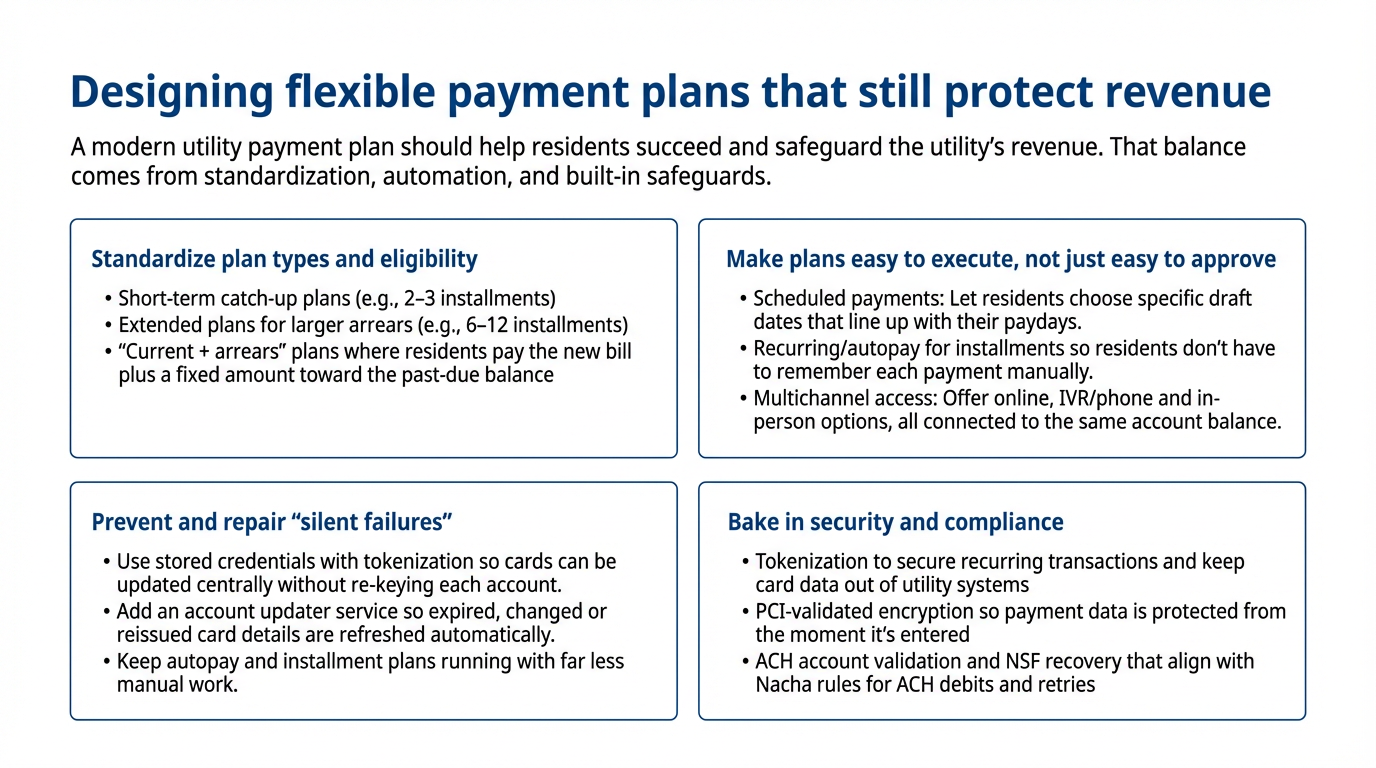
A modern utility payment plan should help residents succeed and safeguard the utility’s revenue. That balance comes from standardization, automation and built-in safeguards.

Standardize plan types and eligibility

Instead of one-off arrangements that depend on which agent answered the phone, define a small set of plan templates, such as:

  • Short-term catch-up plans (e.g., 2–3 installments)
  • Extended plans for larger arrears (e.g., 6–12 installments)
  • “Current + arrears” plans where residents pay the new bill plus a fixed amount toward the past-due balance

Eligibility rules—like minimum/maximum balances, number of plans allowed per 12 months and hardship flags—can be configured in billing systems or payment platforms so frontline staff are applying policies consistently.

This kind of standardization is echoed in internal playbooks on payment plans best practices, which recommend a limited set of options with clear parameters so staff can enroll residents quickly and fairly.

Make plans easy to execute, not just easy to approve

Affordability on paper isn’t enough; residents also need low-friction ways to follow through. Best practices include:

  • Scheduled payments: Let residents choose specific draft dates that line up with their paydays.
  • Recurring/autopay for installments: Encourage residents to put installment amounts on a recurring schedule—either card or ACH—so they don’t have to remember each payment manually.
  • Multichannel access: Offer online, IVR/phone and in-person options, all connected to the same account balance.

When residents can enroll and manage plans through self-service channels, you reduce pressure on contact center staff and shorten call times.

Prevent and repair “silent failures”

Recurring plans often fail because payment credentials change. Instead of waiting for declines and manual outreach, utilities can:

  • Use stored credentials with tokenization so cards can be updated centrally without re-keying each account.
  • Add an account updater service where available, so expired, changed or reissued card details are refreshed automatically.

For example, Hall’s Culligan Water activated an account updater add-on and, in the first month, processed $258,000 more in payments—a 3% increase in successful collections—completed over 4,000 cardholder updates and recovered $193,000 from cards that only needed expiration dates updated.

For utilities, similar tools can keep autopay and installment plans running with far less manual work.

Bake in security and compliance

Because utilities handle sensitive financial data and serve broad populations, payment flexibility must sit on a strong security foundation, including:

  • Tokenization to secure recurring transactions and keep card data out of utility systems
  • PCI-validated encryption so payment data is protected from the moment it’s entered
  • ACH account validation and NSF recovery that align with Nacha rules for ACH debits and retries

These capabilities help utilities offer more options and automation without expanding compliance risk.


Using reminders wisely: channel, timing and tone

Reminders are powerful, but if they’re poorly designed, they can feel intrusive. The goal is to send fewer, more relevant messages at the right time and on the right channel.

Channel: meet residents where they are

The right payer engagement platform should combine email, SMS and automated calls to reach more diverse populations.

Consider:

  • Email for full bill details, plan confirmations and receipts
  • SMS/text for short nudges—“Your bill of $X is due on [date]. Pay now: [link]”
  • Automated voice/IVR for residents who prefer or rely on phone payments

Timing: intervene before penalties and shutoffs

A typical cadence might include:

  • Upcoming-due reminders 3–5 days before the due date
  • Day-of nudges with a one-click or one-tap path to pay
  • Early past-due notices (1–3 days after) that clearly explain options, including payment plans
  • Installment reminders a few days before scheduled payments so residents can confirm funds

Tone: supportive and action-oriented

Especially in essential services, tone matters:

  • Focus on information and options, not blame
  • Clearly state amount, due date and what to do next
  • When past due, highlight ways to avoid interruption—Pay now, Schedule a payment, or Set up a payment plan

This approach respects residents’ circumstances while still driving action.


Coordinating billing, customer service and collections

Reducing late payments isn’t just a collections problem; it’s an end-to-end payments problem. Utilities see the best results when billing, customer service and collections teams share one playbook.

Billing: clear presentment and unified channels

Billing teams can:

  • Move more bill presentment online with EBPP (electronic bill presentment and payment) to send invoices electronically so customers can view bills and pay on their own, which speeds payment and reduces customer service calls.
  • Consolidate payment channels into a single, integrated platform to reduce errors and confusion from fragmented systems.
  • Ensure bills (paper and digital) clearly call out self-service options and how to enroll in autopay or payment plans.

Customer service: resolve issues and close the loop

Frontline agents need tools that let them help residents in a single interaction:

  • Quick access to standardized plan options and eligibility rules
  • The ability to send secure payment links during a call, so residents can complete payments on their device without reading card or bank details aloud (this also reduces PCI scope).
  • Visibility into whether reminder emails, texts or calls were sent, to avoid confusing experiences for residents

Collections: focus on true non-payers

When plans, reminders and autopay are working, collections teams can:

  • Spend more time on genuinely at-risk accounts instead of routine delinquencies
  • Use analytics (e.g., frequent NSFs, chronic non-response) to prioritize outreach
  • Work more closely with billing and CX to refine upstream policies and scripts

Real-world examples from adjacent sectors show what this looks like in practice. WasteWORKS, a solid waste management platform serving utilities and waste facilities, integrated CSG Forte to support online, in-person and card-on-file payments. Facilities now process payments “in seconds,” see fewer manual errors and have a seamless experience at every touchpoint, processing more than 144,000 payments each month through CSG Forte.

That same model—flexible channels with strong back-office integration—translates directly to utilities.


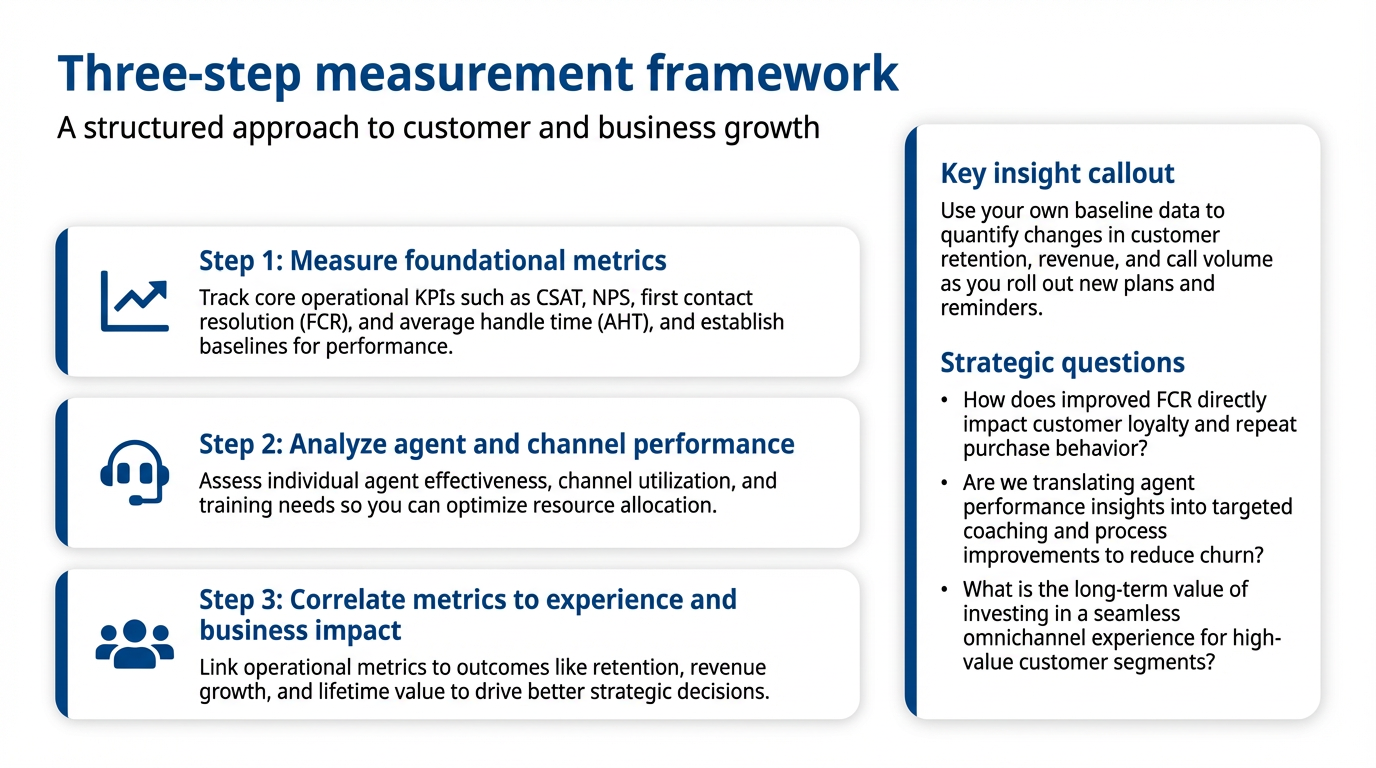
How to measure the impact on delinquencies and call volume

To prove the value of flexible plans and smarter reminders, track changes across three dimensions: delinquencies, operations and customer experience.

1. Delinquencies and revenue metrics

Key measures include:

  • Percentage of accounts 1–30, 31–60 and 61+ days past due
  • Average days sales outstanding (DSO) or equivalent receivables aging
  • Adoption and completion rate of payment plans
  • Autopay enrollment rate (overall and among previously delinquent segments)
  • Card and ACH decline rates before and after implementing tools like account validation, account updater and NSF recovery

2. Call center and operations metrics

Monitor:

  • Total billing- and payment-related call volume
  • Calls specifically about past-due balances or payment plans
  • Average handle time for payment calls
  • Self-service containment (what percentage of payments occur without an agent)
  • Manual work effort in collections (for example, hours spent manually updating cards or chasing declined payments)

Hall’s Culligan reports that after adding CSG Forte’s Account Updater, staff saved significant time because more than 4,000 cardholder records were updated automatically in the first month, rather than through 15–20-minute calls per decline.

3. Customer experience and fairness indicators

To ensure your approach is both effective and equitable, track:

  • Complaint rates related to billing, fees and shutoffs
  • The share of residents using digital channels vs. in-person/phone, segmented by demographics where possible
  • Re-default rates among residents who completed a payment plan
  • Qualitative feedback from surveys or community forums about payment communication and options

Over time, you can adjust plan structures, reminder timing and channel mix based on what improves both on-time payment and satisfaction.


Bringing it all together with modern utility payment solutions

The most effective strategy doesn’t treat payment plans, reminders and autopay as separate projects. Instead, it weaves them together into a single, modern payment experience:

  • Clear, electronic bill presentment and self-service access
  • Standardized, flexible utility payment plans tuned to resident realities
  • Scheduled and recurring payments that align with pay cycles
  • Automated, multichannel reminders with respectful language
  • A secure, compliant infrastructure that protects both customer data and cash flow

CSG Forte’s utility billing and payment solutions are designed to support exactly this kind of approach, with omnichannel acceptance (online, IVR, in-person), payer engagement capabilities for reminders and flexible payment options, and secure electronic bill presentment.

If your organization is ready to reduce late payments, lower call volume and improve the resident experience, it may be time to revisit your payment strategy.

Talk with CSG Forte’s sales experts to explore how modern utility payment plans, reminders and recurring autopay can work within your existing systems and policies. You can also download our government-specific eBook to learn more about how CSG Forte serves government-run utility customers.


FAQs

What is a utility payment plan?

A utility payment plan is an agreement that lets a customer pay down a past-due balance over time—often in fixed installments—while keeping current bills paid. Modern plans can be managed online, over the phone or in person, and may support recurring or scheduled payments.

How do recurring autopay options reduce late utility payments?

When residents enroll in recurring payments for their monthly bill or plan installments, they no longer rely on remembering due dates. Combined with card updater and ACH validation tools, autopay can significantly reduce missed or declined payments.

What channels should utilities use for payment reminders?

Best practice is to combine email (for detail), SMS/text (for quick nudges and pay links) and automated phone/IVR for residents who prefer to call. CSG Forte’s payer engagement and utilities solutions highlight this multichannel approach to reduce delinquencies and support diverse customer preferences.

How can utilities keep flexible payment options secure and compliant?

Utilities should work with providers that support tokenization, PCI-validated encryption, ACH account validation and Nacha-compliant NSF recovery. CSG Forte emphasizes these controls across its utilities and bill presentment solutions.

What metrics show that payment plans and reminders are working?

Track past-due rates by aging bucket, autopay and plan adoption, card/ACH decline rates, billing-related call volume, and complaints about billing or shutoffs. CSG Forte case studies, like Hall’s Culligan and WasteWORKS, demonstrate how the right tools improve collections and reduce manual workload.

Secure, Fast, Easy: How Electronic Payments Can Help Your Business

Top Takeaways

  • Electronic payments are now the default. Customers expect to pay with cards, ACH/eChecks, digital wallets, and contactless—across online, in‑person, and phone channels—not with paper checks or cash.
  • ACH and eChecks quietly drive big savings. Account‑to‑account payments via the ACH Network reduce processing costs and chargebacks, support same‑day funding, and streamline recurring and high‑value payments.
  • The biggest pain points are fees and slow funds; modern platforms fix both. Consumers are frustrated by provider fees and delayed payments, while platforms like CSG Forte use low‑cost ACH/eChecks, modern security, and unified reporting to deliver faster, safer, more convenient bill pay experiences.

Electronic payments are now the default—not the exception—for how customers move money. Instead of paper checks and cash, most transactions are completed through digital channels, including credit and debit cards, automated clearing house (ACH), and eCheck payments, digital wallets, and even virtual cards, whether a customer is paying online, in person, or over the phone.

Within that broader electronic payments landscape, eChecks offer a modern way to move money directly between bank accounts through the ACH Network—no paper, no manual deposits, and far less time spent on back-office reconciliation. Modern payments platforms allow eChecks alongside cards and digital wallets on a single platform, helping you cut processing costs, speed up cash flow with options like same-day ACH, and deliver a consistent, secure payment experience every time your customers choose to pay.


4 Clear Benefits of Electronic Payments 

With a complete online payment solution, users can enjoy:

  1. Payment ease: Many forms of e-payment allow users to pay with as little as a tap. With an easier payment process, you improve the user experience for payers and payees.
  2. Reduced processing costs: Processing checks involves printing, signing, and mailing. These tasks require manual labor and material expenses. Electronic payments eliminate these processes, saving you money on payment processing.
  3. Greater visibility: With electronic payments, you can track transaction status, access financial metrics, and follow audit trails for compliance needs. These tracking capabilities are often integrated into e-payment platforms, so following the status of your financials is much easier than when manually processing physical payments.
  4. Improved security: Handling cash or checks can easily lead to theft or fraud. With electronic payments, you eliminate passing physical money between hands and benefit from built-in encryption that protects user data during transactions.


Different Payment Options, Different Advantages

There are various types of electronic and online payments, and all offer unique advantages.

ACH Debit Pull

The ACH Network processes electronic transactions between bank accounts. In the case of an ACH debit pull, a payee initiates a pull of funds from a payer’s account. One of the most common examples of a debit pull is direct deposit for employees.

These debit pulls are typically low-cost, and sometimes they’re completely free. The most significant advantage of this electronic payment is it eliminates the need to collect and process checks or deposit cash.

ACH Credit Push

An ACH credit push is the opposite of a debit pull. Rather than the payee pulling the funds from the payer’s account, the payer pushes the amount out of their account and to the payee. Credit pushes are common for a range of online payments where the vendor is an established company. ACH payments often come with lower processing fees than credit cards, making them a practical option for some businesses.

Credit Cards and Debit Cards

With a credit card, a user borrows money from their card issuer up to a certain predetermined limit. The cardholder is responsible for paying the borrowed money back, often with interest. Conversely, debit cards use only funds that users have in bank account.

Both debit and credit cards offer a secure payment method. They are easy to use at the point of sale (POS) and online. With the growing use of chip payments with credit cards, every transaction has a unique code that makes it challenging to steal sensitive information.

Credit cards offer more protection against fraud as you are borrowing money are in turn not responsible for as much liability. A victim of debit card fraud could be fully liable for fraudulent transactions depending on the time since the transactions and bank policies.

Mobile Pay, Digital Wallets, and Contactless NFC Payments

Mobile pay relies on a mobile device, such as a smartphone, smartwatch, or tablet, to complete a transaction. Many of these devices are compatible with mobile wallets that allow users to upload their card information for use at POS terminals. These terminals must have near-field communication (NFC) to receive payment information from the mobile device and accept payment.

Mobile payments can also include mobile payment platforms that use ACH payments to complete transactions. This payment type offers convenience since most people carry some kind of mobile device. Additionally, these mobile payment methods typically require authentication before completing a transaction, making them a secure electronic payment option. NFC payments also provide the advantages of being fairly hygienic, quick, and very secure.


How to Keep Your Private Data Safe

Data breaches can have long-reaching financial and systemic impacts on businesses, and can damage the reputation of even legacy organizations. What’s more, breaches can spell financial ruin for companies without the financial, legal, and logistical bandwidth to weather the storms of a hack.

Regulations by both Nacha and Payment Card Industry Data Security Standard (PCI DSS) determine how payment data is received, stored, transmitted, and processed for each transaction. This detection helps reduce the likelihood of an attack. However, it’s important that payment processors who offer PCI compliance programs stay ahead of those who wish to do harm to hardworking business owners by hacking their systems.

For point-of-sale transactions, end-to-end encryption provides a level of security to your entire payment processing system from terminal to payment acceptance and beyond. When accepting payments online, SSL webpages, and other methods of data encryption help ease the worry of consumers and take some of the burden off merchants to remain PCI-compliant.


What’s Next For Electronic Payment Systems?

Digital payments are no longer a niche behavior; they’re how most people already pay.

But the experience still isn’t working the way they need. In the Federal Reserve’s 2024 Consumer Payments Study, 45% of consumers said fees charged by payment service providers were a top challenge, and 25% pointed to slow speed of funds, which can trigger late or insufficient-funds fees and even service disconnections.

For businesses, that means the bar has moved: customers expect to view bills, choose their preferred payment method, and check out in just a few clicks, whether they’re on a laptop, a phone, or standing at the counter.


5 Ways Your Business Benefits from Electronic Payments

  1. Improved supplier relationships: When your vendors can enjoy the ease of e-payments, they know that you value their time, security and ease of payment processing. These e-payments also include remittance data for ease of reconciliation. Many modern suppliers may come to expect e-payment options and may even turn down relationships without this convenience factor.
  2. Increased customer satisfaction: Your customers will enjoy the convenience and security of e-payments as much as your vendors. When paying for products or services is easy, consumers are more likely to follow through with a purchase.
  3. Reduced costs: Processing cash and checks can require hours of physical labor and expenses dedicated to stamps and mailing. Enjoy the reduced administrative overhead of e-payments.
  4. Enhanced security: With encryption and unique transaction codes, e-payments are far more secure than physical cash or checks. Plus, electronic payments eliminate the risk of losing cash or checks before they get deposited.
  5. Greater flexibility: If you offer various types of e-payments, consumers can pay in a way that works for them. For example, a buyer who forgot their wallet can use their mobile wallet to cover costs. This flexibility encourages more sales.


Optimize Your Electronic Payment Systems with CSG Forte

CSG Forte offers a comprehensive electronic payment solution that supports online, in-person, and phone payments. Our payments platform supports secure, flexible payments with reliable reporting and a user-friendly interface. With recurring payment capabilities, intuitive bill presentation, point-of-sale support and trusted security practices, CSG Forte supports the success of modern businesses.

See what electronic payments can do for you, and get started with our platform today.

Frequently Asked Questions

What’s the difference between ACH, eCheck, and card payments?
ACH and eCheck payments move money directly between bank accounts over the ACH Network, while card payments run through card networks and issuers. ACH and eChecks typically have lower processing costs than cards and are ideal for recurring, high‑value, or bill‑pay scenarios, while cards and digital wallets are best for everyday, discretionary purchases and in‑person checkouts.

Are electronic payments really more secure than checks and cash?
Yes. Electronic payments reduce the risk of lost or stolen checks and cash, and modern platforms add multiple protection layers—encryption, tokenization, account validation, and PCI‑aligned controls—to keep card and bank data out of your environment. That combination lowers fraud risk, simplifies compliance, and gives customers more confidence when they pay.

How do electronic payments lower my operating costs?
Electronic payments eliminate manual check handling—printing, mailing, batch deposits, and hand keying—which cuts labor and paper costs. They also reduce bank trips, minimize errors and rekeying, and, when you steer appropriate volumes to ACH and eChecks, help lower your overall payment acceptance costs compared to an all‑card mix.

How quickly will I get my money with electronic payments?
Card and digital wallet payments typically settle within one to two business days, depending on your funding setup. ACH and eCheck payments can clear in a few business days, with options like same‑day ACH available for use cases where faster funds availability is critical to cash flow.

What does it take to start accepting electronic payments with CSG Forte?
Most businesses can get started by completing a single application to enable cards, ACH, and eChecks on CSG Forte’s unified payments platform. From there, you can plug Forte into your website, POS, or phone systems, turn on features like recurring payments and online bill pay, and manage every transaction—online, in person, and by phone—from one dashboard.

The Modern Bill Pay Playbook for Operational Leaders

Key Takeaways

  • Outdated bill pay systems create friction, late payments, and operational drag that show up in cash flow, customer satisfaction, and staff workload.
  • Modern bill pay is now a core operational capability—not just a finance or IT project—and requires cross-functional ownership from operations, billing, customer service, and finance.
  • CSG Forte BillPay gives organizations a plug-and-play, cloud-based way to deliver omnichannel bill payment experiences, branded portals, and a centralized management hub (Dex) without a heavy development lift or rip-and-replace project.
  • Operational leaders can drive measurable improvements by aligning teams around a shared roadmap, nudging payers toward self-service, and tracking real-time metrics like on-time payment rates and self-service adoption.


Why bill pay needs dedicated operational focus

Modern bill pay is no longer a back-office utility you can “set and forget.” It directly influences how quickly revenue comes in, how many calls hit your contact center and how customers feel every time they pay you. For operational leaders in government, utilities, property management, healthcare, and beyond, that makes bill pay a frontline experience, not just a finance workflow.

The hidden costs of outdated systems

Legacy bill pay systems do more than frustrate IT—they create real business risk and operational waste. Common symptoms include:

  • Increased late payments and cash-flow uncertainty. When customers must remember due dates, find paper statements or call to pay, it’s easy for bills to slip.
  • Higher call volumes and repetitive work. Agents spend time answering “Did my payment go through?” or taking card numbers over the phone instead of handling higher-value interactions.
  • Manual reconciliation and brittle reporting. Finance teams stitch together spreadsheets, bank files, and system reports, slowing close processes and limiting visibility into trends.
  • Operational risk and compliance pressure. When payment data is scattered across systems or handled manually, it’s harder to maintain PCI alignment, Nacha rules, and internal controls.

Industry research shows just how much room there is to improve: 54% of consumers pay at least one bill late in a given year—often due to forgetfulness rather than inability to pay—and 77% of online payments are now made directly on biller websites. If your experience is clunky or limited, you’re leaving money and goodwill on the table.

Modern consumer expectations

Your customers compare your bill pay experience to their bank, streaming services and mobile carriers—not to your peers. They expect:

  • Self-service first. Payers want to view balances, update details, and pay from any device without calling in.
  • Choice and flexibility. ACH, cards, and digital wallets; pay-now and registered flows; the ability to schedule, split, or pre-pay when cash flow is tight.
  • Speed and reassurance. Clear confirmations, receipts, and a simple way to see payment history across channels.

When bill pay doesn’t feel as intuitive as the rest of their digital life, they notice—and delinquency, disputes, and call volumes tend to rise alongside frustration.


Core components of modern bill pay

A truly modern bill pay platform goes beyond accepting card payments online. It brings together omnichannel payments, branded experiences, and centralized operations in one place.

Omnichannel payment acceptance

Modern bill pay meets customers where they are instead of forcing them into a single channel. With CSG Forte BillPay, organizations can accept:

  • Online and mobile payments through a responsive, branded portal
  • Phone and IVR payments with secure capture behind the scenes
  • In-person and kiosk payments that share the same processing backbone
  • Text-to-pay and digital wallets for fast, link-driven checkouts on the go

Because these channels all run on a unified platform, operations teams gain a single view of activity instead of managing multiple, disconnected tools.

Branded, customizable portals

A generic third-party payment page can undermine trust and increase abandonment. A branded, configurable portal reinforces your identity while giving customers a familiar, self-service experience.

CSG Forte BillPay supports:

  • Guest “Pay Now” flows for one-time or infrequent payers
  • Registered accounts for recurring users who want saved payment methods and history
  • Multilingual support and mobile-first design to reach broader populations
  • Configurable payment options—including schedule-pay, autopay, partial, over-pay, and pre-pay—aligned to your policies

Behind the scenes, you can customize portal URLs, landing page text, and messaging so the experience feels like a seamless extension of your website, not a hand-off to an unknown vendor.

Security and compliance by design

Payment security and compliance can’t be bolt-ons. A modern bill pay solution must capture sensitive data through PCI-compliant forms, tokenized card, and account details, and store them on secure servers, reducing the scope of your own environment.

CSG Forte BillPay is built to support PCI-aligned processing and evolving regulatory needs across card and ACH, helping you limit staff exposure to raw payment data while maintaining audit-ready records.


Designing payment options and channels strategically

Offering “everything, everywhere” isn’t enough. Operational leaders need to intentionally design payment rails and options to balance cost, risk, and customer preference.

Choosing the right mix

Each payment method carries trade-offs:

  • ACH/eCheck often offers lower processing costs and is ideal for larger or recurring payments.
  • Debit and credit cards give customers flexibility but can increase fees if not managed thoughtfully.
  • Digital wallets (like Apple Pay, Google Pay, or PayPal) can boost conversion on mobile but may be best targeted to specific segments or use cases.

With CSG Forte BillPay, you can configure which rails are available by program, customer type or vertical—steering high-value recurring payments toward ACH while still meeting customer expectations for card and wallet support.

Flexible payment options

Modern bill pay makes on-time payment the default by giving payers options that fit real-world cash flow:

  • Autopay enrollment tied to due dates
  • Scheduled payments aligned with pay cycles
  • Partial, over-pay, and pre-pay options within policy bounds
  • Payment plans for at-risk accounts where appropriate

In many recurring billing environments, these capabilities have helped organizations reduce late payments, smooth cash flow, and cut down on exceptions work for staff.

Removing barriers to self-service

Self-service is one of the fastest levers operational leaders can pull to reduce call volume and manual work. To accelerate adoption:

  • Remove unnecessary friction (like mandatory registration for a one-time payment).
  • Promote digital channels in statements, reminders, and frontline scripts.
  • Pair reminders with direct links to secure payment pages or text-to-pay flows, so customers can complete payment in a few taps.

When self-service is intuitive and clearly promoted, operational teams see fewer “Where do I pay?” calls and more predictable daily payment volume.


Coordinating billing, customer service, and finance around payments

Modern bill payment solutions are as much about alignment as it is about technology. Fragmented tools and siloed processes make it impossible to deliver a consistent payer experience or understand what’s really happening across channels.

Breaking down silos

To make bill pay work harder for the organization, operational leaders should:

  • Establish shared KPIs across billing, customer service, and finance—such as on-time payment rate, self-service adoption, call volume, and reversal rates.
  • Standardize workflows for refunds, disputes, and adjustments so customers get consistent answers regardless of channel.
  • Consolidate systems wherever possible so staff aren’t logging into different portals for each bill type, department or location.

This is where a centralized management hub becomes critical.

Centralized management with Dex

CSG Forte’s Dex platform gives operational teams a single pane of glass into payments across channels, programs and locations. With Dex, teams can:

  • View near real-time transaction activity and settlement status.
  • Access standardized reporting and exports that feed existing finance and policy systems.
  • Manage disputes, refunds, and research through consistent workflows.
  • Surface operational insights (like rising declines or channel-specific issues) without waiting on ad hoc reports.

Instead of stitching together spreadsheets, leaders get a trustworthy source of truth they can use to make decisions quickly.


Building a roadmap and measuring progress

Modernizing bill pay doesn’t have to be a single “big bang” project. The most successful operational leaders treat it as a repeatable roadmap with clear phases, milestones, and KPIs.

Steps to modernization

Use this playbook as a practical starting point:

  1. Assess your current bill pay experience.
    Map every way customers pay you today (online, phone, in person, mail) and document where friction, late payments, and manual work show up.
  2. Define your modernization goals.
    Clarify what “good” looks like: higher self-service adoption, lower calls per payment, improved on-time payment rate, reduced reversal rates, or better reporting for finance and operations.
  3. Design your channel and payment mix.
    Decide where ACH, cards, and wallets fit; which programs should encourage autopay; and how text-to-pay, reminders, and notifications will support your strategy.
  4. Align teams and processes.
    Bring billing, customer service, IT, and finance together around a shared rollout plan. Identify quick wins (like turning on guest checkout or adding reminders) before larger integrations.
  5. Implement with a partner that fits your stack.
    Look for plug-and-play, cloud-based solutions that integrate with your existing systems via APIs or file-based workflows—so you can modernize without rewriting your tech stack.
  6. Track, optimize and expand.
    Use real-time reporting and dashboards to monitor adoption, performance and operational metrics, then iterate—tuning options, communication, and policies over time.

Ongoing enhancements

Modernization isn’t a one-and-done launch. Customer behavior, regulatory requirements, and channel preferences will continue to evolve. To stay ahead:

  • Monitor key metrics like on-time payment rate, self-service adoption, channel mix and reversal rates.
  • Gather feedback from both customers and frontline teams to understand where friction remains.
  • Experiment with new features—such as Text to Pay, Account Updater, or recovery services—as your needs grow.

Organizations using CSG Forte’s capabilities have leveraged this kind of incremental approach to recover revenue, reduce manual work and create payment experiences that match what customers expect from modern digital brands.


Why CSG Forte BillPay is built for operational leaders

CSG Forte BillPay is designed specifically to help operational leaders modernize bill payments without taking on a multi-year, high-risk system overhaul.

BillPay delivers:

  • Plug-and-play, cloud-based deployment that layers on top of your existing systems instead of replacing them.
  • Omnichannel acceptance across web, mobile, IVR, text-to-pay, in-person, and kiosk channels.
  • Branded, customizable portals with guest and registered checkout, multilingual support, and flexible payment options that match your policies.
  • Centralized management through Dex, giving teams real-time visibility, reporting and reconciliation tools in one operational hub.
  • Security and compliance at scale, with PCI-aligned hosted forms, tokenization and controls that help limit internal exposure to sensitive payment data.

In 2024 alone, organizations processed approximately $1.49 billion in bill payments through CSG Forte BillPay, underscoring its role as a proven platform for high-volume, high-stakes payment operations.


Ready to modernize your bill pay experience?

If your bill pay operations still rely on fragmented portals, manual reconciliation, or one-size-fits-all options, now is the time to build a modern playbook that works for your teams and your customers.

Contact CSG Forte to learn how modern bill pay can transform your operations.

To see what’s possible in your environment—and how peers across government, utilities, property management, healthcare, insurance, and financial services are modernizing bill pay—request a demo.

How to Build a Donor Retention Strategy Around Better Payment Experiences

Key Takeaways

  • Donation friction isn’t just a conversion problem; it’s a long-term retention risk that quietly pushes donors away after their first gift.
  • Every payment touchpoint—from the donation form to recurring payment retries—shapes whether supporters feel giving is easy enough to repeat.
  • Treating donations as a product to be optimized lets nonprofits grow recurring programs, cut involuntary churn and strengthen donor lifetime value.

Nonprofits talk a lot about donor retention strategy—and for good reason. Keeping an existing supporter is almost always more cost-effective than finding a new one. But many organizations overlook one of the most powerful (and fixable) drivers of donor churn: the moment someone actually tries to give.

Every appeal, story, and email is working toward a single high-intent action: a supporter choosing to make a gift. If that payment experience feels confusing, slow or insecure, they may push it off—or decide not to try again next time. If it feels effortless and trustworthy, they’re much more likely to come back, upgrade and enroll in recurring giving.

This pillar walks through how donation friction shows up, the key payment touchpoints in your donor journey and how to design your donation flows as a core part of your retention and repeat giving strategy.


How donor friction quietly drives churn

Most teams think of friction as a one-time conversion problem. You’ll often hear laments like, “our donation form has a high abandonment rate.” In reality, payment friction quietly erodes long-term retention.

Friction isn’t just failure; it’s effort

Friction is any extra work, confusion, or delay a supporter must endure to complete or repeat a gift. It includes:

  • Pages that take too long to load
  • Forms that are hard to use on a phone
  • Payment errors with no clear explanation
  • Unclear confirmation or missing receipts
  • Difficulty updating a card or bank account

The donor might still push through once, especially if they’re highly motivated—say, during a crisis appeal. But when they’re deciding whether to respond to your next campaign, that memory of friction becomes a reason to skip it.

Micro-frustrations chip away at trust

Even small issues add up:

  • The donation form doesn’t quite match the email or landing page brand
  • Suggested amounts feel aggressive or out of touch
  • Additional required fields (phone, full mailing address, extra questions) feel intrusive
  • The “submit” button spins for several seconds with no feedback

Individually, these seem minor. Together, they send a message: “This might be annoying again.” Retention is, at its core, the donor deciding: “Do I want to go through that experience again?”

Operational friction triggers involuntary churn

For recurring donors, a big chunk of churn is involuntary—caused by payment failures, not by a conscious decision to stop giving. Common causes:

  • Expired or reissued credit/debit cards
  • Donors changing banks
  • Insufficient funds on a particular day
  • False declines or network hiccups

If your systems don’t retry intelligently, notify donors clearly or offer easy self-service to update payment details, many of those gifts simply disappear. The donor may still care deeply about your mission—they just never get around to fixing a broken payment.

Lack of choice = silent abandonment

Supporters increasingly expect to give the way they pay for everything else: on their phones, with stored details, wallets or bank transfers. If they can’t use a method they trust—especially for recurring gifts—they’re more likely to:

  • Make a smaller, one-time gift instead of monthly
  • Shift their recurring support to another organization that feels easier
  • Abandon the process entirely during checkout

All of this shows up in your reports as “lapsed donors,” “one-time only givers” or “recurring churn.” Underneath those labels is often a simple story: the payment experience made giving harder than it needed to be.


Payment touchpoints along the donor journey

A strong donor retention strategy maps the entire supporter journey—and treats every payment-related moment as a retention opportunity, not just a revenue event.

1. Pre-donation: the confidence window

Before a donor ever types a card number, they’re asking:

  • “Does this look legitimate?”
  • “Is this the right place to give?”
  • “Will my gift do what they say it will?”

What to focus on:

  • Consistency and branding. Donation pages should clearly match your website, emails and campaigns.
  • Clarity of purpose. Explain—in a sentence or two—what this gift will support and what will happen next.
  • Basic reassurance. Visible security cues and privacy language (“Your payment is processed securely…”) reduce hesitation.

If this moment feels confusing or risky, some donors will never reach the form.

2. The donation form: where intent meets friction

This is the most fragile point in the journey. The supporter has decided to give; your job is to make it as easy as possible to follow through.

Retention-friendly form principles:

  • Ask only for what you truly need: Name, email and payment details are usually enough to process a gift. Everything else can be optional or captured later.
  • Design for mobile first: Use large tap targets, minimal scrolling, correct input types (numeric keypad for amounts, email keyboard for email, etc.).
  • Make recurring options clear and simple: Offer an obvious “monthly” or “make this a recurring gift” choice, with plain-language benefits.
  • Avoid surprises: If there are fees, match amounts or other options, explain them clearly and up front.

A donor who completes a first gift in 30 seconds on their phone is far more likely to repeat that behavior than someone who wrestles with a clunky form.

3. Payment method choice: meeting donors where they are

Different supporters prefer different rails:

  • Credit and debit cards
  • ACH / bank transfer
  • Digital wallets (Apple Pay, Google Pay, etc.)
  • Text-to-give or SMS links
  • Hosted portals or mobile apps

Why this matters for retention:

  • Bank accounts don’t “expire” like cards, making them more stable for recurring gifts.
  • Wallets and stored details reduce the “typing tax,” especially on mobile.
  • Familiar options can feel more trustworthy to some donors.

You don’t need every possible option. But you do need a mix that reflects your audience, with at least one low-effort, pay-by-phone choice and one stable option for recurring gifts.

4. Confirmation and receipts: locking in the “I’ll do this again” feeling

Once a donor hits “submit,” they should never wonder whether their gift actually went through.

A retention-oriented confirmation flow:

  • A clear, immediate on-screen message (“Thank you. Your gift of $X to [program] has been received.”)
  • A simple summary (amount, frequency, date, last four digits of payment method)
  • A prompt, well-formatted email receipt they can save or forward for records
  • A short, mission-focused thank-you that connects their gift to impact

This is also a prime place to:

  • Let recurring donors know how to manage or update their gift
  • Invite one simple next step (e.g., “Watch a 2-minute story about the work you’re supporting”)

Handled well, this moment reinforces: “Giving here is easy, secure and meaningful”—exactly the mindset you want at renewal time.

5. Post-donation support and self-service

Over the life of a donor relationship, questions and issues will come up:

  • “I didn’t get my receipt.”
  • “I need to change my card or bank account.”
  • “Can I update the amount or date of my recurring gift?”

If solving these creates long email threads, phone calls or confusion, supporters feel the friction—and sometimes opt out entirely.

Better approach:

  • Create a simple “Manage my giving” path from your website and emails.
  • Offer donors self-service where possible (update card, change amount or date, download receipts).
  • Back it up with responsive human support when needed.

The easier it is to fix a problem, the more likely donors are to keep their relationship going.

6. Recurring payment management: your hidden retention engine

For sustainers, a great recurring payment system is the relationship. If it works smoothly, the donor might stay with you for years. If it fails silently, you can lose them without ever having a conversation.

Key capabilities:

  • Smart retries. If a payment fails, retry automatically on a logical schedule instead of giving up after one attempt.
  • Helpful notifications. Let donors know when there’s a problem, in a friendly, non-alarming tone, with a one-click way to fix it.
  • Flexible rails. Offer the ability to switch from card to bank transfer or another method that may be more stable long term.

A mature donor retention strategy treats this “back office” work as front-line stewardship.


Designing donations as part of your retention strategy

To connect payment experiences directly to retention and repeat gifts, treat donations like a product you’re constantly improving—not just a form you launched once.

1. Start with clear, payment-linked retention goals

Before you change anything, define the outcomes you want that are influenced by payment experiences. For example:

  • Second-gift rate: Percent of first-time donors who give again within 12 months.
  • Recurring enrollment rate: Percent of donors who start a monthly gift.
  • Recurring survival: Average number of successful payments before a recurring gift stops.
  • Involuntary churn: Percent of recurring gifts that end because of failed payments, not donor choice.

These metrics help you tie UX and payment changes to tangible improvements in your donor retention strategy, rather than just “the form feels nicer.”

2. Map friction to data, not just anecdotes

You probably hear comments like “our form is too long” or “people don’t like creating accounts.” Those observations are useful—but you’ll make better decisions if you ground them in data.

Look for:

  • Completion and abandonment rates by device (desktop vs. mobile)
  • Error rates at each step of the form
  • Distribution of payment methods and their failure rates
  • When recurring gifts tend to fail (e.g., after card expiration)

From there, you can prioritize fixes that attack the biggest sources of friction first.

3. Redesign the donation journey around donor effort

A practical lens is donor effort: how much cognitive and physical work does someone have to do to complete and repeat a gift?

Ways to reduce effort:

  • Simplify field sets. Make address and phone optional unless they’re truly required for compliance or acknowledgment.
  • Use smart defaults. Pre-select a reasonable gift amount or cadence based on typical giving patterns, while making changes easy.
  • Limit decision points. Avoid stacking too many choices (funds, premiums, opt-ins) on a single screen.
  • Write plain-language microcopy. Replace jargon like “CVV” or “billing instrument” with short explanations.

Design goal: a supporter should be able to complete a gift on their phone, from a campaign email or text, in under a minute—without guessing, scrolling endlessly or switching devices.

4. Engineer reliability into recurring giving

Because recurring donors are so central to retention and lifetime value, it’s worth investing in payment reliability for this segment.

Focus on:

  • Proactive card and account updates. Use tools that can update card details when issuers reissue cards, and validate bank details when first used or changed.
  • Thoughtful dunning (failed-payment outreach). When a payment fails, send clear, empathetic messages that assume good intent and make it easy to fix the issue.
  • Alternative rails. Offer bank transfers or other lower-failure-rate methods as an option, especially for larger recurring gifts.

Communicate these improvements as benefits to donors: “We’ve updated our systems so your monthly gift can continue without interruption, and your details remain secure.”

5. Align fundraising, finance and technology around the donor

Payment experiences sit at the intersection of fundraising, finance and IT. If these teams work in silos, donors feel it:

  • Finance enforces rules that add friction without understanding donor behavior
  • Fundraising teams launch new campaigns on different forms with inconsistent experiences
  • IT implements tools without clear UX requirements

To make donations a core part of your retention strategy:

  • Bring all three groups into shared planning for donation flows and platforms.
  • Agree on a small set of shared metrics (e.g., recurring churn, payment success, average days to resolve a donor payment issue).
  • Treat major changes—new payment methods, redesigned forms, new portals—as cross-functional initiatives with clear owners.

Retention improves when donors experience your organization as one coordinated whole, not a patchwork of disconnected systems.

6. Test, learn and iterate like a product team

Finally, bake iteration into your approach:

  • Run A/B tests on key elements (field count, button copy, default gift amounts, recurring toggle placement).
  • Time changes so you can compare performance before and after big campaigns (e.g., year-end, GivingTuesday).
  • Gather qualitative feedback from real donors—short surveys on the confirmation page can reveal pain points you’d never see in analytics.

Over time, small, continuous improvements to the payment experience compound into:

  • Higher first-time conversion rates
  • More donors choosing recurring gifts
  • Fewer failed payments and lapsed sustainers
  • Stronger, more predictable revenue you can invest in your mission


Bringing it together

A resilient donor retention strategy is built on more than great stories and thank-you emails. It depends on whether giving to your organization consistently feels:

  • Easy
  • Secure
  • Respectful of a donor’s time and data
  • Emotionally rewarding

By treating donation and payment experiences as core retention levers—not just back-end plumbing—you can reduce silent churn, grow your recurring base and make it far more likely that first-time supporters become lifelong partners in your mission.

Ready to build lasting donor relationships? Start optimizing your donation experience today. CSG Forte can help you set up your merchant account, grow your recurring base, reduce friction, and turn one-time supporters into lifelong champions for your cause.

Reach out to one of our nonprofit payments experts today or sign up to get started.


FAQs

Q1. What is a donor retention strategy in the context of payments?

A donor retention strategy is a coordinated plan to keep supporters giving over time. On the payment side, that means designing donation forms, methods, confirmations and recurring management so that giving is consistently easy, trustworthy and repeatable.

Q2. How do I know if payment friction is hurting our donor retention?

Look for signs like high mobile abandonment on donation forms, a large share of “one-and-done” donors, frequent payment errors, and recurring gifts that stop after a few months due to failed payments. These patterns often indicate that the payment experience, not donor intent, is driving churn.

Q3. Which payment methods are best for recurring donors?

Cards are familiar and convenient, but they expire and are reissued. Bank transfers (ACH or similar) often have lower failure rates over time. The best mix typically includes both, plus mobile-friendly options like digital wallets, so donors can choose what feels easiest and most trustworthy.

Q4. How often should nonprofits review and update their donation experience?

At minimum, review your donation flows annually and before major fundraising seasons. Many organizations benefit from a lighter quarterly audit to check for new friction points, mobile issues, or opportunities to streamline fields and add relevant payment options.

Q5. What metrics should we track to connect payment improvements to retention?

Track donation completion rate (by device), recurring enrollment rate, recurring payment success rate, involuntary churn (failed payments), and second-gift rate within 6–12 months. When you make payment UX changes, compare these metrics before and after to see the impact.

Modernizing Insurance Payments: Lower Admin Burden, Higher Retention

Key Takeaways

  • Legacy, fragmented insurance payment stacks create unnecessary manual work, higher operating costs, and frustrating payment experiences that quietly erode retention.
  • Modern, omnichannel payment platforms let insurers offer ACH, card, and digital wallet options across web, mobile, IVR, text-to-pay, and in-person channels.
  • A phased modernization roadmap helps insurers improve collections and retention while reducing disruption.

Insurance leaders are under pressure from every direction. Claims costs are rising, new competitors are entering the market, and policyholders now benchmark every interaction against the best digital experiences they have in banking, retail and other services.

Yet many insurers still rely on aging billing systems, paper-heavy workflows, and a patchwork of vendors to collect premiums and pay claims. That gap shows up most clearly in payments.

When it is hard to pay a premium, confusing to understand a bill or frustrating to update a payment method, policyholders notice. They call the contact center, delay payment, or quietly move their business elsewhere. Internally, billing and finance teams spend hours each week reconciling files, chasing late payments, and fixing errors that never should have happened.

Modern insurance payment solutions change that dynamic. By upgrading how you present, accept, and reconcile payments, you can reduce manual work, improve on-time collections, and deliver the kind of experience that keeps policyholders around longer.


Why legacy insurance payment workflows are breaking down

1) Siloed systems between billing, policy admin, and claims

Most insurers did not set out to build a complex payment stack; it evolved over time. A core policy administration system here, a standalone online payment portal there, and a separate provider for refunds or claim disbursements. Agencies and managing general agents (MGAs) often use their own tools on top.

The result is a patchwork of portals, files, and vendors that do not talk to each other cleanly. Policyholders might:

  • Receive a paper bill for one line of business and a digital notice for another.
  • Pay premiums in one portal but receive claim payments by check.
  • Call the contact center because they are not sure whether a payment went through.

Internally, this fragmentation makes it hard to see a complete payment history or even answer a simple question like, “Did this policyholder pay on time?”

2) Manual work and exceptions that never end

When payments are scattered across systems and channels, manual work expands to fill the gaps. Billing and finance teams:

  • Download files from multiple portals and import them into finance systems.
  • Manually reconcile premiums, refunds, and agency commissions.
  • Re-key payment data from one system into another.
  • Track down exceptions when an online payment does not match what is in the policy system.

These tasks are painful in normal times and almost unmanageable during peak cycles like renewals or major storms. They also contribute directly to higher operating costs and staff burnout.

3) Growing gap between policyholder expectations and reality

Across industries, customers expect simple, digital, self-service experiences, from getting a quote to managing claims. Insurers must provide clear, personalized communication across preferred channels to build trust.

Yet many insurance payment experiences still involve:

  • Limited options—card only, no ACH insurance payment option for larger or recurring premiums.
  • Portals that are hard to use on mobile devices.
  • Few or no proactive reminders or confirmations.
  • Paper checks for claim payments when policyholders would prefer digital disbursements.

Because bills and payments are often the most frequent touchpoints between a policyholder and their insurer, clunky experiences quickly undermine even the best underwriting and marketing.


The hidden cost: churn, leakage, and staff burnout

Payment friction rarely shows up as a line item on a P&L, but it affects core metrics:

  • Lapsed policies when a premium fails and the insurer cannot re-engage quickly.
  • Increased call center volume as policyholders call to confirm balances or make payments by phone.
  • Slower collections and more write-offs when billing teams cannot keep up with manual work.
  • Staff attrition when billing and finance roles are dominated by low-value, repetitive tasks.

In a market where combined ratios are under pressure and insurance companies compete on experience, these “hidden” costs add up quickly.


What modern insurance payment solutions look like

Modern insurance payment solutions are built to simplify interactions “every step of the way,” from quote to claim.

They share a few key traits.

Omnichannel, policyholder-friendly payment experiences

Policyholders expect to pay however and wherever it is easiest for them. Modern insurance payment portals should support:

  • Web and mobile portals that are easy to use on any device.
  • IVR and contact-center payments for customers who prefer to call.
  • Email or text-to-pay notifications that let customers complete a payment in a few taps.
  • In-person or agent-assisted payments using POS devices—all backed by the same platform.

The key is consistency. Whether someone pays online, via text or over the phone, they should see the same balance, options and confirmation. That consistent omnichannel experience is central to your broader insurance story.

Support for card and ACH insurance payments

Card payments are familiar and convenient, but they can be expensive at higher ticket sizes and more prone to failures when cards expire or limits are reached. Automated Clearing House (ACH) insurance payments add important flexibility:

  • Lower processing costs for large or recurring premiums.
  • Less susceptibility to card expiration.
  • A good fit for policyholders who are comfortable linking their bank accounts.

A modern platform lets insurers and agencies offer both options, design preferred behaviors (for example, encouraging ACH for large annual premiums) and manage rails from a single place.

Unified platform for policy, claim and agency payments

Instead of separate systems for inbound premiums, outbound claims and agency remittances, modern insurance payment solutions provide a unified platform that can support:

  • Direct-to-carrier premium payments through branded portals.
  • Insurance agency payment processing and remittances (“payment solutions insurance agency”).
  • Select digital claim disbursements and refunds, where electronic options make sense.

This “one-stop” approach makes it easier to consolidate vendors, integrate with existing systems, and see payment performance across the journey.

Security, compliance, and risk management baked in

Payments are a regulated, high-risk domain. Insurers need partners that:

  • Operate PCI-compliant platforms and protect card data via tokenization and encryption.
  • Align with Nacha rules for ACH transactions.
  • Provide strong data protection controls and clear shared-responsibility models.

CSG Forte BillPay captures sensitive payment data through PCI-compliant forms and stores it in tokenized form on secure servers, helping reduce PCI scope without sacrificing security.

While the Health Insurance Portability and Accountability Act (better known as HIPAA) is specific to healthcare, it serves as a benchmark for the rigorous security and compliance standards CSG Forte applies across regulated industries.


Payment friction as a quiet churn driver

Most insurers invest heavily in pricing, underwriting and marketing. Yet payment friction can quietly undermine all of that work.

Examples include:

  • A premium payment fails because a card expired; the customer misses the notice and the policy lapses.
  • A policyholder has to call in every time they want to pay, waits on hold and starts to question whether staying is worth the hassle.
  • Renewal notices are unclear about amounts and due dates, leading to accidental non-payment.

The insurance industry is particularly vulnerable to churn because a failed payment can quickly translate into lost coverage. Reducing payment friction also drives churn down, and better payment experiences support retention goals no matter what industry your company serves.


Treat payments as strategic, not secondary

Insurance payment modernization is not just a technology upgrade. It is a strategic shift that reduces manual work, improves collections and supports the kind of policyholder experience that keeps customers around longer.

By moving from fragmented, manual workflows to unified, digital-first insurance payment solutions, you can:

  • Free billing and finance teams from low-value tasks.
  • Offer card and ACH insurance payment options that fit real policyholder needs.
  • Equip agencies and partners with better tools to collect and remit payments.
  • Build trust with clear, convenient, consistent payment experiences across channels.

CSG Forte BillPay is a unified, omnichannel platform that supports web, mobile, IVR, text-to-pay, in-person and agent-assisted payments. With support for ACH, card, and digital wallet payments—including recurring, scheduled, partial and over-payments—BillPay helps insurers systematically reduce manual work, improve payment completion rates and deliver a consistent, branded experience across every channel.

Here are several CSG Forte features you’ll benefit from:

  • PCI DSS Level 1 certification that supports tokenization and end-to-end encryption and aligns with NACHA rules for ACH transactions.
  • Cloud-based reporting and reconciliation tools that provide near real-time visibility and standardized processes across all payment channels.
  • For agencies and MGAs, CSG Forte enables centralized, branded payment acceptance and remittance, with unified reporting and embedded payment options for agency software platforms.

If you are ready to see what modern insurance bill pay could look like for your organization, contact our payments team to discuss your roadmap and see CSG Forte BillPay in action.


Frequently asked questions

What payment methods does CSG Forte BillPay support?

CSG Forte BillPay supports credit and debit cards, ACH/eCheck and leading digital wallets such as Apple Pay, Google Pay, PayPal and Venmo, so policyholders can pay using the method that’s most convenient for them.

This mix of rails lets insurers balance convenience with cost—e.g., steering larger or recurring premiums toward ACH when it makes sense.

How does BillPay help reduce manual work for insurance billing teams?

BillPay centralizes bill presentment and payment capture in a hosted, PCI-compliant portal, then delivers standardized payment files and cloud-based reports that drop into existing finance and policy systems, reducing manual posting and reconciliation effort.

Features like recurring/autopay, scheduled payments and automated reminders cut down on one-off outreach and exceptions work, especially around renewals and late payments.

Is CSG Forte BillPay PCI DSS Level 1 certified?

CSG Forte operates as a PCI Level 1–certified service provider, and BillPay uses PCI-compliant hosted forms, tokenization and encryption to protect card data and reduce your PCI scope.

That means sensitive payment information is captured and stored in CSG Forte’s secure environment, rather than in your internal systems.

Can BillPay integrate with my existing policy and claims systems?

Yes. CSG Forte provides REST APIs and flexible file-based integrations so BillPay can work alongside your existing policy, billing and claims platforms rather than replacing them.

You can exchange payment status, settlement and reconciliation data with core systems to keep balances, coverage status, and communications in sync.

What metrics should insurers track to measure payment modernization success?

Key metrics to track include:

  • On-time premium payment rate, by channel and payment method (card vs. ACH).
  • Decline and failure rates for card and ACH, plus recovery after retries or reminders.
  • Digital adoption: share of payments through self-service channels (web, mobile, IVR, text) versus checks or call center.
  • Billing- and payment-related call volume, especially around due dates and renewals.
  • Lapse/cancellation rates where payment issues contributed, to tie payment experience directly to retention outcomes.