
How PFaaS Helps Large Health Systems Standardize Embedded Payments

Key Takeaways
Payment facilitation-as-a-service (PFaaS) helps large health systems unify fragmented payment tools under a more consistent enterprise model.
The value goes beyond payment acceptance to include stronger onboarding, reporting, oversight, and scalability.
The right PFaaS partner can support better patient experiences while reducing operational friction for finance, IT, and compliance teams.
Large health systems rarely choose fragmented payment environments on purpose. They inherit them over time. One hospital adopts a portal, a physician group uses a different processor, clinics add separate terminals, and a digital team launches text-to-pay for one service line. Each decision may make sense locally, but together they create a payment ecosystem that is difficult to govern.
That fragmentation creates friction across the enterprise. Patients encounter inconsistent payment experiences. Revenue cycle teams spend more time reconciling data across systems. Finance leaders struggle to get a unified view of collections. Security and compliance teams inherit more vendors, integrations, and control points than they want to manage.
This is why embedded payments matter to healthcare leaders. A patchwork platform used to cut it, but for large health systems today, embedded payments alone are not enough. The bigger question is which operating model makes embedded payments manageable at scale. In many cases, the answer is payment facilitation-as-a-service, or PFaaS.
PFaaS gives large health systems a way to standardize how payments are embedded across entities, channels, and partner platforms without forcing every hospital, clinic, or business unit to run its own standalone payments program. Instead of managing disconnected point solutions, the organization can work from a more consistent foundation.
Why large health systems struggle with payments
The core problem is not a lack of payment options. It is a lack of consistency. Large health systems support payments across hospitals, specialty groups, ambulatory sites, telehealth, call centers, and third-party digital tools. When those environments evolve independently, payment operations become harder to scale and harder to govern.
One team may prioritize convenience. Another may focus on speed. Another may optimize for local reporting. Over time, the enterprise ends up with multiple gateways, different settlement patterns, and inconsistent patient journeys. That affects efficiency, trust, and visibility.
Patients notice when one part of the system offers a polished payment flow and another redirects them elsewhere. Staff notice when data does not post back reliably. Security teams notice when every new vendor adds more complexity.
What embedded payments should mean for health systems
For a large health system, embedded payments should make payment moments feel like a natural part of the digital and operational experience—not a disconnected add-on.
That can include estimates during scheduling, pre-service balance collection during registration, card or ACH on file for post-visit balances, and secure reminders that lead patients back to a branded payment flow. It can also include more consistent experiences across portals, mobile journeys, IVR, and in-office workflows.
At enterprise scale, the challenge is not embedding one payment form into one workflow. It is creating one payment layer that can support many workflows without multiplying complexity behind the scenes. That is where PFaaS becomes strategically important.
Why PFaaS matters at scale
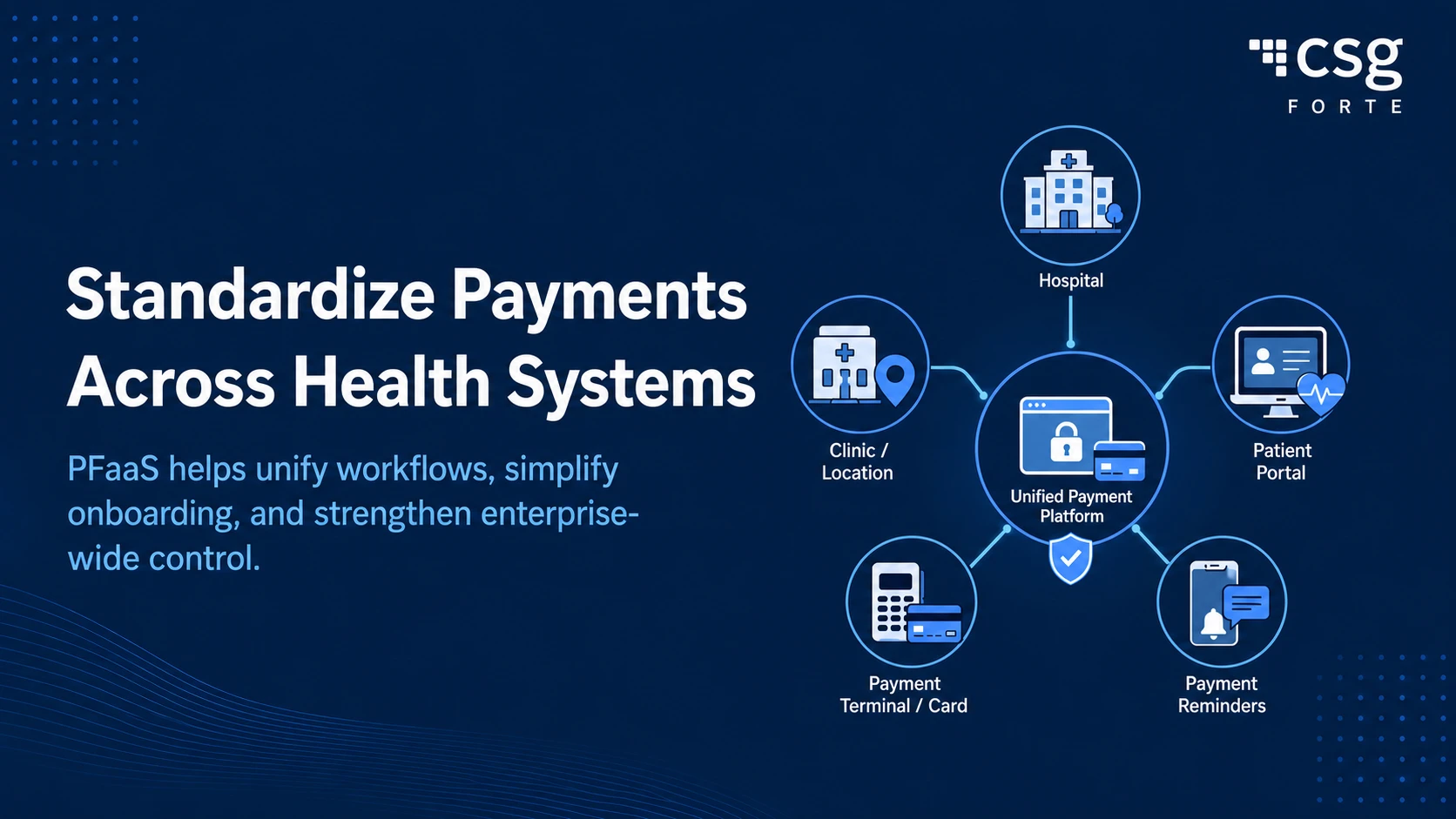
PFaaS helps large health systems embed payments without forcing each entity to behave like its own merchant program.
In a more traditional setup, hospitals, clinics, and affiliated organizations may each maintain separate merchant relationships, onboarding processes, and reporting structures. That creates duplication and makes governance harder. PFaaS replaces that with shared payment infrastructure that can support a broader enterprise strategy.
In practice, that can mean a structure that simplifies onboarding entities, centralizes monitoring, standardizes reporting, and supports embedded payment experiences across channels with less operational sprawl. For growing systems, acquired entities, and organizations that rely on partner software platforms, that consistency matters.
How PFaaS can support controls and compliance
A strong PFaaS strategy can help reduce duplication across the enterprise. New clinics, service lines, and partner platforms can be brought into a more common framework. Finance teams can work from more standardized reporting. Digital teams can support a more consistent user experience.
Architecture matters here. Approaches such as tokenization, encryption, hosted fields, and tightly defined data flows can help reduce exposure to sensitive payment data. In healthcare environments, where payments may sit close to patient-account information and other sensitive workflows, that discipline is especially important.
The claim should stay precise, though. PFaaS does not make PCI or HIPAA concerns disappear. The better message is that the right model can support architectures designed to reduce exposure, improve governance, and clarify responsibilities.
What to look for in a PFaaS partner
Large health systems should look beyond basic payment acceptance and ask whether the partner can support long-term standardization.
Start with infrastructure fit. Can the platform support cards, ACH, digital wallets, and the mix of in-person and digital channels your organization uses? Then evaluate operating-model fit. Can it scale across hospitals, clinics, affiliated entities, and partner platforms while still supporting centralized visibility?
Security and governance matter, too. Look for clear documentation, auditability, and an architecture built for healthcare-sensitive environments. Finally, assess flexibility. The best partner is not only the one that helps you launch quickly. It is the one that can support a more mature embedded-payments strategy as your organization evolves.
Why CSG Forte
For large health systems, payments are no longer just a back-office workflow. They are part of the patient experience, the revenue cycle, and the enterprise technology stack. When payment tools are fragmented, the effects show up everywhere—from reconciliation and reporting to trust and governance.
CSG Forte’s PFaaS offers a more scalable way forward. It helps large health systems embed payments across channels and entities while operating from a more consistent foundation. That does not require replacing every system overnight. It means building a smarter underlying model—one that supports better experiences, stronger controls, and more sustainable growth over time.
Ready to learn more? Reach out to one of our payments experts today.
FAQ
1. What is PFaaS in healthcare payments?
PFaaS, or payment facilitation-as-a-service, is a model in which a specialist provider manages key payment-facilitator infrastructure so a healthcare organization can embed and scale payments more efficiently.
2. Why is PFaaS relevant for large health systems?
Large health systems often have multiple entities, payment channels, and partner platforms. PFaaS can help standardize onboarding, reporting, monitoring, and embedded payment experiences across that complexity.
3. How is PFaaS different from basic payment processing?
Basic processing focuses on moving transactions. PFaaS supports a broader operating model for embedded payments, including structures that can simplify onboarding, governance, and enterprise-wide consistency.
4. Can PFaaS help with compliance and security?
It can support architectures designed to reduce exposure and improve governance through capabilities such as tokenization, encryption, hosted components, and clearer role definition. Specific compliance scope still depends on implementation.
5. What should a health system evaluate before choosing a PFaaS partner?
Look at channel support, payment-method coverage, integration fit, onboarding structure, reporting, auditability, security controls, and the partner’s ability to support healthcare-sensitive environments at enterprise scale.