
Embedded Payments in Financial Services: How to Reduce Friction, Grow Revenue

Key Takeaways
Embedded payments are no longer just an upgrade—they are becoming an operating model that shapes onboarding, reporting, reconciliation, and customer retention.
Fragmented payment stacks create hidden costs through manual reconciliation, slower change management, and higher outage risk.
Financial services teams that want more flexibility should think beyond a single processor and evaluate orchestration, security, and reporting together.
For financial services leaders, payments used to sit quietly in the background. If transactions cleared, reports arrived eventually, and customers could complete basic tasks, that was often enough. That standard is gone.
Today, the payment experience influences how customers judge your platform, how quickly your teams can launch new offerings, and how much operational drag your organization carries behind the scenes. That is why embedded payments for fintech are moving from “nice to have” to strategic priority across the digital payment experience.
Embedded payments in financial services are not just about placing a checkout flow inside your app. At a higher level, they mean building payment capabilities into the digital experiences your customers and teams already use—while also thinking through payment orchestration, onboarding, compliance, reporting, funding, support, and long-term scalability.
Why this matters now
Customer expectations have changed. Users expect fast, branded, low-friction experiences whether they are paying a bill, funding an account, or managing an ongoing financial relationship. At the same time, internal teams are under pressure to reduce manual work, move faster during payment reconciliation, and support more channels without rebuilding their payments stack every year.
That tension is where many financial services organizations get stuck: with embedded payments (aka embedded finance).
They may have strong products and customer relationships, but their payments environment still runs through a patchwork of gateways, processors, portals, and point integrations. Over time, that fragmentation creates hidden costs: more reconciliation work, slower launches, harder reporting, and more exposure when a single provider becomes a bottleneck.
What embedded payments really mean in practice
In plain terms, embedded payments provide a unified payment structure that lets users complete payment-related actions without leaving your platform. But operationally, the shift is much bigger than that. Once payments sit inside your experience, your platform becomes the front door for workflows such as onboarding, payment acceptance, reporting, support, and issue resolution.
That is why the real conversation is not just about APIs. It is about ownership.
Who owns the customer experience? Who owns exception handling? Who owns underwriting, monitoring, and compliance boundaries? Which team sees the data first when something fails? Embedded payments work best when product, operations, and compliance align early—instead of treating payments as a feature request that gets layered onto a legacy stack later.
The cost of staying fragmented
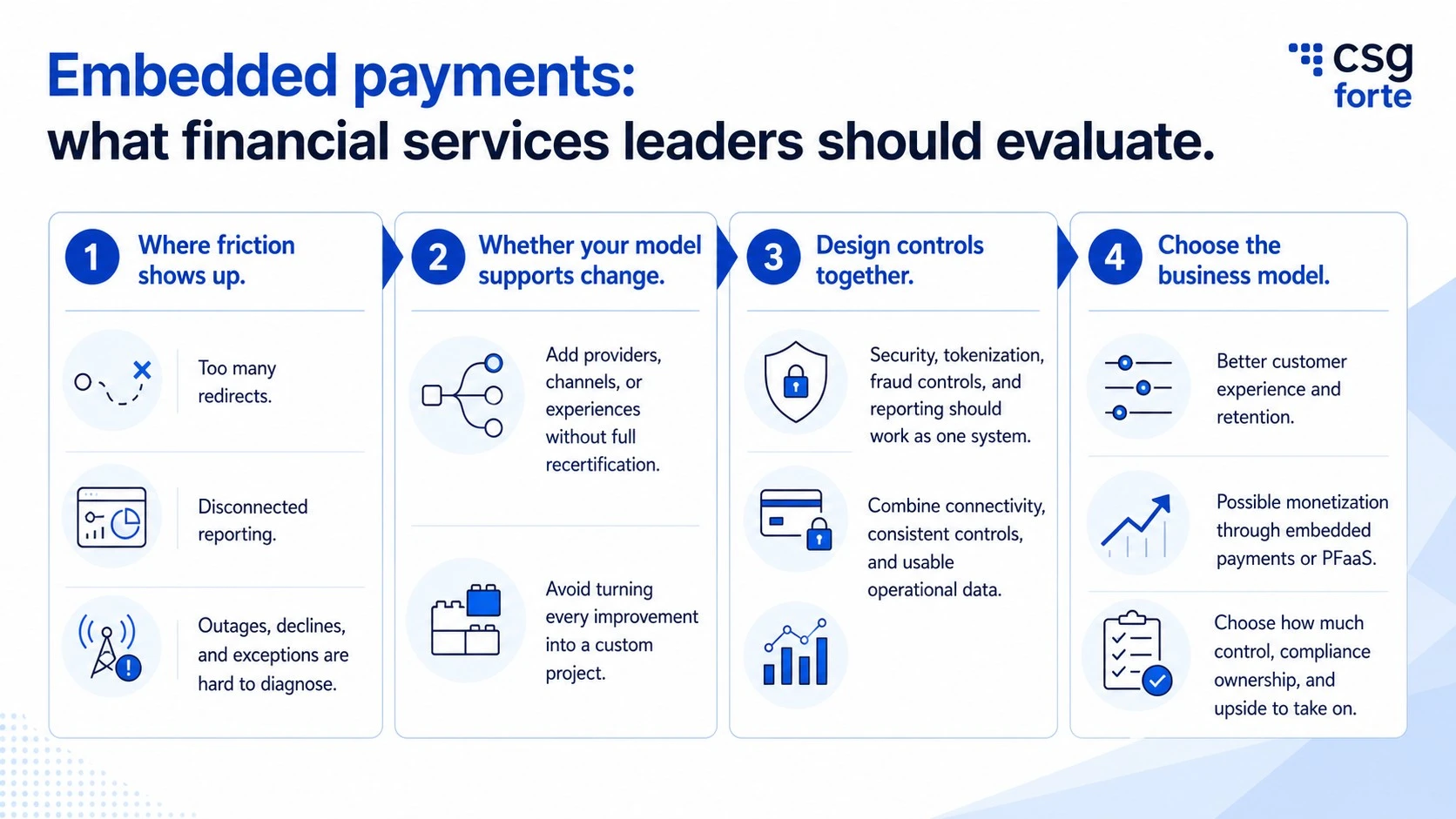
A fragmented payments setup can look manageable at first. One processor here, another provider there, a hosted portal for one flow, and a separate reporting process for another. But as the business grows, each new certification, feature request, provider change, or outage adds more complexity. That complexity tends to show up in four places:
Slower time to market when every new payment feature requires another integration project
Heavier operational load from disconnected reconciliation and reporting workflows
More customer friction when branding, balances, or confirmation experiences vary by channel
Higher resilience risk when too much depends on a single provider connection
These are not just technical annoyances. They affect revenue, customer trust, and your team’s ability to execute on roadmap priorities.
Why gateway orchestration belongs in the conversation
For many financial services teams, the next stage of maturity is not adding yet another point solution. It is creating a more flexible payments backbone.
That is where gateway orchestration becomes relevant. Instead of treating each bank or processor connection as its own long-term project, orchestration creates a centralized layer for routing, managing, and monitoring transactions across multiple providers. In practice, that can improve flexibility, strengthen failover, and make reporting more consistent across channels.
It also helps answer a common strategic question: how do you modernize payments without ripping apart everything underneath?
For many organizations, the right answer is not replacement. It is creating one access point that simplifies change management, supports future expansion, and reduces dependency on a single connection model.
Where CSG Forte fits
When financial services organizations want to simplify the payment experience without adding more chaos, they need more than basic processing. Whether it’s through payment facilitation-as-a service, or full payment facilitation, they need a partner that can support embedded experiences, unify reporting, strengthen security, and create a clearer path for growth.
CSG Forte’s messaging around embedded payments and gateway orchestration centers on exactly that: one integration that supports more flexibility, streamlined changes, stronger resilience, and a more unified source of truth for payment operations.
That matters for financial services teams trying to balance customer expectations with operational discipline. The goal is not simply to “add payments.” It is to reduce friction across the full payment lifecycle—while keeping future options open.
The bottom line
Embedded payments in financial services are becoming a strategic lever because they sit at the intersection of customer experience, operational efficiency, and platform growth. Teams that keep layering new payment needs onto fragmented infrastructure will keep paying for that complexity in slower launches, harder reporting, and more operational drag.
Teams that rethink payments more holistically—with embedded workflows, clearer ownership, and a more flexible infrastructure layer—put themselves in a stronger position to scale.
If your current payment environment still feels like a collection of workarounds, now is the right time to evaluate what a more embedded model could unlock.
FAQs
What are embedded payments in financial services?
Embedded payments in financial services are payment capabilities built directly into a platform’s own digital experience, so users can pay, onboard, and access reporting without being redirected to a separate portal.
How are embedded payments different from integrated payments?
Integrated payments usually mean a platform has connected to a processor or gateway, but users may still encounter redirects or separate environments. Embedded payments keep the payment journey inside the platform’s own UI and workflows.
Why do fragmented payment systems create problems for financial services teams?
Fragmented systems often create more manual reconciliation work, slower updates, inconsistent reporting, and more operational risk when teams depend on one-off integrations or multiple disconnected vendors.
What is gateway orchestration?
Gateway orchestration is a model that lets organizations connect once and manage transactions across multiple banks and processors through a centralized layer, improving routing flexibility, resilience, and reporting consistency.
Do financial services platforms need to become a registered payment facilitator right away?
No. Many platforms do not immediately become a registered payment facilitator. Instead, they start with lighter-weight embedded models, including PFaaS or referral-style approaches, before taking on more direct payment facilitation responsibilities.