
Bank Account Verification: 4 Questions to Scope the Right Solution

If you have been told to “add bank account verification,” you are not alone. And you are probably discovering that phrase means different things to different teams.
Risk may be thinking about fraud and ownership. Billing wants to stop fat‑finger errors that cause ACH returns. Product may be picturing a slick login flow that confirms a user can see their bank account online. Compliance is reading Nacha rules about WEB debit account validation and new fraud monitoring requirements.
All of those conversations use the same words—“bank account verification”—to describe at least four different checks that answer different questions. Buying the wrong one is one of the most common and most expensive scoping mistakes in ACH programs.
This guide organizes the problem by the four questions every operations, finance, or product owner should ask:
Are these account details real and usable?
Is this account in good standing?
Does this account actually belong to the person or business handing it to me?
What happens after the check passes?
Before we get to the questions, it helps to understand the main method archetypes you will encounter.
Common bank account verification methods (and what they really prove)
Verification method archetype | What it proves | Payer friction | What it does not prove |
|---|---|---|---|
Login‑based “instant verification” / open‑banking credential flows | The user can authenticate to online banking and see activity on the account (a form of control). | Medium–high: requires bank selection, credential entry, and often MFA; some users abandon. | Does not, by itself, confirm the named person or business is the legal owner, or that funds will be available at debit time. |
Micro‑deposits plus callback / amount confirmation | The user can observe and report micro‑credit amounts, showing they can see activity on the account (control again). | High: adds 1–2 day delay plus a return‑visit or out‑of‑band confirmation; notable abandonment risk. | Does not guarantee future funds, ongoing account status, or that the person confirming deposits is the lawful owner. |
Signatory / transactional authority verification (common in B2B) | The person appears to have authority to act on behalf of the business or account based on documents or bank records. | Low–medium: often handled via onboarding, documentation, or back‑office review. | Does not automatically validate routing/account usability for a specific ACH flow or forecast return behavior. |
Database or multi‑bureau bank‑record matching | Routing and account details appear valid and consistent with trusted data sources; some services add account‑status and risk indicators. | Low: runs in the background at entry; no extra steps for the payer. | Does not guarantee settlement, and “no hit”/limited data is still possible (especially for smaller institutions and niche account types). |
With that in mind, you can now scope your needs by question instead of vendor buzzwords.
Question 1: Are these account details real and usable?
This is the data‑quality question. You are trying to avoid obvious failures before they ever reach the ACH network:
Invalid routing numbers
Bad account‑number structures or check digits
Transposed digits and other data‑entry errors
Accounts that are clearly not able to support the flow you are about to run
Basic ACH validation sits here. Database‑driven services can instantly check that routing numbers are active, that account numbers pass structural checks, and that details appear consistent enough to proceed.
CSG Forte Validate is designed to confirm that routing and account information appears valid and can support the intended payment flow, helping merchants catch bad routing numbers, invalid checksums, and data‑entry errors before a transaction is submitted.
Why it matters in practice
Every avoidable ACH return creates work: researching what went wrong, contacting the customer, fixing records, and sometimes managing service or coverage implications. Nacha expects originators to keep administrative return codes such as R02–R04 (account closed, no account, invalid account number) under 3% and overall debit returns under 15% over a rolling 60‑day period. Keeping obviously bad data out of the network is the lowest‑friction way to stay well inside those thresholds.
How method choice shows up here
Login‑based and micro‑deposit flows can catch some bad data indirectly, but they require the user to complete extra steps.
Database or multi‑bureau matching can check routing/account details in the background as the payer types, adding no visible friction.
For recurring ACH debits in utilities, insurance, government, and software platforms—where payers expect a smooth enrollment experience—background validation is often the most scalable answer.
Question 2: Is this account in good standing?
Once you know the numbers are usable, the next question is risk context: given what is known about this account, how likely is it to cause downstream issues?
Depending on the provider and data sources, “good standing” checks may include:
Whether an account appears open or closed
Whether debits are allowed
Stop‑payment or debit‑block indicators
Insufficient‑funds or returned‑item history where that information is available
This is where enhanced ACH account validation comes in.
CSG Forte Validate+ builds on the basic checks of Validate by adding broader account‑status and risk context when data is available, including closed accounts, stop‑payment indicators, insufficient‑funds indicators, and returned‑check history.
When does this layer matter most?
Recurring debits where every failure kicks off collections work.
High‑value or time‑sensitive payouts where a bad account forces manual re‑issuance.
Verticals where ACH returns trigger operational or regulatory attention.
Nacha’s risk‑management changes underscore this need. Fraud monitoring rules taking effect in 2026 require all non‑consumer originators, Third‑Party Senders, and service providers to establish and implement risk‑based processes and procedures “reasonably intended to identify entries that are suspected of being unauthorized or authorized under false pretenses,” with at least annual reviews. Knowing in advance when an account shows concerning signals is a natural input into those processes.
Method trade‑offs
Login‑based and micro‑deposit verification give you a “snapshot” of control, not a rich history of account behavior, and they slow enrollment.
Database/multi‑bureau approaches can surface status and risk indicators passively in the background.
If you are already managing to Nacha’s WEB debit validation expectations and thinking ahead to broader fraud monitoring, enhanced validation can help you distinguish between low‑risk and higher‑risk accounts before you move funds.
Question 3: Does this account actually belong to the person or business handing it to me?
This is the ownership question. It is different from both “are the numbers valid?” and “does the account seem healthy?”
Ownership checks answer: does the personal or business name you collected match the owner of the bank account? That matters in scenarios such as:
Payouts to claimants, vendors, or constituents where misdirected funds are unacceptable.
ACH debits where you want assurance the named party is truly connected to the account.
Platform marketplaces where you are responsible for verifying payee details on behalf of others.
It is also different from the control signals you get from login‑based or micro‑deposit methods. A fraudster who has taken over online banking can often pass those flows; ownership verification aims to confirm the account still belongs to the intended person or entity.
CSG Forte Authenticate is an ACH authentication solution that provides bank account owner verification. It confirms whether the personal or business name provided aligns with the bank account owner before processing, returning outcomes such as Match, No Match, Conditional Match, or No Info. Authenticate references hundreds of millions of account records from large U.S. banks and other institutions to support these payee‑name checks.
Critical language guardrail
Authenticate is an ownership tool, not a validation tool. It does not:
Confirm that funds are available.
Guarantee that a specific debit will be authorized.
Replace the need for account‑number validation or ongoing monitoring.
It is most effective when layered with validation, so you know both that the account details are usable and that they belong to the right party.
Friction implications
Because ownership checks can run against external data sources in the background, they typically do not add steps to the payer’s experience. That is a key distinction from login‑based verification and micro‑deposit callbacks, which require the user to do more work.
For high‑risk payouts in insurance, government, and platform ecosystems, that background ownership signal can dramatically reduce fraud and routing errors without slowing legitimate users.
Question 4: What happens after the check passes?
This is the question most vendors skip, and it's the one that earns trust with your internal stakeholders.
Verification—whether it is account validation, enhanced risk checks, or ownership matching—is always a point‑in‑time check. It happens before the entry reaches the receiving bank for settlement.
After that moment, several things can still change:
Account status (closed, frozen, restricted).
Available funds (balances and holds).
Customer intent and authorization.
The receiving Depository Financial Institution (RDFI) still makes the final decision when the entry is presented, and it signals problems using standardized Nacha return codes. CSG Forte’s internal guides and public content highlight this explicitly: return codes tell you why a transaction failed, and many failure modes can arise after a clean verification.
A few concrete examples that are useful in stakeholder conversations:
Funds problems after a clean check
R01 – Insufficient Funds: available balance or cash‑reserve balance is not enough to cover the debit.
R09 – Uncollected Funds: ledger balance is sufficient, but collected/available funds are not.
Authorization and revocation changes
R07 – Authorization Revoked by Customer: the customer revoked authorization after you captured it.
R08 – Payment Stopped: the customer placed a stop‑payment order on a specific debit.
Unauthorized debits and disputes
R10 – Customer Advises Entry Not Authorized or Originator Not Known: the consumer says they did not authorize the debit or do not recognize the originator.
R29 – Corporate Customer Advises Not Authorized: a non‑consumer account holder tells their bank a debit was not authorized.
Account status changes
R02 – Account Closed: an account that was once active has been closed.
R16 – Account Frozen / Entry Returned per OFAC Instruction: access to the account is restricted or subject to sanctions.
Account information mismatches and structure issues
R03 – No Account / Unable to Locate Account: the account structure is valid but does not correspond to the named individual or an existing account.
R04 – Invalid Account Number Structure: the account‑number structure is not valid.
Put plainly: a successful verification means the account passed the available checks at that point in time. Nothing more.
Why this matters for Nacha compliance
Nacha’s WEB debit rules explicitly say that originators of WEB debits must use a “commercially reasonable fraudulent transaction detection system” that includes account validation at first use and on any subsequent change of account number for online debits. Nacha’s newer fraud monitoring rules go further, requiring risk‑based processes and annual reviews from all non‑consumer originators and financial institutions, not only high‑volume players.
Verification services are relevant inputs to those expectations, but they are not the entire program. You still need processes to:
Monitor return codes and patterns over time.
Investigate unexpected spikes in unauthorized or administrative returns.
Document how you tune controls and respond to emerging fraud patterns.
CSG Forte’s ACH returns explainer provides practical guidance on common codes, Nacha thresholds, and process improvements that reduce returns without adding unnecessary friction.
How CSG Forte layers these questions into one verification strategy
CSG Forte treats bank account verification as three distinct but complementary questions, mapped to different tools:
Validate – “Are these details real and usable?”
Confirms routing and account details appear valid and can support the intended flow.
Validate+ – “Is this account in good standing?”
Adds broader account‑status and risk insight where available, including closed accounts, stop‑payment indicators, and insufficient‑funds or returned‑item history.
Authenticate – “Does this account belong to the person or business I am paying or debiting?”
Provides bank account owner verification (ACH authentication), confirming whether the name provided matches the account owner before processing.
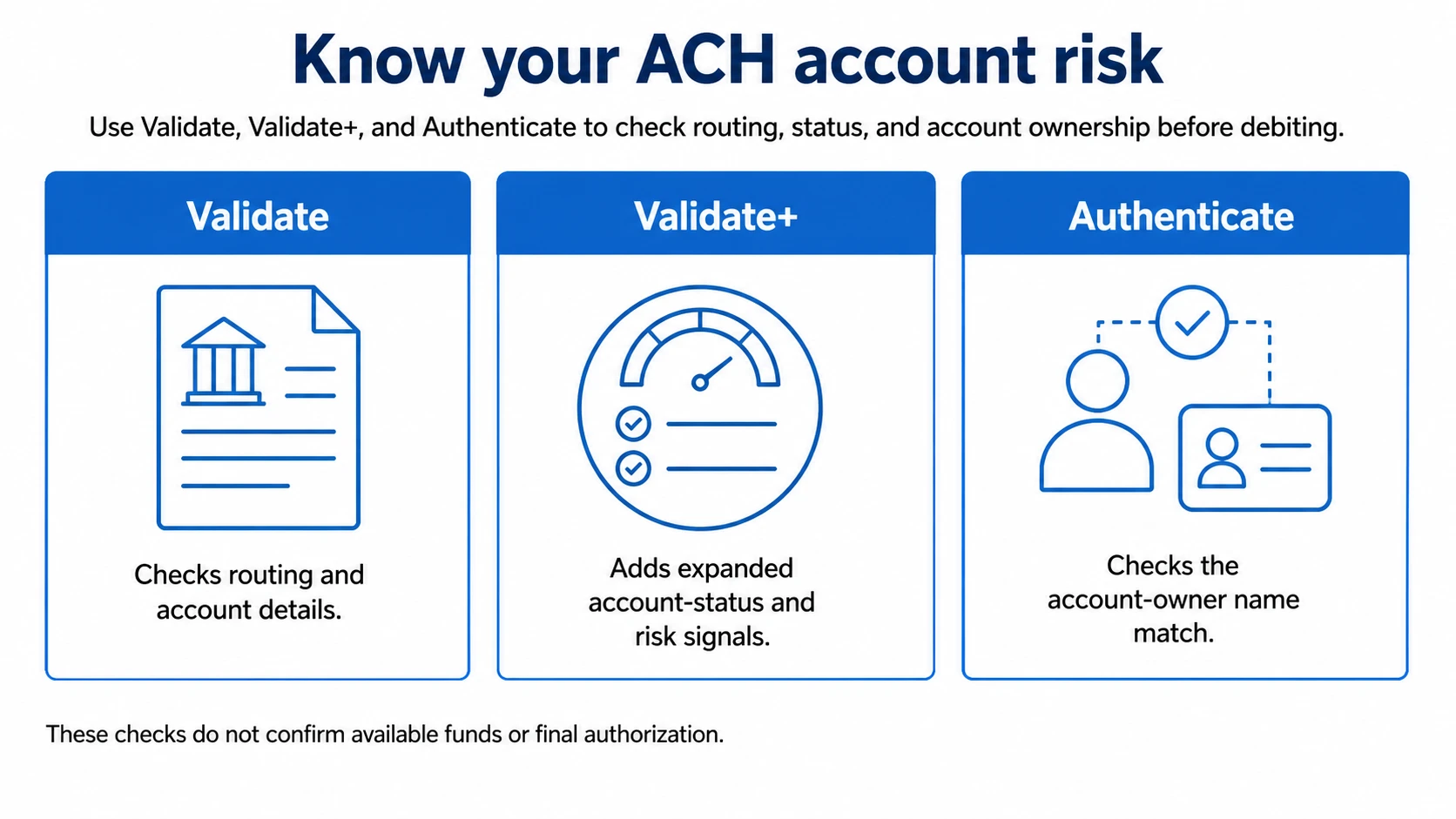
These services are available individually or in combination and can be deployed as standalone verification tools, so merchants can add checks to an existing processing stack without migrating their entire payments relationship.
For a side‑by‑side breakdown of what each service covers, read our guide: “Validate, Validate+, or Authenticate? Understanding ACH Verification Services” walks through typical use cases and limitations.
To explore how these layers can fit into your enrollment, billing, or payout flows, you can talk directly with a CSG Forte expert about payment verification options:
Questions to ask a bank account verification vendor
When you talk to potential verification partners, these questions help cut through vague claims and align tools with your four core questions:
Which questions do your services answer—data usability, account status/risk, ownership, or all three—and what do they explicitly not address?
What methods do you support for WEB debit account validation (for example, prenotes, micro‑entries, database validation, open‑banking logins), and how do you recommend choosing the right method by use case and risk level?
How are results returned (simple pass/fail, multiple decision codes, Match/No Match/Conditional, “No Info”)? How should we handle gray areas and “no hit” responses in our workflows?
What payer friction should we expect for each method, and which checks can run invisibly in the background during account capture?
How do you support Nacha’s WEB debit validation expectations and the broader risk‑based fraud monitoring rules—specifically around documentation, reporting, and annual program review?
Can we deploy your validation and authentication services as standalone APIs alongside our existing processor, and what is involved technically to integrate them?
What reporting do you provide so we can see verification outcomes and ACH return patterns by segment, and use that data to refine our risk strategy over time?
If you are ready to map these questions to your own flows, talk to an expert about layering verification into an existing payment stack (without a re-platform).