

Why You Should Focus on Platform Stability and APIs for a Rock-Solid Payments System
Top Takeaways
- Platform stability and uptime directly protect revenue and customer experience: Even small differences (99.9% vs. 99.99% uptime) can mean hours of lost online payments, frustrated customers, and brand damage.
- Flexible, developer-friendly application programming interfaces (APIs) from your payment processor are key to scalable growth: This makes it easier to integrate payments into your existing tech stack, launch new experiences, and reduce long-term IT overhead.
- Choosing a payments partner with proven stability and modern APIs makes it easier to do business: By keeping online payments available, secure, and seamless, you can focus on growth instead of outages and workarounds.
Every time a customer pays you, they’re trusting more than your brand—they’re trusting the payment processor and technology stack behind your checkout. For most organizations, that stack includes multiple software vendors handling everything from onboarding and billing to online payments.
Choosing who moves your money isn’t just another vendor decision. It’s a foundational choice that shapes how reliably you can accept payments, how quickly you can scale and the experience your customers experience every time they click “Pay.”
Fees, security, compliance, customer support and features all matter. But two often-underrated pillars can make or break your payment strategy:
- Platform stability
- API quality and flexibility
Together, they form the foundation of a rock-solid payments system.
Why platform stability matters
For payment providers, platform stability is all about uptime and availability.
- Availability is the degree to which a system can perform its intended function when it needs to.
- Uptime is the percentage of time that a system is operational and accessible.
When your payment processor is stable, your transactions run without interruptions or unexpected errors. When it’s not, your teams feel it—and so do your customers.
What 99.9% vs. 99.99% uptime really means
Uptime percentages can feel abstract until you translate them into actual downtime:
- 99.9% uptime means your software can be unavailable for about 8.77 hours per year.
- 99.99% uptime cuts that to roughly 52 minutes per year.
Those hours aren’t just an IT inconvenience. When your payment gateway is down, you can’t accept online payments—which means:
- Lost revenue
- Frustrated customers at checkout
- Extra pressure on support teams
- Potential long-term reputational damage
Industry analyses consistently show that downtime is expensive, especially when it hits revenue-critical systems like payments.1
A third-party view of stability
Independent validation can help separate marketing claims from real performance.
In TSG’s Real Transaction Metrics Awards, CSG Forte has been recognized multiple years in a row for payment gateway stability and minimal downtime. In a controlled third-party study, CSG Forte earned top honors in categories measuring uptime and “Lowest Minute Outage” in North America, based on real credit card transaction performance across the market.
This award recognizes payment gateway providers that keep downtime to an absolute minimum, using 24/7/365 monitoring and real transaction data—not lab tests—to benchmark performance.
A strong uptime record signals more than technical excellence. It reflects:
- Mature incident management and on-call practices
- Proactive capacity planning and scaling
- Investment in redundant infrastructure and failover
- A culture that treats payments as mission-critical
That makes it easier to grow your organization on top of a platform you can trust.
What to look for in a stable payment platform
When you evaluate a payment provider’s stability, look past the marketing one-pager and dig into:
- SLA and historical performance
- Documented uptime commitments
- Evidence of performance over multiple years, not just last quarter
- Architecture and redundancy
- Active-active data centers or cloud regions
- Redundant payment processing paths and databases
- Operational excellence
- 24/7 monitoring and alerting
- Clear, timely incident communication and public status pages
- Scalability
- Ability to handle seasonal peaks, promotions and unexpected volume spikes without degrading checkout performance
Your goal: choose a payments partner whose stability makes it almost invisible—because everything just works.
Why a flexible API is important
APIs (application programming interfaces) are how your systems “talk” to your payment provider. A payment gateway API lets you connect:
- Your website or mobile app
- Your CRM, ERP or billing system
- Your customer portals and back-office tools
to the payments platform that processes your transactions.
A great payments API lets you:
- Accept online payments without redirecting customers to a third-party site
- Automate routine payment operations, like refunds, recurring billing and chargeback handling
- Keep your teams working in the systems they already use, while the payment provider handles the complex parts in the background
Over time, the quality of that API directly affects your development velocity, integration costs and how quickly you can launch new customer experiences.
What “developer-friendly” really looks like
A strong payment API and developer experience should offer:
- Modern RESTful design
- Consistent resource models and endpoints
- Standard authentication patterns
- Clear, complete documentation
- Step-by-step guides, code samples and SDKs in common languages
- Realistic examples for key use cases (e.g., vaulted cards, ACH, recurring billing)
- Robust eventing and webhooks
- Real-time notifications for settlement, disputes, chargebacks, subscription events and more
- Test environments that mirror production
- Full-featured sandbox with realistic data and error conditions
- Versioning and deprecation policies that give you time to adapt
A great API doesn’t just make the initial integration faster. It also reduces the ongoing maintenance burden on your developers and makes it easier to evolve your payment experience as your business changes.
How CSG Forte’s APIs support flexible, scalable payments
CSG Forte’s APIs are built on modern, RESTful architecture and a unified developer platform, so you can manage the entire payment lifecycle through code:
- Accept payments: cards, ACH and more, across web, mobile and phone
- Securely store and tokenize payment methods for future use
- Automate recurring billing and subscription workflows
- Reduce fraud and risk with validation, authentication and risk tools
- Access reporting and analytics programmatically for reconciliation and insights
When your payment processor offers this level of API flexibility, it becomes much easier to:
- Add new payment methods or channels
- Support new business models (subscriptions, usage-based billing, marketplace payouts)
- Maintain a consistent, branded experience across all the touchpoints where your customers experience your payment flows
The bottom line: make it easy to do business
Evaluating platform stability and API flexibility is ultimately about answering one question:
How easy does this payments partner make it for us—and our customers—to do business?
A strong payments partner should help you:
- Keep online payments available and responsive, even during peak demand
- Protect revenue by minimizing downtime and failed transactions
- Offer a seamless, secure payment experience that builds trust
- Integrate payments cleanly into your existing systems and workflows
- Scale with you as your transaction volume, product mix and customer base grow
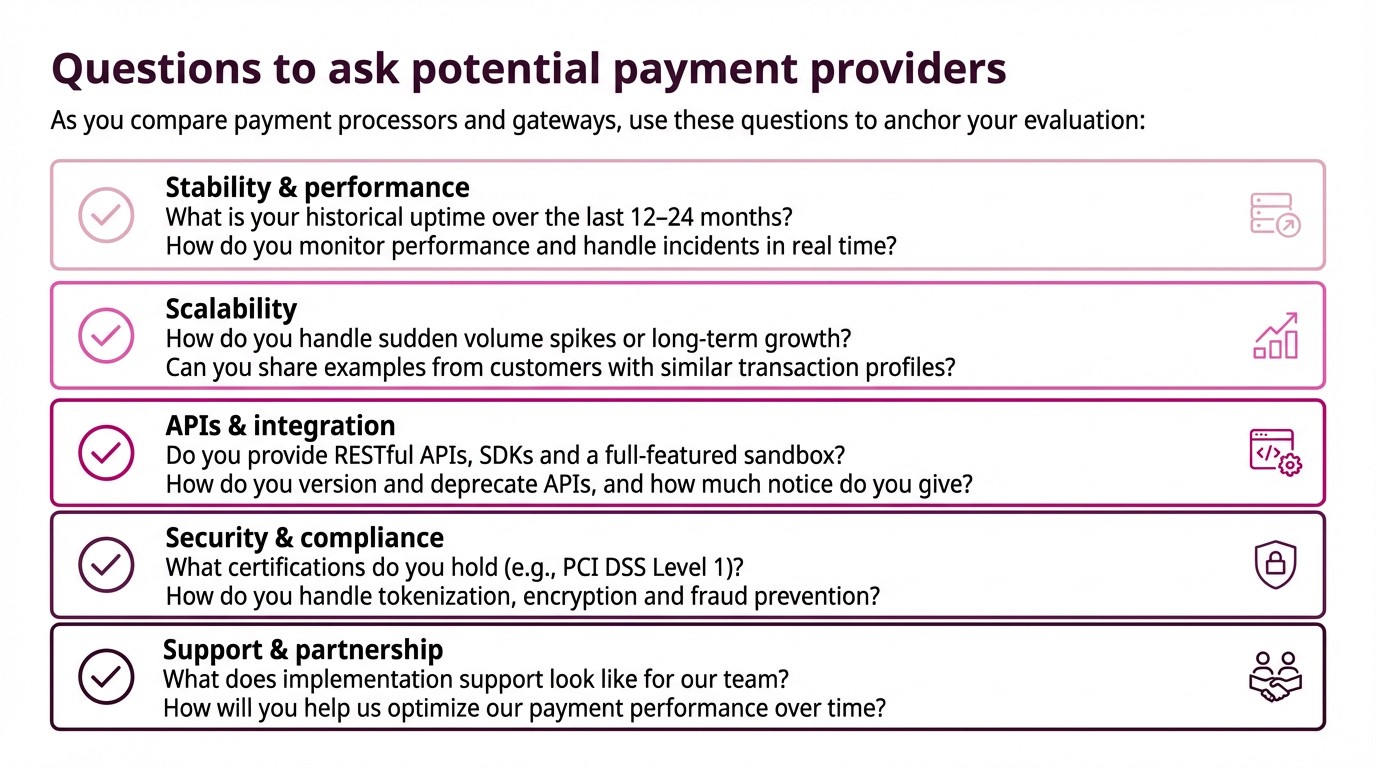
Ready to strengthen your payment foundation?
If you’re revisiting how your organization handles online payments and evaluating what you need from a payment processor, platform stability and API quality belong at the top of your checklist. They’re the levers that determine how reliable your revenue engine is and how quickly you can adapt to what your customers experience and expect.
Want to learn what criteria to prioritize—and how CSG Forte can help you build a more stable, developer-friendly payments stack?
Contact our team of payment experts.
Frequently asked questions
Why is platform stability so important for online payments?
Because any outage at your payment gateway blocks customers from completing transactions. Even brief downtime can translate into lost revenue, support strain, and a poor customer experience at the most critical moment—when they’re trying to pay.
What should I look for in a payment processor’s API?
Prioritize RESTful design, clear documentation, strong webhook/event support, and realistic sandbox environments. Those pieces make integrations faster, reduce maintenance work for your developers, and give you flexibility as your payment use cases evolve.
How does a stable platform and strong API improve customer experience?
When your provider combines high uptime with modern APIs, customers experience fast, reliable checkouts, consistent payment options across channels, and fewer errors or declines—making your brand feel easier to do business with and more trustworthy over time.