P2PE vs. E2EE: What’s the Best Payment Security Option for Governments?

Top takeaways
P2PE and E2EE both protect payment data, but PCI-validated P2PE gives government agencies a more structured way to reduce PCI scope and keep sensitive card data out of their environment.
For agencies managing front-counter or field payments, the biggest difference is operational—not just technical. P2PE can reduce audit burden, simplify terminal controls, and lower internal risk exposure.
A modern government payment strategy should pair strong in-person encryption with a broader payments platform that supports cards, ACH, digital wallets, reporting, and integration with existing finance systems.
Government agencies are under pressure to offer faster, more convenient payment experiences without weakening security. Residents expect to pay taxes, fees, permits, fines, and other obligations online, by phone, and in person. At the same time, agencies need to protect cardholder data, limit fraud exposure, and avoid creating unnecessary compliance work for already stretched teams.
That combination makes payment security architecture a strategic decision—not just a technical one.
Two terms often come up in that discussion: end-to-end encryption, or E2EE, and point-to-point encryption, or P2PE. They sound similar because they are similar. Both are designed to protect payment data in transit. But for agencies focused on secure government payments, the real question is not whether data is encrypted. It is which model creates a safer, simpler operating environment for the agency itself.
In most cases, that answer is P2PE.
Why this distinction matters for government payments
Government payment processing solutions are often complex. Many agencies accept payments across service counters, field locations, kiosks, websites, IVR systems, and departmental workflows. They also need to connect payments back to existing ERP, tax, court, utility, or case-management systems—without forcing a major rebuild.
That means the best payment gateway is not just one that moves transactions. It is one that helps agencies reduce exposure, simplify reconciliation, and support compliance across a broad, multi-channel environment.
When you compare P2PE and E2EE through that lens, important differences emerge.
What is E2EE?
End-to-end encryption refers to a model in which payment data is encrypted from one point in the transaction flow to another so that intercepted data is unreadable in transit. In practical terms, that is valuable. Encryption helps reduce the risk that exposed payment data can be used if a bad actor intercepts it.
But E2EE alone does not automatically simplify PCI obligations. Encryption technologies can reduce PCI burden, but they do not remove the need for compliance altogether.
That matters because agencies are not only trying to encrypt and decrypt payment data securely. They are also trying to control where sensitive data appears, who manages the keys, how terminals are governed, and how much of their own environment remains in PCI scope.
What is P2PE?
P2PE is a more tightly controlled payment security model built specifically for point-of-interaction environments. In CSG Forte’s in-person payments are PCI-validated, and P2PE encrypts data at the dip so the agency never handles raw card numbers directly, helping keep sensitive data off its network and reduce PCI scope.
That distinction is important. Instead of simply encrypting data somewhere along the process, P2PE is designed so the encryption begins at the payment device itself and remains controlled through a validated chain of custody. The PCI Security Standards Council also maintains searchable listings for point-to-point encryption solutions, reinforcing that P2PE is treated as a formal, governed category—not just a general security concept.
For government agencies, that structure can translate into fewer internal touchpoints with sensitive data and a clearer compliance posture.
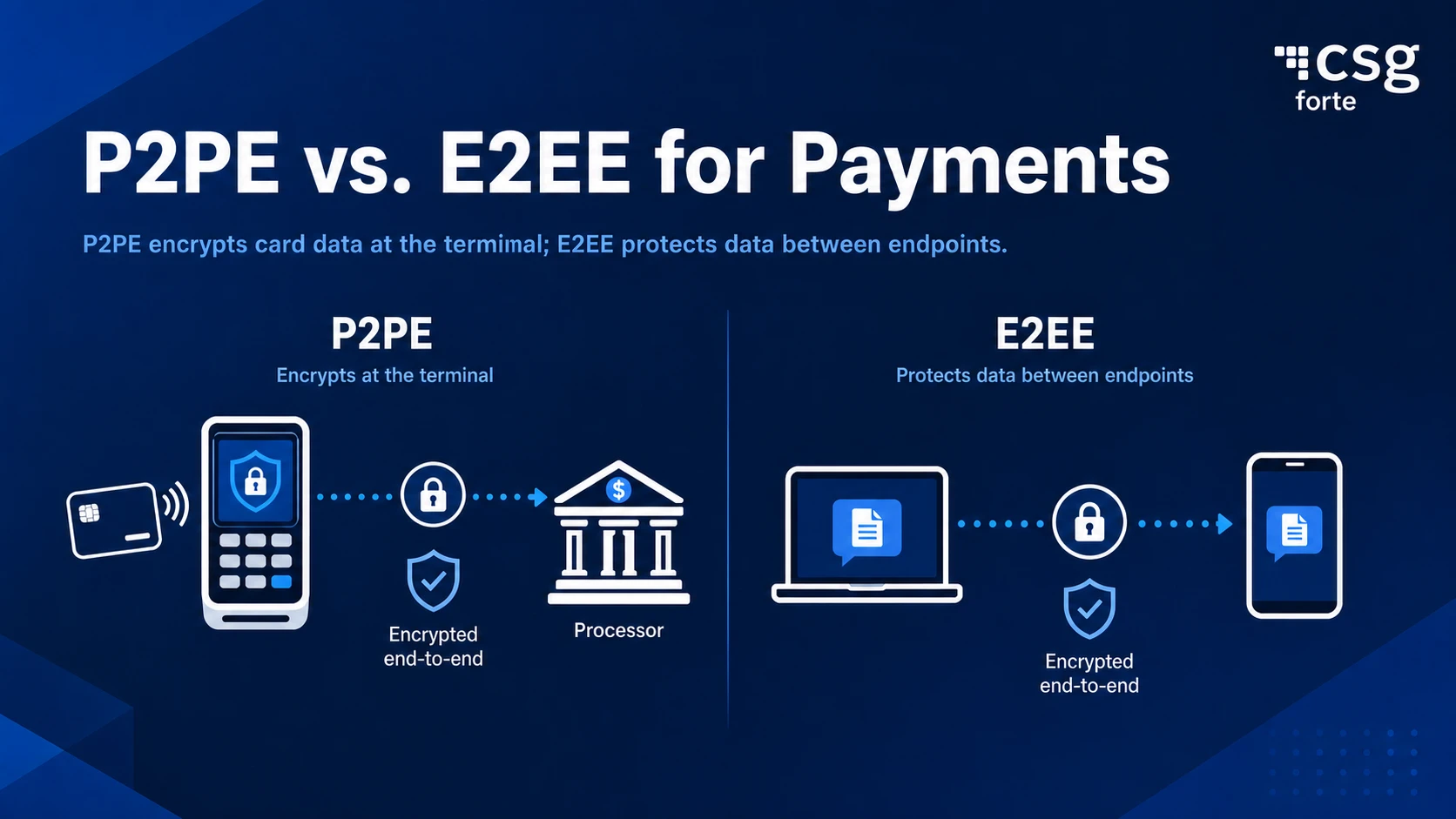
P2PE vs. E2EE: the practical differences
From a purely technical perspective, both models protect payment data. From an operational perspective, they create different realities.
With E2EE, encryption may protect data during transmission, but the agency can still end up with broader PCI responsibilities depending on how the environment is configured, how keys are handled, and what systems remain in scope.
With P2PE, the goal is more specific: remove raw cardholder data from the agency’s environment as early as possible. That shift can reduce the compliance burden around networks, devices, and internal processes because the agency is touching less sensitive data in the first place.
In other words, E2EE helps protect transactions. P2PE helps protect transactions and reduce the agency’s operational exposure around them.
Why P2PE is often the better fit for government agencies
1. It helps reduce PCI scope
This is often the most compelling benefit. Agencies that can keep raw card data out of their own systems have a simpler path to managing PCI responsibilities. CSG Forte’s PCI content emphasizes that reducing the environment that stores, processes, or transmits cardholder data is central to scoping and compliance effort.
For a government team that already has limited IT, treasury, and finance bandwidth, reducing scope is not a small advantage. It can mean less documentation, fewer controls to manage internally, and less risk of hidden exposure.
2. It creates stronger controls at the device level
Payment terminals remain a major point of risk in any card-present environment. CSG Forte in-person payments use point-of-sale terminals that are secure, since they're often prime targets. Our P2PE is known for its tamper resistance and reduced PCI scope as core defenses.
That is particularly relevant for agencies with distributed counters, satellite offices, or staff taking payments in the field. The more places you accept cards, the more important it becomes to standardize device controls and minimize opportunities for data leakage.
3. It supports modernization without a full rebuild
Payment security decisions do not happen in isolation. Agencies also need a practical way to modernize constituent experiences. CSG Forte’s government solution positioning centers on accepting payments across channels, integrating with existing systems, simplifying reconciliation, and improving resident experience without forcing a rip-and-replace project.
That makes P2PE more valuable when it is part of a broader modernization strategy. Agencies can strengthen in-person card security while also supporting ACH, digital wallets, reminders, reporting, and even bank account validation across other channels.
Where E2EE still fits
E2EE is not the wrong choice in every context. It still provides meaningful protection for payment data in transit, and it can be part of a broader security model. But agencies should be careful not to mistake “encrypted” for “out of scope” or “easy to manage.”
If your goal is simply to add encryption, E2EE may sound sufficient. If your goal is to reduce operational risk, tighten controls around in-person payments, and create a more manageable compliance posture, P2PE is usually the stronger fit.
What to look for in a government payments partner
If your agency is evaluating secure government payments infrastructure, compare providers on more than encryption terminology alone. Look for a partner that can support:
Secure in-person card acceptance with PCI-validated P2PE
Omnichannel payments across web, mobile, phone, kiosks, and counters
Integration with existing ERP, billing, tax, or case-management systems
Unified reporting and reconciliation
Support for cards, digital wallets, ACH, and bank account-based payment flows
A clear compliance and audit posture backed by documented controls
Those capabilities matter because security does not live in one transaction. It lives across the full payment operation.
The bottom line
P2PE and E2EE both serve an important purpose. But they are not equal from a government operations standpoint.
For agencies that accept in-person card payments, P2PE offers a more structured, lower-exposure path. It protects payment data from the moment it enters the terminal, helps keep raw card data off agency systems, and can reduce PCI scope in ways that matter to real-world teams managing risk, audits, and constituent service.
That is why, for many agencies, P2PE is not just the more secure model on paper. It is the more practical one in practice.
If your team is rethinking payment security, the next step is to evaluate whether your current payment gateway is only encrypting transactions—or actually helping you reduce risk across the full government payment environment.
FAQs
1. Is P2PE the same as E2EE?
Not exactly. P2PE is a more tightly governed form of encryption for payment environments. Both protect data in transit, but PCI-validated P2PE adds strict controls around devices, key handling, and solution management.
2. Does encryption remove PCI compliance requirements?
No. CSG Forte’s PCI guidance is explicit that tokenization, E2EE, and P2PE can reduce PCI burden, but they do not replace PCI compliance requirements entirely.
3. Why do government agencies often prefer P2PE for in-person payments?
Because it can help keep raw card data off agency systems, reduce PCI scope, and support more manageable audit and device-control processes for distributed offices or departments.
4. What should agencies look for in a payment gateway?
A strong fit includes PCI-aligned security, in-person and digital channel support, ERP or billing integration, clear reconciliation, and support for multiple payment methods, including card and bank account payments.
5. Can agencies modernize payments without replacing core systems?
Yes. CSG Forte’s government positioning emphasizes layering modern payment capabilities onto existing ERP, tax, and case-management systems rather than forcing a full rebuild.