
What Is a Bill Payment Platform, and How Does It Work?

Remember the last time you paid a streaming bill without even noticing? That friction-free moment is no accident; it’s the result of purpose-built bill payment platforms that move money quietly in the background. Today, more than one-third ( 34.6% ) of United States consumers use automatic payment methods, and Baby Boomers use it 43% of the time when given the option. For merchants—utilities, property managers, healthcare providers, insurers and more—meeting that always-on expectation means ditching patch-work portals and embracing a single, automated platform.
Bill Payment Platforms: A Plain-English Definition
A bill payment platform is cloud software that lets businesses present, collect and reconcile customer payments—recurring or one-time—through any channel your customers prefer, including web, mobile, text, IVR and in person. Think of it as the command center that:
Generates or imports invoices.
Displays balances in self-service portals or pushes them via SMS/email.
Accepts cards, ACH and digital wallets.
Routes transactions through a payment gateway/processor.
Reconciles funds, posts to your accounting system and issues receipts.
Digital payment usage in the U.S. hit an all-time high in 2024, with 60% of consumers saying they’ve adopted digital payments . That’s eight percentage points greater than 2019—and much of that growth stems from merchants embedding platforms rather than building from scratch.
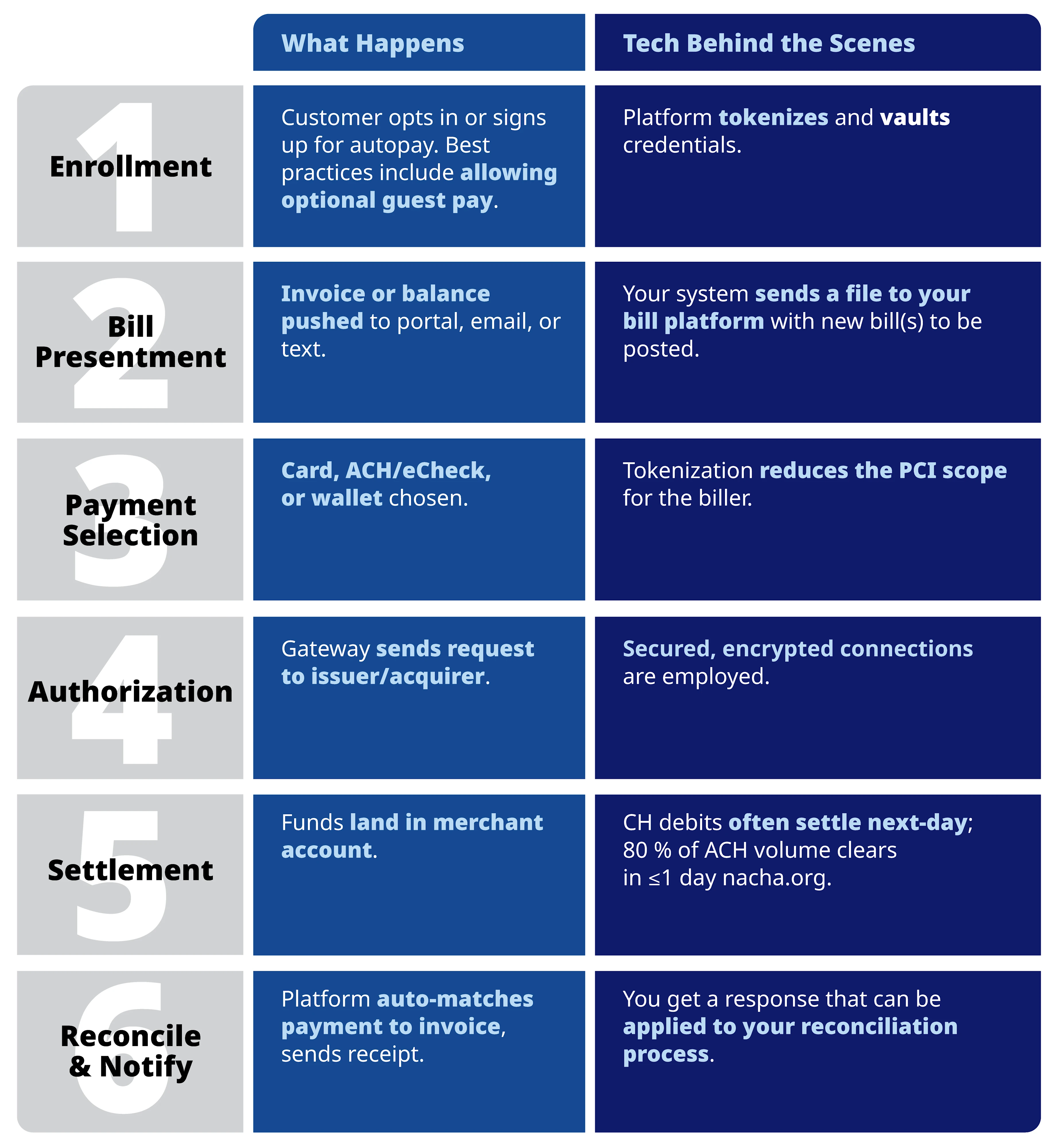
Under the Hood: How It Works, Step by Step
While the term “bill payment platform” might sound complex, the actual process is designed to simplify every stage of your billing and payment workflow. From the moment a customer receives a bill to the instant funds hit your account, each step is streamlined and automated to reduce manual effort, improve accuracy and ensure a smoother experience for both you and your customers. Below, we break down how a modern bill payment platform works behind the scenes—so you can see exactly where the value comes in.
What Should You Look for in a Payment Platform?
Not all bill payment platforms are created equal. As more businesses embrace digital transformation, it’s critical to choose a platform that doesn’t just accept payments—it helps you operate more efficiently, reduce risk and meet evolving customer expectations. Whether you’re billing tenants, patients, policyholders or utility customers, these are the essential features that distinguish a high-performing solution from a basic processor.
Seven key capabilities every platform should offer:
Omnichannel payments: Support for online, mobile, phone and in-person transactions.
Recurring + one-time billing: Handle both predictable schedules and one-off invoices.
Card & ACH acceptance : Expand payment options while reducing processing costs.
Real-time reporting: See payment status, reconciliation progress and failed attempts at a glance.
Integration-ready: Connect seamlessly with your accounting, billing, or practice management systems.
Brand customization: Keep the experience consistent with your business identity.
Secure & compliant: Ensure PCI-DSS compliance and protect cardholder data with tokenization
Who Benefits from a Bill Payments Platform?
If you think bill payment platforms are just for big corporations or government agencies, think again. From solo practitioners to multi-location service providers, a wide range of businesses are using this technology to streamline payments, improve cash flow and enhance customer experience.
Here are just a few examples of how direct merchants across different industries are putting bill payment platforms to work:
Utilities – Reduce overdue balances with automated reminders and frictionless payments.
Property Management – Make rent collection faster, easier and less prone to errors.
Healthcare Providers – Let patients pay on their schedule with card-on-file and installment options.
Insurance Agencies – Simplify policy renewals and recurring premium payments.
Education & Childcare Centers – Automate tuition billing and reduce admin time spent on manual tracking.
What Benefits Will Your Business Experience by Adding a Bill Payments Platform?
Beyond customer convenience, adopting a bill payment platform can dramatically improve your operations. Automating your billing and collections process not only reduces administrative tasks—it also protects your bottom line by speeding up payments and minimizing missed invoices.
Here’s how the right solution pays off:
Faster cash flow: Payments are processed on time, reducing your days-sales-outstanding (DSO) and boosting liquidity.
Lower Overhead: Fewer manual tasks and reduced reconciliation time translate into cost savings.
Happier customers: Give customers the payment options and control they expect, improving satisfaction and loyalty.
Higher retention: Easier payments mean fewer cancellations and stronger customer relationships.
Smarter insights: Real-time dashboards give you full visibility into trends, delinquencies and revenue performance.
CSG Forte: Making Bill Payments Easier
At CSG Forte, we know that managing bill payments isn’t just about transactions—it’s about relationships. That’s why our BillPay platform is designed to make the experience easy and secure for both businesses and customers. From branded portals to text and voice payments, we give you the tools to meet customers where they are and get paid faster with less hassle.
Here’s what you get when you partner with Forte:
Hosted BillPay portal: A brandable, mobile-friendly interface that’s PCI-compliant and easy to implement.
Text-to-Pay & Voice-Pay: Offer frictionless payments directly through automated reminders.
Processor-agnostic gateway: Use your existing bank and still leverage our powerful platform.
Hands-on support: Get help from real people who understand the needs of direct billers.
API-first architecture: Integrate directly with your ERP, EMR or custom billing system.
In a world where speed, convenience and digital access are everything, clunky billing systems are holding businesses back. A bill payment platform doesn’t just modernize your payments—it can transform how you engage customers, improve your cash flow and scale more efficiently.
Whether you’re a healthcare provider, utility company, property manager, or insurer, CSG Forte’s BillPay solution is designed to help you get paid faster—with fewer errors and better customer outcomes.
Ready to simplify your billing? Talk to a Forte expert today and see what smarter bill payments can do for your business.